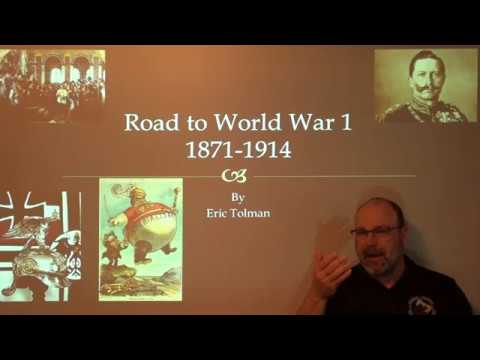
[0:10]All right, greetings everybody and uh welcome to uh what is essentially uh going to be the starting point of our broad sweeping themes of history in the 20th century. Um certainly there's a lot of things that are going on in Europe uh between 1900 and 1914, but uh much of what was dominating the geopolitical landscape at the time was this movement towards what would inevitably be uh war in 1914. Now when we look at the causes of World War I, it it's multi-layered and multi-faceted. So what I hope to be able to do is to kind of break things down into small pieces and um eventually connect those pieces in in giving you an understanding of the complex dynamic uh that existed in Europe and the complex forces that existed because as I said, there was many many layers that were contributing to the cause of World War I. Uh from this, of course, we will continue into the war itself and then look at themes like the Russian Revolution, the Weimar Republic, uh and a Spanish Civil War and many many others uh during that really fascinating uh interwar period from 1918 to 1939. So lots of really um good topics coming up and much of the things that occur in the pre uh World War I period and of course the period directly after really sets the tone for much of the 21st or the 20th century rather, and even to some degree circumstances we find ourselves in in the 21st century uh are were predetermined by events in this time frame. So wanted to just look at a couple of pictures here of course, we're going to talk quite a bit about this fellow here, Kaiser Wilhelm the II of Germany. Here's some uh pictures of uh looks like a king, maybe a British king, imperialism. Here's some of the symbolism of uh, you know, the helmet and uh pickel gruba. I don't think there's a pickel gruba on this helmet, but the the little pointy thing was called a pickel gruba and that was strictly ceremonial. It goes back to the days of pressure before, um the unification of Germany. And this is a very important painting, um which I had the privilege of seeing in Berlin in all its glory. It's a massive landscape uh uh uh this painting, but um this is where the new German Empire would proclaim its empire in 1871. And no, this was not in Berlin. This was in occupied Paris in the Hall of Mirrors at Versailles. And uh, if that sounds familiar, uh, it certainly does, certainly when we get to the end of World War I, but um, we're going to talk about why this event is so important when it comes to not only where the treaty of Versailles was signed, but uh, the um, the punitive nature of this treaty, where that stems from. And it goes beyond just World War I as well. So All right, well, let's look at Europe. Uh, um in 1900. Now I want to be clear right off the bat that we are going to be focusing on the five main players in Europe at this time and by no means do we mean to disrespect Belgium or Luxembourg or Holland or any others, but I wanted to really focus on the nations that were in a major position to set the tone and to offset the equilibrium of this balance of power that existed in Europe at the time. So we're going to be focusing on the great powers. you can see this map here, of course. Uh you might be familiar with this. Uh here we have, of course, Great Britain, we have France, we have the new Imperial Germany. That's a big country. The Austro-Hungarian Empire, the Habsburg Empire, the dual monarchy was also referred to. And of course, to the far east We have the great Russian Empire which probably extends well extends well past the view of your screen right now. So those are the big five that we're going to be focusing on. So as I said, the great powers were mainly comprised of Great Britain, France, Republican France, Zarist Russia, Imperial Germany and the Austria, Austro-Hungarian Empire also of course known as Austria-Hungary. So those are the five key players that were going to be looking at as we lead up to the events that contribute to the causes of or that lead to the breakout if you will of World War I. In a very general sense and the details of which we're going to get into thoroughly, the war was caused by long-standing rivalries between them which were worsted by a series of events uh between 1905 and 1913, culminating in the immediate cause that spark the war, the assassination of Archduke France and in June 1914. He was the air to the Austrian throne. Okay, so that's kind of the broad sweeping spectrum with which we're going to be looking at in this uh in this lecture. So, let's look at some of the long-term causes. All right. Well, cause number one and we're going to look at several. Colonial rivalry or imperialism. Uh the word colonialism is used interchangeable with the word imperialism. They essentially mean the same thing. The competition for colonies was intensified by 1900 when Germany under the Kaiser, Kaiser Wilhelm II decided that Germany also deserved a place in the sun. A place in the sun was basically the Kaiser's way of saying, hey, you guys have been taking over all parts of the world, um, for for for decades. If not centuries, um we deserve a piece of this pie too. So, imperialism by its very nature is extremely arrogant. It suggests and I want to be clear that all the European colonial powers were beset with this kind of superiority complex. So, we are a powerful nation, we are the most civilized nation. It is within our right to head overseas and take over regions of the world that easily fall to us. You have to consider that when the Europeans were spreading their wings if you will overseas into Africa, Asia, uh and the South Pacific and everywhere else, you know, what was the one thing that separated Europeans from the people around the world was gunpowder. So if you could roll in your ships and blow off a couple of cannons, you could scare the heck out of uh indigenous people around the world. The other tragedy of colonialism and this goes way back to the days of Columbus and John Kabat and Jack and many others is that indigenous people around the world unfortunately falsely thought. Uh these Europeans were gods and it made them that much more easy to overcome and to take over because they worship them initially and when you look at the experience of the Kabadors and uh the Aztecs uh that tragedy there. So so basically, you know, imperialism is powerful nations going overseas and taking over nations that were easy to overtake, you know. Um, the interesting thing is is that for example, if we use Great Britain as an example, what did British people think of the British Empire during the Victorian period, let's say. Let's say the height of the empire really sort of the 1870s to the pre-World War I period, 1914. What was it that British subjects understood about Empire? Well. They understood that it was a moral responsibility. It was a religious crusade to bring Christian civilization to the darkest corners of the globe. That in fact, we were doing these people a tremendous favor. It was the white man's burden to use a term from uh Riard Kipping's uh brilliant poem. Um, it was the burden and responsibility of of Europeans to civilized all corners of the globe. So, for public consumption, uh, British subjects and the same could be said certainly for the Germans and the French and other colonial powers. This was a noble act to bring uh civilization to four corners of the globe. And you could argue that this colonial mentality, of course, you could draw all sorts of parallels and in the case of Canada, when you look at the uh phenomenon of the residential schools, that was an extension of this colonial mentality. The more they're like us, the better off they will be. The more we remove their local or indigenous culture and language and teach them English and put them in a top hat and a cane, the better off they will be. So, you know, imperialism by its very nature is not only craft because it's it's it's it's about conquest, but it's arrogant to suggest that we, Europeans, um are better and therefore we have every right to take countries over. You know, there's many complex layers to the imperial mentality, but really if you look at sort of um the justification, we begin to see early signs of what later would become Naziism, you know, and when you look at something like social Darwinism, you know, pitting certain races against others, some are better than others and therefore it's our right to take them over. That in fact, Naziism stems from this imperial colonial mentality uh and social Darwinist thinking of the late 19th century. Now, I am not comparing of course, the imperial powers of the late 19th century to Naziism. And what I'm suggesting is that those attitudes towards um indigenous peoples around the world or people of other cultures, uh becomes uh in its most extreme extreme and hateful form in the rise of Naziism. We'll come back and look at Naziism another time. So, what happens by the 1880s is, you know, Britain and France have carved up a significant portion of the world under their the yoke of their colonial apparatus. And of course, the British used to gloat that the sun never sets on the British Empire that um, you know, and India of course would be the crown jewel of the British Empire and the French were really anchored down in North Africa, in Indo China, were the two main ones. and other places as well. But what happens with Germany is because they get into this race late. They get into it at a time where Britain and France had finally kind of found a place where they could somewhat respect each other's territory. But when Germany gets into this race particularly in the scramble for Africa, it really throws the British and French off because they're thinking wait a second here, who do you think you are coming down here and setting up shot next to me? And uh, you know, the aggressive of nature of German imperialism because they were late boomers really exaserbate of course tensions at home. So therefore imperialism is an important cause of the outbreak of World War I. Increasing pressure from working class political movements in rapidly industrializing Europe. This cause I believe is overlooked. And I want to give you an example. So what's happening in Europe, particularly in Great Britain and France, rather Great Britain and Imperial Germany we're leading the way in terms of industrial advancement, in terms of um, rapid building of railways systems and so forth. I mean, everybody else would eventually catch up, but really was Germany and Great Britain. Out of this rapid industrialization as we see a growing uh proletarianization of the cities. That is the birth and expansion of this new class, the working class. And out of this, of course, uh rapid growth of a working class stems the birth of Marxism which we've talked about in previous elections.
[13:06]The rise of socialist communism philosophy and thinking. We see communist and socialist parties uh, you know, um, blossoming as well. And the reason I think this is important is because the expansion of radical political thought in Europe is creating a lot of tension amongst European powers who are saying, oh my gosh, we got these radical parties, you know, how do we How do we take the heat off? Well, how you take the heat off is you provide them things that make their lives better. You give them cheap resources and cheap products that you can provide to them that are a result of the fact that you're exploiting uh third world nations around the world. So there was a real sense that you know, an on-by-onism will talk about later was the master of this of understanding that to take the heat off the revolutionary nature of left-wing socialist communist parties. Provide them the things that they claim they want. An eight hour work day, a minimum wage, old age pension, whatever it may be those kinds of things that we need to alleviate the pressure of of revolutionary activity by making the standard of living better for working uh working class people. And in many ways I would argue that the birth and rise of militant Marxism in the 19th century did a great service to humanizing Western governments by forcing to make the decision to treat their citizens better or else they're going to be overthrown by revolution. So Anyway, an important part. Next we have um accelerated militarism brought on by the industrial investments and continental fear and insecurity. It's like a vicious cycle. Europe is industrializing at a rapid rate. They're colonizing at a rapid rate. There's this growing tension in Europe as a as a result of this this growing working class radicalized uh group of uh young workers. And as a result of rapid industrialization, we also now Europeans have the have the uh technological ability to mass produce uh armaments. And, you know, the best way to protect yourself from your neighbor who could potentially be your enemy is to have an arsenal in your in your warehouses at the ready should war break out. So we see this rapid acceleration of militarization occurring throughout many of the European countries at the time. Then you have another factor. So once again just to revisit you've got imperialism, you've got pressures of working class parties in Europe. You have accelerated militarization as a result of industrial rapid industrial advancements and in addition that you have thisness of Europe as it's called the Balkans. Balkan nationalism. The Balkans were once part of the Ottoman Empire, the Balkans were still are inhabited by largely Slavic people who sought independence.
[16:27]And you know, we'll come back and talk about this but but what makes the Balkan so complicated is you have such a diversity of ethnic groups. You have Croatians, you have Serbians, you have Romanians, Albanians, uh you know Macedonians. And they're not necessarily all living in one distinct geographical area. They're all kind of spread out and mixed in together. So when you talk about Balkan nationalism and you say Serbian nationalism would be the obvious one when we look at the causes of war. Um, how do you create nations out of these ethnic groups if they're all mixed in together, right? That was a fundamental problem when we looked at the partition of India in 1947 because you had Muslims, you had Hindus, all mixed in together. Similar set of circumstances and we're going to come back and look at how that dynamic of all these ethnic groups uh desiring autonomy in particular the Serbians and why that became sort of a powder keg in the Balkan area. Many of these slaves were also part of the Austro-Hungarian Empire who feared the loss of their territories to nationalism. You know, couple things we need to put in context. Russia and the Austro-Hungarian were extremely uh ethnically diverse. British, Great Britain was predominantly British. You have the Welsh, the Scottish, you have the Irish, you have the English. They're all English speaking, they're many of them, they're all coming from the same historical background, give or take a few variances of course. Germany same thing. Yes, the Netherlands are very different than Russians and the Saxons are different than the Bavarians, but at the end of the day they all speak Russian, or rather Germans, sorry. Uh and they all share the same uh religious history whether it be Protestants or Luther in a form of Protestantism or Catholicism and so forth. So in many ways nationalism in Germany and Britain and France for that matter could be very much a unifying force because you're bringing together all these people that have so many shared communalities. But when you talk about nationalism in the Balkans, then you're talking about pulling things apart and the Austro-Hungarian Empire because it you have to consider we're dealing with Austrians and Hungarians and Checks and Poles and and you know this goes on and on and on that once people begin to think in terms of ethic umness uh and they don't want to be part of me, why would the Serbians want to be part of a uh a kingdom in Austria who speak German?
[19:19]You know, a lot of people in the Balkans would say why can't even identify with my king? He doesn't speak the same language. He comes from a completely different place. Uh let's do our own thing. So nationalism is a very destabilizing force for uh the Austro-Hungarian Empire as a result. This region became a powder keg between Russia, Serbia's protector, and Austria-Hungary. See Russia began to see itself as the Slavic um proclaiming Slavic leadership in the region because the Serbs for example were Slavic people. They would say, look, we'll stand by you guys and the Astros are saying, wait a second here, don't get the way of our internal affairs. So really the Balcans becomes a bit of a, you know, a struggle if you will between the interests of the Astros and Empire and Imperial Russia as well. All right, the arms race and this is this is an extension of uh vast industrial advancement in Western Europe. So massive industrial development had led to these main powers a massive large armed forces and concription or mandatory service was common. So you have large armies at their back and call, you have this mechanization of of industry which is now pumping out so many guns and and ships and you know weapons and helmets and so on and so forth, just stop piling waiting. Guns, shells, bullets, other weapons had been stock pile resulting in a snowball effect of nations competing for military supremacy. Mass weapons and armies increase confidence and later pressure to prove their metal. Well, this is the one fundamental problem with having an economy that is built around massive industrial development that is geared towards a military, um, framework. I just asked the Nazis, my gosh, between 33 and 39, their whole economic advancements and reemployment and everything that they did economically was geared towards rearmament. And unfortunately, in those circumstances, uh the bubble will burst and uh once economy is begin to recede or go into recession, then usually in these cases war breaks out. So the Anglo-German naval race between Germany and Britain further exacerbated Britain's insecurity, their dependence on the navy for empire and defense made them fear German competition. This was one of the great um mistakes I think of Imperial Germany is they really shouldn't they should have laid off on this, but when we talk more about the Kaiser's personality, we'll explain why this happened, but the navy was always central to the sense of security of Great Britain because they were a vast imperial nation. They needed the ships to control and maintain the control of their Imperial Network, but they also needed uh a strong navy for defense because they are an island. So the moment you start competing with Great Britain, particularly in the case of Germany that's so close and you say, well, we're going to build ships too, um then you're creating a lot of instability, uh and you're antagonizing the British in many ways and unfortunately the Kaiser, um had the very was very good, unfortunately, at um creating these kinds of tension. So all right, so the launch of the German Dreadnought in 1906 created a naval race and soured any relationship between the two. So the Germans are are really focused on one-upping the British. Well, we want ships too and so on and so forth. So that really soured uh relationship between the two.
[50:30]All right. So the heir to the Austrian throne, meaning the next king to be was the nephew of the current monarch, France Joseph, who in 1914 had been in power for, oh gosh, since 1867 if not, I mean for a long, long time. Um, he's assassinated in Sarajevo which at the time is part of Bosnia, with the aid of Serbian nationalists. Okay. Sarajevo was technically within the boundaries of the Austro-Hungarian Empire because the province of Serbia was there. So what the Archduke does is he says, let's go extend an olive branch to thesey Bosnian Serbs. By saying, hey, we're your monarch. We love you. We don't want you to go anywhere. I'm going to prove my good faith and come for a visit. And a lot of people in his entourage in in in the Austrian Hungarian government said, do not go to Sarajevo. You are a sitting duck. You cannot did Someone will knock you off. You must wear bulletproof vests. You and your wife. And he refused. I'm not going to wear a bulletproof vest. I don't need such a thing. I don't want such a thing. I'm going to extend an olive branch to my Bosnian sister brothers. Well, when the assassination occurs, um, outrage in Europe occurs. But Austria was slow to respond to Serbia, which it was determined to invade. Germany, Germany. Now it's interesting, Germany was not part of the initial process here. Germany pledges to support Austria and Russia, building up its military, was likely to defend Serbia while drawing in France. Now before we continue, I wanted to talk briefly about the the events of the assassination because what's interesting is, um, there was an assassination attempt on him before he was killed. And he demanded to go to city hall and register a complaint, which I think he did and he and his wife got back in the car. And they were convinced to take a different route, um then the main drag in Sarajevo. And what's interesting is as they do this sort of loop-de-loop route, they end up bumping into a fellow Gavro Princip. Who is heading to the main street to assassinate the archduke. And there he is walking up the street heading towards the main street. And he sees this go by. He's like, oh my gosh, what are they doing here? He pulls out his gun. He kills them both. So, um, you know, the fact that they took this other route may have been a major factor as to how they were so effectively assassinated. Well, when the assassination occurs, um, outrage in Europe occurs. But Austria was slow to respond to Serbia, which it was determined to invade. Germany, Germany. Now it's interesting, Germany was not part of the initial process here. Germany pledges to support Austria and Russia, building up its military, was likely to defend Serbia while drawing in France.
[54:15]Austria mobilized. Russia mobilized. Germany declared war on Russia and the next day declared war on France. Germany invaded Belgium, drawing Britain into the war, Germany invaded France, and then Britain declared war on Germany.
[55:20]What's interesting with Belgium is that Britain had signed a neutrality pact with Belgium in 1839, I believe it was guaranteeing their neutrality. So basically, when Germany invaded Belgium as part of their sweeping plan motion, Great Britain felt they had no choice but to declare war because they were there to defend the honor and neutrality of Belgium. So all of a sudden, what starts in a regional conflict in the Balkans explodes into a massive war, and you have to consider. Couple of things. We had not had a continental war of this nature in Europe since 1815. since the end of the Napoleonic Wars. There was nobody alive who remembered the Napoleonic Wars. And the European powers go into this war with a 19th century mentality, but now they've got 20th century technology. And this is why the Great War or World War I become so tragic. So next time, we are going to do our first part of a series on uh World War I.
[56:40]And I know it's a narrative often told, but I hope to have the opportunity to share some insights with you maybe that you had never heard and uh once again if you have any questions or any comments you're always welcome to make any comments on uh YouTube. I'm happy to reply. Um, and I want to thank you again for continuing. I will continue to load my lectures and uh they may not necessarily come in order on my YouTube channel because I'm sort of doing them in a variety of of times based on what I'm teaching in my classes. Uh, but either way, I do appreciate you coming and uh we'll see you next time. Thank you.
![Thumbnail for [ESPORTS] MATCH 1: Dead By Blink(S) vs Team Toxic(K) - Dead By Daylight [PS4] - (Qualifiers) by DioSebek1010](/_next/image?url=https%3A%2F%2Fimg.youtube.com%2Fvi%2F3_2TR3la7Tc%2Fhqdefault.jpg&w=3840&q=75)