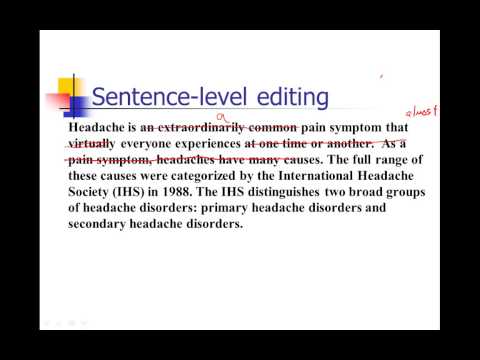
[0:14]All right, so in this next module, we're going to do some more practice on paragraphs. I'm going to lead you through the editing of two more paragraphs where we go through and kind of bring out the logic, bring out the organization, improve the organization, and also do some sentence-level editing to make things read more smoothly and to get rid of extra clutter. So, as I've mentioned with earlier modules when we're doing kind of this kind of practice, there's two ways you can watch the video. You can just watch it straight through and I'll kind of lead you through how I would approach each of these and edit each of these. Uh if you want to challenge yourself even a little bit more, uh and you've got some extra time and want to kind of test yourself, you could after I introduce the each example, shut the video off for a moment, pause the video, uh and try to edit it on your own, see what you come up with. And then rejoin the video and kind of compare against my edits, just to see how many of the things we've been talking about in this class that you can pick up. Either way is fine to watch the video. So here's the first example. This was from something I was editing. And, um, it's actually a little bit, uh, easier than the example that we ended in the last module because it's something that pretty much I think everybody can understand without too much background, it's about headache. So I'm just going to kind of read this through, and then we'll talk about different, uh, I'm going to point out some different things in this and we'll talk about how to edit it. So it says, headache is an extraordinarily common pain symptom that virtually everyone experiences at one time or another. As a pain symptom, headaches have many causes. The full range of these causes were categorized by the International Headache Society (IHS) in 1988. The IHS distinguishes two broad groups of headache disorders: primary headache disorders and secondary headache disorders. Secondary headache disorders are a consequence of an underlying condition, such as a brain tumor, a systemic infection, or a head injury. In primary headache disorders, the headache disorder is the fundamental problem; it is not symptomatic of another cause. The two most common types of primary headache disorder are uh episodic tension-type headache (ETTH) and migraine. Although IHS is the most broadly used/recognized classification system used, a brief comment on others would be appropriate, especially if there are uses that have epidemiologic advantages. Okay, so you can kind of step back from this one and see, okay, well, what were they trying to do in this paragraph? They were trying to basically define headaches for you. There's two types, secondary and primary. You can see when I'm reading this out loud, you can kind of hear all the repetition in there. It's just, it's really wordy and there's probably a lot, the purpose of this paragraph is really definitional. There's probably a lot we can cut from this paragraph. So, I'm going to go through and just point out a few things to you. So one is, you can do what I call a verb tally. So, I've underlined all the verbs here, and I'll just point out to you that what do we have? We have, this is a really good task in revising your own work. It's very easy to go through and circle the verbs and that's one thing you can really pay attention to. So when you count up the verbs in this paragraph, we have, um, eight to be verbs, that's the is, are, was, were, be, been, am. So as I mentioned last week, to be verbs are kind of weak. Uh, you can use them sometimes, but we probably don't want to use them so much because they're boring. There's two to have verbs, also boring. Uh there's a passive verb, were categorized by. And then there's two more slightly more lively verbs, experiences and distinguishes. Still not the greatest words in the world, but at least a little bit more lively than the others. So you can see in terms of verbs, we're not doing great on verbs, so we're going to change that a little bit. You can, there's a lot of wordiness, I can point out to you in this paragraph. So, for example, there's a lot of adverbs, extraordinarily, virtually, especially. You can get some wordiness like at one time or another, um, as a consequence of, not symptomatic of, uh, fundamentals one of those kind of empty words that we can probably edit out. So there's a lot of wordiness here that we're going to try to edit out. There's an interesting, uh, style of this author happened to have. They they kind of were a little bit repetitive in in a very specific way. They liked to end that one sentence with a a particular term and then start the next sentence with the same term or a very close to that. So for example, in the first sentence, they used the term common pain symptom, and then they start the next sentence with, as a pain symptom. And then they end the that sentence with have many causes. They start the next sentence with the full range of these causes. They end the next that sentence with, the International Headache Society, and they start the next one with the International Headache Society. Uh they end the next sentence with secondary headache disorders and then they start the following sentence with secondary headache disorders. So you can see that there's this amazing repetition here, somehow they've wanted to end each sentence and start the next sentence with the same words. It's just obviously too much repetition. Now, repetition isn't always bad, but here it's just repetitive, it doesn't really work. Means there's a lot we can edit out. One other thing I'd to point out about this paragraph is that they've done, they've added at the end what I call a meta-comment. So they they're telling you about why they chose to write about what they wrote about. They they're giving you this extra information about their thought process on why they chose to include certain things or not include certain things in this chapter. And usually that kind of meta-comment is really not necessary. You can just go ahead and, you know, include what you're going to include and exclude what you're going to exclude from from the article, from the chapter. You don't really need to give the reader all of your thought process behind that. Usually that's not very helpful to the reader, so I would just delete that whole meta-comment there. All right, so the next thing we want to do is, we want to take this whole paragraph and we kind of want to just point out all the things that are going on, point out the underlying logic. And again, I'm going to make a kind of outline, a kind of idea flow chart. I usually, uh, I'm not going to write it out in such great detail, but for the purposes of teaching, this is what I'm kind of sorting out in my brain when I'm editing things like this. So I first asked myself, well, what's the main idea of this paragraph? Well, that one's pretty easy actually, it's pretty straightforward. There are two types of headaches, primary and secondary headaches. That's the main idea. The author is just really definitional to tell you that there's two types of headaches, secondary and primary. And then, uh, beyond that, what is the author doing? Well, the author is defining primary headache disorders and secondary headache disorders, so those are just definitions. And then beyond that, the author goes ahead and gives you some examples of each type. So some illustrative examples of primary and secondary headache disorders. So it's really a definitional paragraph, it's not too hard to do this outline, right? But that's the underlying logic of the paragraph and if you kind of figure out what is the main point, what's the point of the paragraph, what's the paragraph after? Then you can use that to help when you're editing to get rid of anything that isn't pertinent to that main aim of the paragraph. As we're going along and reorganizing the paragraph, editing the paragraph, I'm also obviously going to do some sentence-level editing. So I'll show you some sentence-level editing, starting with the, uh, the very first, uh, sentence of this paragraph. We can edit this a bit. So, uh, it says, headache is an extraordinarily common pain symptom that virtually everyone experiences at one time or another. That's a little bit long winded, right? So I'm going to get rid of some things. So headache is, how about just a, uh, notice that extraordinarily common is the same, is the same really as saying virtually everyone experiences it. So I don't really need to say that twice.
[7:27]So I could call it common or I could delete the common and leave in the virtually everyone experiences it, so you could go either way on that, but I took out the common and just said headache is a pain symptom that I changed virtually to almost, that's a little bit of a stylistic preference there. Uh that almost everyone experiences and I don't think we need at that at one time or another, just that almost everyone experiences. And then we get this little repetition that I pointed out before. As a pain symptom, headaches have many causes. Well, they actually got rid of that all together. I didn't think that sentence was particularly helpful. This is that they're not giving anything specific about those particular causes. They also then go on to tell you that the full range of these causes were categorized, notice the passive voice, were categorized by. The full range of these causes were categorized by the IHS.
[8:23]Well, you know what I actually went through and deleted all of that because I can just go ahead and say how the IHS categorized them and then I I don't need to tell the author, obviously if I'm giving the categories from the IHS, the IHS must have categorized them. Um, I'm going to get rid of the fact that they did this categorization in 1988. I don't really think that's an important detail, unless the author came back to me and said that was really important. So I'm going to start at the International Headache Society, and then we get to, uh, distinguishes two broad groups of headaches, I'm going to shorten that a little bit by just saying groups.
[9:05]The International Headache Society groups headache, and then I'm going to say into two types based on cause.
[9:17]So that gets the idea across, the of the sentence that I deleted, and then we'll write back in there. So, um, that gets the, you know, the idea that it's it's based on cause, the primary and secondary distinction. So, uh, we're going to edit that all together, and this is the main idea of the paragraph. Headache is a pain symptom that almost everyone experiences. The International Headache Society (IHS) groups headaches into two types based on cause: primary headache disorders and secondary headache disorders. So, okay, check, I've hit the main idea of the paragraph. Now, we're going to get to the next ideas of the paragraph. So the paragraph goes along and starts defining secondary and primary headache disorders for you. So, um, I'm going to point out some thing about these, some things about, uh, these two sentences that we can fix a little bit. So, uh, secondary headache disorders are a consequence of an underlying condition. Now, notice that it's kind of backwards order, right? They're saying the the cause, you know, the effect came from the cause, it's sort of backwards. They do this twice. They actually do this as well as, it is not symptomatic of another cause. So they it's like effect, uh, before cause, it's the illogical order. So you kind of want to, again, that's that goes against the logic that most people are used to thinking of. So you kind of want to change that if you can to have cause come before effect, if possible. That's one little, uh, thing to point out. Again, we get that repetition, in primary headache disorders, the headache disorder, obviously we don't need to repeat that twice there. Uh, we get some empty words, is the fundamental problem. I I probably can cut all of that without losing anything. Uh, and then another thing to point out here, it's just kind of interesting and the way the human brain works is, I really want primary to come before secondary. Probably a lot of you feel the same way, right? We want the first thing to come before the second thing. It's just the natural ordering of things. So, I want the author to define the primary headaches first in the paragraph and then the secondary headaches second. It's just the natural logical order. So I looked at all of that and I changed some things around so that I put the primary headache first and secondary headache second. And so here's my edited version, kind of fixing all of these things I just pointed out to you. So, in primary headache disorders, the headache itself is the main complaint. The two most common types of primary headache disorder are episodic tension-type headache (ETTH) and migraine. So notice I got the primary first, now the secondary, secondary headache disorders result from an underlying condition, such as a brain tumor, a systemic infection, or a head injury. So notice how much I was able to weed out. I rewrote a lot of that. And, um, I've hit now all of the rest of the things that I need to hit in this paragraph. So I've defined primary and secondary headache disorders, so I've hit that, check. And then I've given the examples of the primary and secondary headache disorders and with the secondary headache disorder, I just ran the examples right into that one sentence. They they helped even with the definition there. Okay, so we got the sub-supporting ideas, we got the examples. All right, so we're done. So altogether, here's the edit, and you can see it's much much shorter than what we started with. Headache is a pain symptom that almost everyone experiences. The International Headache Society (IHS) groups headaches into two types based on cause: primary headache disorders and secondary headache disorders. In primary headache disorders, the headache itself is the main complaint. The two most common types are episodic tension and migraine. Secondary headache disorders result from an underlying condition, such as a brain tumor, a systemic infection or a head injury. And you can go back to the outline, make sure we hit all the main points. Sure, we hit all the main points, good. All right, so that was an fairly easy one because it was just dealing with definitions. This one's slightly trickier, although, still, uh, I think, uh, largely definitional. So, let's read through this one. If you want to pause the video and try this on one on your own, go for it. Uh if you want to just follow along with me, I'll kind of lead you through my thought process. So, uh this one says, although the methodological approaches are similar, the questions posed in classic epidemiology and clinical epidemiology are different. In classic epidemiology, epidemiologists pose a question about the etiology of a disease in a population of people. Causal associations are important to identify because, if the causal factor identified can be manipulated or modified, prevention of disease is possible. On the other hand, in clinical epidemiology, clinicians pose a question about the prognosis of a disease in a population of patients. Prognosis can be regarded as a set of outcomes and their associated probabilities following the occurrence of some defining event or diagnosis that can be a symptom, sign, test result, or disease. So, again, as you're reading this one out loud, as I'm reading it to you, you can hear some of the repetition and some of the kind of awkward phrasing. So, there's a lot we can edit out of this one. So, again, my approach to this, at least in my head, is to kind of figure out, to ferret it out at first, just what was the author trying to accomplish in this paragraph? What's the main take home message, the main aim of this paragraph? And then beyond that, what are some what are all the points that the author needs to get in? So, I kind of make a an outline in my head and I'm going to actually write it down explicitly here. Does the main idea of this paragraph is that they want to tell you about the differences between classic and clinical epidemiology? How do those differ? So that's the main idea, it's a compare contrast essentially. And then the supporting ideas, well, they give you the definitions. Classic epidemiology is about disease etiology and preventing disease. In contrast, clinical epidemiology is about improving prognosis in people who already have diseases. So that's the supporting ideas, and then beyond that, uh, the authors are defining a couple of words in case you don't know what they are. Uh since they've said classic epidemiology is about etiology, they need to define the word etiology. And they've said clinical epidemiology is about prognosis, so they need to tell you what prognosis is, so we need some definitions there. So that's it, that's the whole main idea of this paragraph, and that's all of the pieces in the paragraph. So when we edit it, we're going to make sure that we get in all of those pieces and again, get out anything that doesn't contribute, um, to those pieces. And I'm also going to do a lot of sentence-level editing as we go along here. So, we'll start with the very first sentence. Although the methodological approaches are similar, the questions posed in classic epidemiology and clinical epidemiology are different. So, we can do a little bit to streamline this sentence a bit. So, now it's a little wordy, although the methodological, that word methodological, again, approaches are similar, the questions posed are different. And then, you know, are different, we can streamline that a little bit by making that differ, which is a little bit better verb than a to be verb are. So, I streamlined that one to, despite methodologic similarities, classic epidemiology and clinical epidemiology differ in aim. So, that gets to the main point of that paragraph, the main idea. All right, I'm going to now move on to the next part of that paragraph because there's some interesting things here. So there's actually the author of this, um, article had done a good job in setting up a particular compare contrast with parallel sentences, that is, parallel structure across multiple sentences. And this is a really great technique. They needed to bring it out a little bit more though, so I just wanted to point this out to you. Notice the structure that's there. So they say, in classic epidemiology, epidemiologists, that's the group, pose a question about etiology in a population of people, a general population.
[16:21]Okay, so we get this in discipline one, group one poses a question about etiology in a particular population. And then we get all this kind of intervening stuff, which for now I'm going to ignore, and then we get this transition word, on the other hand. Uh we're not going to need that transition word if we bring out the structure nicely here, this parallel structure. But then we get to, uh something that's a kind of parallel form. In clinical epidemiology, clinicians, that's the next group, pose a question about prognosis in a population of patients. So we get the same kind of parallel structure. So that's kind of nice, right? They kept the language the the parallel in the across those two sentences, which made it easy for the reader to make a nice compare contrast. Here's exactly what's the same and here's exactly what difference, what differs. They have the same kind of idea about posing questions about something in a population, but the exactly the question they're asking differs and exactly the population differs. So I think that's really nice structure and the author can bring it out a little bit more by doing the following, just directly saying. Classic epidemiologists pose a question about the etiology of a disease in a population of people. Clinical epidemiologists pose a question about the prognosis of a disease in a population of patients. So we're going to keep that structure the same across those two sentences to really bring out the compare contrast. Notice when I do that, I don't need that transition on the other hand. It's completely unnecessary because I've got this nice parallel structure that's making that paragraph flow.
[18:07]So we get that nice compare contrast. That's telling us a lot. Now, that gets actually to the second, uh, supporting ideas of the paragraph. What is classic epidemiology? What is clinical epidemiology? So now, all we need to do is the last little bit, which is to define etiology and prognosis, to define those two words. And that's actually fairly easy to do. So, um, I'm going to leave the etiology bit for the end and going to jump right to their definition of prognosis because this one was a little bit more, there's a little bit more going on here and a lot we can edit in this sentence. So it says, prognosis can be regarded as a set of outcomes and their associated probabilities following the occurrence of some defining event or diagnosis that can be a symptom, sign, test result, or disease. That's quite a long sentence. And I'll point out a few things in it. So one thing that hopefully by now you're you can pick up is that prognosis can be regarded as, you, that's a long-winded way of saying is. Right? And then we get a lot of extra things going on here. Uh, I changed this to is, uh the probability that, uh and then I changed that to is the probability that, uh an event or diagnosis will result in a particular outcome. So prognosis is the probability that an event or diagnosis will result in a particular outcome. I'm improving the logic here because we're, we're kind of it was in the wrong order before, I'm making the event or diagnosis now precede the outcome rather than the other way around. So, uh, we can edit that to prognosis of the probability that an event or diagnosis will result in a particular outcome. So we can streamline that definition quite a bit. And then that gets to the prognosis idea and in a minute, I'll add the little definition for etiology, I can do that pretty quickly. So, let me pull the whole thing together. So despite methodologic similarities, classic epidemiology and clinical epidemiology differ in aim. Classic epidemiologists pose a question about the etiology of a disease in a population of people. Notice that I stuck in the little definition of etiology with a semicolon there, etiologic factors can be manipulated to prevent disease. Clinical epidemiologists pose a question about the prognosis of a disease in a population of patients. Notice that I still don't need any transition there, and then with the again, with the semicolon, I stick in the diagnosis the definition of prognosis. Prognosis is the probability that an event or diagnosis will result in a particular outcome. The preceding program is copyrighted by the Board of Trustees of the Leland Stanford Junior University. Please visit us at med.stanford.edu.


