[0:02]Section 1. First, you have some time to look at questions 1 to 5.
[0:36]Now we shall begin. You should answer the questions as you listen, because you will not hear the recording a second time. Listen carefully, and answer questions 1 to 5.
[0:57]Thank you all for coming to our community meeting. As you know, we're excited to unveil our improvement plan as we look forward to the influx of tourists in the summer months. I'll start with a quick overview of the main points of interest in the area, for anyone who may not quite know his or her way around yet, and then I'll get to the improvements made. First off is my favorite, the Science Museum, which is on the corner of St George Road. If you have not visited yet, I encourage you to go before the busy season. It is absolutely spectacular. There is even a flight simulator you can try out. Just west of the Science Museum is the National History Museum. It's a site not to be missed as well, with each floor devoted to a different era in our nation's history. There are special exhibits for children with interactive games and fun history lessons too. If you're looking for parking, it is available on the intersection of Queen Street and South King Street in the car park. Standard hourly and daily rates do apply. The best place for souvenirs is the shopping mall, though it gets extremely busy during peak times. You can get there from the tube or the entrance on Timber Road, just south of Cornwall Road. This area has students everywhere, usually from the primary school across the street from the shopping mall. Classes often take field trips and engage in guided tours through the area. So that's the overview of the main sites and hopefully by now, I've given you a general idea of the area. Before you hear the rest of the conversation, you have some time to look at questions 6 to 10.
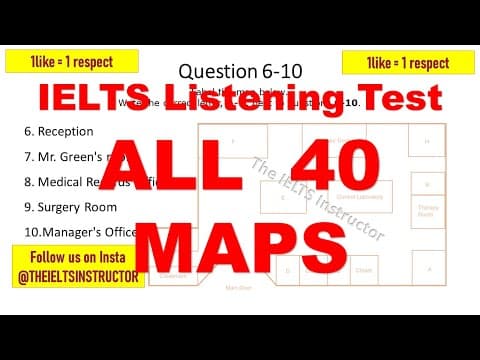
[3:09]Now listen and answer questions 6 to 10. Now, please look at the map I've given you of the Healthy Hearing Medical clinic and surgery. For those not familiar with our practice, reception can be found through the main door at the end of the corridor. If your consultation is booked with Mr Green, you need to go through the main door and turn right by the nurse's desk. And his office is at the end of the corridor on your left-hand side. If you need to alter any of your personal details, please visit our secretary at the office for medical records. Which you will find next to the therapy room. If you're awaiting surgery, please first check in with reception, before taking the first door on the right after you enter the clinic. Finally, in the event that you feel disappointed with any of the services we have provided, or have any further questions, please locate our manager's office, which can be found near the office for medical records and between two closets. If you have any more questions about the healthy hearing Medical Clinic and Surgery, please do not hesitate to contact us on 01256111111. That is the end of Section 1. You now have half a minute to check your answers.
[5:13]Now turn to Section 2.
[5:21]Section 2. First, you have some time to look at questions 11 to 13.
[5:48]Now listen carefully and answer questions 11 to 13.
[5:58]Well, here we are at the top of the tower, and we're going to look at the view from each direction. Out to the east, the large buildings about a kilometer away are on the Olympic site. There's an indoor arena for gymnastics, a stadium for track and field, and a swimming pool for races and synchronized swimming and also diving. If you look carefully down there, you can see the train lines. The Olympic site has its own station to encourage the use of public transport. There is also a car park, but it only holds a limited number of cars. The formal park has some specially created water features. If you look out here to the south, you can see a circular ornamental pond. And around to the west, you can relax and sit on a bench to smell the flowers in the rose garden. And finally up to the north, if you look in front of you now, there's a lake with a small island in the center. You can hire rowing boats at the boathouse, which you can't see from here, but if you look through the trees, you can see the cafe, which has lovely views across the water. Okay. Before you hear the rest of the talk, you have some time to look at questions 14 to 20.
[7:50]Now listen and answer questions 14 to 20. Now, I'm going to give you a plan of the site, and I'd just like to point out where everything is, and then you can take a look at everything for yourself. I've already pointed out the river, which is on the left, and of course, running along the bottom is Woodside Road. Got it? Okay. Now, we're standing at the entrance. See it at the bottom? And immediately to our right is the ticket office. You won't need that, because you've got your group booking, but just past it are the toilets. Always good to know where they are. In front of us is the car park, as you can see, and to the left, by the entry gate is the gift shop. That's where you can get copies of the guide like this one here. Now, beyond the car park, all the buildings are arranged in a half circle with a yard in the middle. The big stone building at the top is the main workshop. That's where the furnaces and where all the metal was smelted and the tools were cast, as you'll be able to see. Now, in the top right-hand corner, that building with bigger windows is the showroom, where samples of all the tools that were made through the ages are on display. In the top left corner is the grinding shop, where the tools were sharpened and finished. And on one side of that, you can see the engine room, and on the other, is the cafe, which isn't an antique, you'll be pleased to know. Though they do serve very nice old-fashioned teas. The row of buildings you can see on the left are the cottages. These were built for the workers towards the end of the 18th century, and they're still furnished from that period, so you can get a good idea of ordinary people's living conditions. Across the yard from them, you can see the stables, where the horses were kept for transporting the products. And the separate building in front of them is the works office, and that still has some of the old accounts on display. Right, if anyone wants a guided tour, then I'm starting at the engine room. If you'd like to come along this way, please, ladies and gentlemen. Now turn to Section 3.
[11:09]First, you have some time to look at questions 21 to 25.
[11:49]Now listen carefully and answer questions 21 to 25. So, where's the Indian restaurant? Don't worry, it's really easy to find. Have you got that map I gave you? This one? Yes, that's it. See here, the main entrance to the school. Yes. Well, don't go out of there. There's a smaller entrance here round the back. Oh yes, I see. Okay. So you go out of there, past the phone box, and then turn right into this road here. The one that goes along the side of the park. You'll see a supermarket on the left, and then it's just after that on the right. It's quite a big place, you can't miss it. Okay. And one more thing, is there a post office near here? Post office? Oh yes, of course, just the other side of the park. Go through the middle of the park and it's there by the park entrance. Thanks a lot. You're welcome. Oh, there's a good cafe near here too, very popular with the students, just there. You go out of the main entrance into Valley Road, then turn left at the bank and it's at the end of the street. They do amazing coffee. That's great. Thanks very much. No problem. Enjoy your course. Thanks again. Bye. Before you hear the rest of the discussion, you have some time to look at questions 26 to 30.
[13:57]Now listen and answer questions 26 to 30. Welcome to Bely Castle. It's nice to see so many of you here today. Before we go in, I'd like to tell you some information about the castle, the things to see and do, and the facilities available to you in the grounds. We'll do our best to make this a truly memorable visit. Now, the castle grounds are quite big, and we don't want you to get lost. So I'm going to give you an idea of the layout. At the moment, we are at the entrance, and immediately to our left is the tourist information office. Go here if you need any questions answered. They'll be happy to help. And of course, behind the tourist office is the car park where the coach dropped you off. And he'll also pick you up from the same spot at 5:00 p.m. today. In front of us are the water gardens. If you stroll through, you get to the North Bridge, which is the entrance to Bely Castle. Take your time and enjoy looking around the castle. There's a lot of history steeped in those walls. As you leave the castle via the South Bridge, you'll be greeted with the sight of roaming deer. During the day, there will be scheduled feeding opportunities where visitors can get involved. However, we do request that you do not feed the deer outside these times. To the right of the Deer Park is the Castle Museum, and behind that is our award-winning restaurant. It's a relatively new addition to the castle grounds, but is fast gaining a reputation for its food. Alternatively, you can choose to dine in the picnic area on the other side of the Deer Park. It's perfect for the family, as it's next to the kids' play area and homemade ice cream hut. We hope that on your way out, you pop into the gift shop by the exit for something to remember us by. That is the end of Section 3. You now have half a minute to check your answers.
[16:49]Now turn to Section 4.
[16:57]Section 4. First, you have some time to look at questions 31 to 40.
[17:48]Now listen carefully and answer questions 31 to 40. Good morning and welcome to the National Botanical Gardens for the garden tour. I'm your guide, Lisa. This garden is a step closer towards the conservation of indigenous trees that are essential to the regional vegetation. Since it is a planned project, it also becomes a useful center for research on the conservation of plant species. Actually, this region is too big to be called a garden. It covers about 30 hectares of land, which is protected by the Central Forest Service Management of the country. As you can see in this map, there are no concrete structures anywhere in this area. You will see only landscapes and narrow paths lightly cleared for walking. These special pathways are called the garden walks. We are here at the Botanical Garden office, and there's an L-shaped garden walk from here right up to the forest zone. The first square section on the left is the nursery, with saplings of some of the most exotic plants and trees. You can buy everything you like when we complete the tour. From here, we'll be walking the track to the two forest areas that have the native trees and smaller plants that are used for landscaping the local urban areas. The native tree zone is here immediately behind the nursery. And next to it is the non-native tree zone. We are now looking at the huge fenced area on the west. You can see an area with fencing. This is the exotic forest zone. Several species of vegetation and insects that breed in this land will be destroyed or lose their habitat due to trampling by visitors. So entry is allowed for researchers only. There's a smaller garden walk going up north beyond the fencing. It leads to the research center, which is built of eco-friendly construction material, has natural heating and cooling technology, and uses solar energy. This building is not open to visitors. But we will visit the exhibition in a smaller extension of this building, not the larger one. It has a separate entrance within the research center. We will see a short documentary on the importance of forest conservation, followed by a talk by an expert on how you can contribute to tree conservation. After we tour the nursery and the exhibition in the research center, we will gather in the Shamiana for lunch. It's on the left as we head back to the garden office. Meals in the open are a unique experience, and I am sure you will enjoy it. After lunch, we will head to the main entrance. To the left, you will see a circular garden with a display of colorful ornamental plants. On the other side of this garden walk, there is a beautiful topiary display. You'll get to see the topiarists at work trimming plants into various shapes of birds, animals, and other objects. This garden walk connects the Botanical Garden to the village nearby. Most workers are local and use this pathway, but it is also open for morning walkers or visitors who want to have a glimpse of the rural life around. You will be paying for your purchases here at the garden office as we exit the premises. That is the end of Section 4. You now have half a minute to check your answers.