[0:10]Hi, my name is Juan Van Wyk. I'm a 42 year old clinical psychologist, and I live in Dubai with my lovely wife and our three beautiful daughters. Playing guitar, or painting, or taking a long ride on my motorcycle are my hobbies. Since I was eight years old, I experienced joint and muscle stiffness and pain. As I grew older, it just became worse. I felt increasing weakness in my legs, my trunk, my arms.
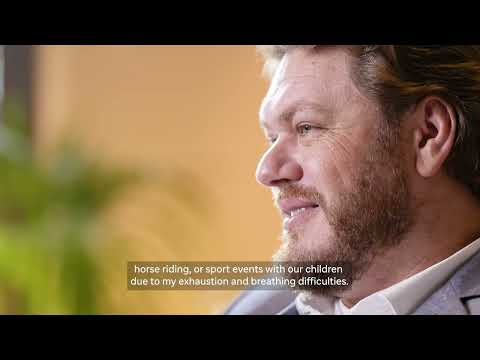
[0:54]Several different diagnoses were made since I was 23 years old. The initial idea was that I had arthritis, like rheumatoid arthritis, psoriatic arthritis, neuromyotonia, and limb-girdle muscular dystrophy. Starting in my 30s, I had trouble falling and staying asleep, and often woke up with morning headaches. I felt very tired and was short of breath even when resting. This progressed into excessive snoring which disturbed my wife's sleep. I was often tired and unable to accompany friends, family on recreational activities like hiking, horse riding, or sport events with our children due to my exhaustion and breathing difficulties. I continued to consult with several specialists over the years as I continued not to feel well. By then, I had seen general physicians, rheumatologists, orthopedics surgeons, and finally neurologists. My current treating neurologist did multiple tests, like a sample of my muscle was checked for the level of glycogen. Several blood tests were done to check the level of my enzymes. Breathing tests were done to measure my lung capacity. This was followed by an electromyography, MRIs, heart studies, several X rays, and finally a sleep study.
[2:31]After multiple tests, and living with a misdiagnosis for approximately 18 years, I was finally diagnosed with Pompe disease at 41 years of age. As no one from my family had ever suffered from Pompe, I knew absolutely nothing about it. The doctor informed me about Pompe disease and its complications, but I wanted to know more. So I looked on the internet, and asked for more details from my doctor. I wanted to know how and when the deterioration would happen, and how I can prepare for the future. The most difficult part of my life with Pompe is managing day-to-day activities, as well as my social life. I've accepted the reality of change and impermanence. And I have to readjust my daily routines accordingly, and reinvent and recalibrate according to my capacity in order to try and maintain some form of work life, recovery balance, and try to continue my hobbies, but doing it in short spans over longer periods. Lately, I've been taking more moments to pause during the day, and just enjoy a cup of tea to be fully in the moment, to focus on mindful living to summarize it all. It is important to maintain a positive outlook towards life. Sometimes professional counselling can help with that. I have received emotional and practical support from my whole family, my friends, and even my colleagues who helped me continue my daily tasks, and even accommodating my limitations to engage in certain activities. I also count on support from my physician and my physiotherapist as part of my treatment team. Pompe disease, can be debilitating. Part of my experience and my approach to life is changing and transitioning faster than other people. The gift in that is that it invites me to truly experience this moment and grab hold of the present.