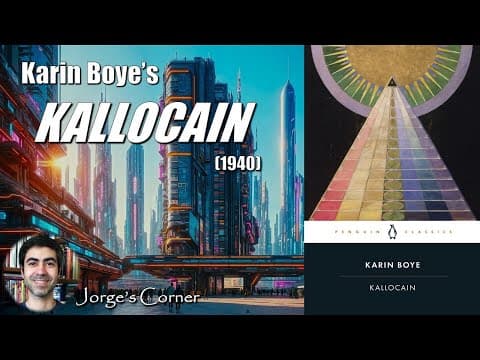
[0:00]Hello my friends, welcome to my corner. As you know, there is a kind of a Holy Trinity of dystopian novels. I'm going to go in chronological order. We have We by Zamyatin, then of course we have Brave New World by Huxley, and last but not least, the very famous 1984 by George Orwell. A little bit over a year ago, I heard about another dystopian novel I had never heard of it before. That is Kallocain by the Swedish author Karin Boye. This was the first time that I heard of the author and of the novel. So I thought that the story was interesting. I immediately bought a copy, but it was only now that I finally managed to read it. You know how it is when you like books and you keep buying books even though you already have more books than you will be able to read in one lifetime. That's the problem of the book lover. You know what I'm talking about, but I have just read it. I think this is a magnificent novel. I have no idea why it is that not more people are talking about it. So let's see what we have with Kallocain. Let me tell you a little bit about it. First of all, we're going to look at some info on the author just so we know who we are talking about. Karin Boye was born in 1900, so the plain 1900, and she was born in Gothenburg. She moved to Stockholm at a very young age, and she studied there. She also studied in Uppsala. She was primarily a poet, but she wrote five novels, at least. So it's a very important part of her output, and by far the more, the most famous novel that she wrote was Kallocain, which is the one that concerns us today. She was also a translator, and she is at least in part responsible for the Swedish translation of The Waste Land. Between parentheses here, if you want to hear my thoughts on The Waste Land, you are welcome to check out my video on it. This was a translation that she did with Erik Mesterton. So it was a kind of a collaborative efforts. And that was, I believe, the first translation of The Waste Land into Swedish. She was married for a few years, but she separated from her husband, I believe, after three years of marriage, and she spent the rest of her life living with a German woman by the name of Margot Hano. In 1941, unfortunately, she committed suicide by taking sleeping pills. That is at least the official version of the story. If you read the chronology that comes with this Penguin edition of the book, it says right here for 1941, that, uh, and on April the 23rd, she is found dead in open country near Olingsoos in circumstances that are still unclear. And unfortunately, we also have the information here that Hano commits suicide shortly after. So we are talking about a very sad life and a very brief life. Now, let's look at the novel itself, okay? If you look at the title, the complete title of this novel is Kallocain, a novel from the 21st century. And it was first published in 1940, so the year right before Karin Boye died. It was inspired, very interestingly, by a trip that she took, two trips, actually, one to Nazi Germany and the other to Soviet Russia. So we are looking at totalitarianism, both sides of the spectrum here. This is a very brief novel, as you can see. We're talking about 170 pages only, 19 chapters plus a one-page postscript that is part of the narrative. So this is something, a text that is quite manageable. You can read it in a few hours, probably. It took me maybe two days to read it. The novel is narrated in the first person, so we have the protagonist who is telling us the story. And his name is Leo Kall, okay? He is in prison when the novel begins, and he's looking back on his life, and that is what we get with Kallocain. So through his observations, what Kallocain does is to depict this totalitarian world state, as it is known. And this is a place where there's no place for individuals, no place for individual thoughts or emotions. So it's familiar territory for those who are interested in dystopian novels. Now, I'll tell you a little bit about the characters, okay? Let's look at the protagonist and a couple of secondary characters that are also part of the action. Leo Kall tells us at the beginning of the novel that he is not sure why he is writing. So this is a text that doesn't necessarily have a purpose, or at least the narrator in the first person is not he doesn't really know what the purpose is. So we are going to find that out as we read the text also. He is a prisoner, but he says that his life as a free man, it was not that different from the life that he leads as a prisoner. That's quite a statement right there. Before he was imprisoned, Kall was a scientist. He is married, his wife is named Linda, and they have three children. I'm going to tell you a little bit more about these characters in a minute. I would say that that was the protagonist, right? I would say that there is no antagonist in this novel, but there's a man that Kall sees as a bit of a rival, and that is his superior, a guy by the name of Rissen. Okay? What happens here is that Kall thinks that Rissen may have had something to do, may have had some kind of an affair with Linda. So it's a personal conflict that is at the core of this novel, and also a professional conflict. You can you get the sense that there's also that type of thing going on behind. So I would say that even though there are a couple of more characters that are mentioned by name, with these three, you have a good triangle right there. Kall is working on a drug, okay? We're going to talk a little bit about the story right now. This is the Kallocain of the title. And what this drug is supposed to do is that it is supposed to reveal the inner secrets of every person. So it's a kind of a truth serum. That's the way it is normally called in science fiction films. This is all, of course, for the benefit of the state. He only has that in mind with his scientific work and his work on this drug. So as the story begins, he is about to receive permission to test the drugs on human beings. So it's a major step for him. This is huge for his career, and that's how the novel begins. So Kall and Rissen begin to test this drug, and it is in fact a success. People are injected with Kallocain and they begin to reveal their inner soul and their secrets and everything. But for Kall, what what happens is that seeing a person reveal themselves in this way has a very interesting effect on him. All of a sudden, he becomes aware of the frailty of human beings, how weak they can be, and that really affects him very deeply. So one day, the two men, right, Kall and Rissen, are testing the drug on one of the subjects, and they stumble upon a secret society of sorts. It's a group of people who say that they want to summon forth a new spirit, and that's where the novel gets interesting when they start to realize that there are people here who actually think for themselves. Let me tell you something about the themes now, okay? So Kallocain is at one level about the end of privacy. Or at least about the possibility of privacy coming to an end, and how that would affect a society, right? How would it affect a society if people all of a sudden were completely laid bare in a way that you would be able to know all that they are thinking. And what happens is that as soon as the drug is tested and is successful, Kall says that we should have a law against treasonous thoughts and emotions so that even if the person has not really done anything, if there has been no treasonous action, these people would be found guilty just by having these thoughts. So it's another version of thought crime, the way it is called in 1984. So it's very interesting that you find that common element right there, even though 1984 comes later than Kallocain. So this is a society under surveillance. There are police eyes and police ears in every room, even the rooms where people live, their private homes. There is no privacy, so it doesn't really matter within the context of the novel. So you have cameras and microphones all over the place so that people can be under surveillance all the time. Another obvious theme that has been implied already by what I have said is the destruction of the individual. In Kallocain, in the world that Boye depicts for us, the individual belongs to the state. So there is no sense of an individual personality. Everybody has sacrificed that, and the state is supposed to provide security for everybody. We have a little bit here on the, uh, purpose of the state. Uh, listen to this. It's on page 92. If there were reason for trust between people, no state would have arisen. The sacred and necessary foundation of the state's existence is our mutual, well-founded mistrust of each other. Those who cast suspicion on that foundation cast suspicion on the state. The kernel of the individual's cells relation to the state organism lies in the hunger for security. So it is basically that hunger for security that led people to sacrifice their individual identity for the sake of the state. But then when Kallocain is being tested on the subjects, and they find that there are those persons who think for themselves, and that there may be this secret organization or secret society. So the person who is basically revealing this is asked about that organization, the secret society of people who think for themselves, and this is how she replies. So I want to give you the other side of the story. You have the notion of the state with this, we're going to get a little bit of information into how the free thinkers work. So she says, organization, we seek no organization. What is organic doesn't need to be organized. You build from outside. We are built from inside. You build with yourselves like stones and fall apart from outside and in. We are built from inside like trees, and between us grow bridges that are not made of dead matter and dead coercion. From us, the living emerges. In you, the lifeless enters. So that's how you can see the two aspects of things, right? So let me mention finally, another theme before we move on to another topic. The place of women in this society, and also of the family. So women are simply regarded as vessels. They are supposed to give birth, and that is the primary function that they carry out in this society. And actually, if you get to chapter 16 of this novel, there's a passage right there in which Linda speaks, and she tells us quite a bit about the devastating effects that this type of mentality, that this type of perspective on women has on the women themselves. So maybe you could draw a parallel and make a comparison here between Kallocain and, of course, The Handmaid's Tale by Margaret Atwood, which is an excellent story, by the way, an excellent novel. Divorce is generalized in this society. I talked about the family, right? The purpose of the family is to bring children into the world so that they can be part of the world state. So people have kids, and then they immediately move on, generally speaking, to another partner so that they can have more kids. We don't hear a lot about the children. I thought that part was interesting. They tell us a little bit at the beginning, but then after that, we don't really hear a whole lot more. We know that the kids play strategy games at school. They also play with mild explosives. So you can tell that they are being trained for a future war, maybe, or for some kind of conflict. But that's about it. So conditioning is also a part of this society. There's a chapter where Kall gets the opportunity to see how films are produced. So he sees how propaganda is spread among people. So it's very interesting in that sense, also, all the themes that you can find here. Now, the style, okay? Uh, there is really a lot to be said for works of prose fiction that are written by poets. As I'm sure you know, you have probably experienced many of them. Kallocain, I found it to be a page turner, to be honest with you, okay? Boye is really economical writer, and just a very engaging narrator. She is great at portraying both the inner lives of her characters, and also the world outside, the environment in which they move. So really, there's there's a really, really nice sense of balance here. She can do anything, it seems. Now, because this is a very short novel, you're not going to find in it a lot of details about the world state or this future world that is being portrayed. Not the kind of detail that you would find, for example, in 1984 or in Brave New World. But that's not really the point, because this text has different purposes, even different narrative purposes than, for example, 1984 or Brave New World. But I would say that there is nothing in this novel that is out of place. I felt that there was nothing there that was missing and there was nothing extra, either. Now, very briefly, I want to tell you a little bit about Kallocain in comparison to the other famous texts. And this is going to be based on my experience primarily, so not so much comparing the characters or anything like that. I would say that there are reasons why Brave New World and 1984 are famous novels and why we continue to read them. These are simply magnificent, okay, in every sense of the term and and just so many ways. Now, Kallocain's goals, uh, narrative purposes, as I was saying before, are more humble. But that doesn't mean that the story is any less powerful, because this one has the advantage of brevity. I believe that brevity is an advantage, okay, in many cases. So I would say that in comparison, Kallocain is not as philosophical as 1984. It is not as scientific as Brave New World. And I'm going to say this, I enjoyed it more than I did We, okay? And that's probably my fault. I think I need to give We another chance. I have no idea why I reacted in in a lukewarm way to to this great novel, because it is a great novel. But some people say that it is a very difficult novel to read. Now, one thing about this one that I appreciated, I have to say this, is the style. It's quite original. But Kallocain, I would say, is somewhere in the middle when it comes to all of these novels that we are considering here. But if you take it for itself, okay, I think this is simply perfect. I am going to use that word, because it really had a very powerful effect on me.
[21:18]So one more thing, further reading before I leave you, okay? I wanted to recommend to you a book that I have already shown you, that I think is a great companion piece to any kind of dystopian fiction that you decide to read. And I showed you this book before in the video that I did on Gabriel García Márquez's The Autumn of the Patriarch, his dictator novel. I am referring, of course, to Escape from Freedom by Erich Fromm. This is a great exploration of totalitarianism, and also of the reasons and the mechanisms through which individuals sometimes come to willingly surrender their freedom to the state. So I think that is very important to read in itself. There's tremendous insight that can be gained from this book, and I think it helps us to understand not only the past, but also the present. Because we have that tendency to think, oh yes, these are things that happened in the past, right? And we tend to forget about the fact that history, I'm not going to say that history repeats itself, because that is simplistic. But you know how history is. Some things come back under different circumstances, but the same things. So I think it's important to understand what gives rise to a totalitarian society. And as I said, I think this book by Erich Fromm is a really good companion piece to dystopian novels if you want to understand them a little bit more and to have a richer reading experience with them. So, uh, bottom line, Kallocain is simply amazing, okay? You must absolutely read it. It's a quick read, but it's also very deep. I think what you find here is going to keep resonating with you. I think it's important to read this novel because, as you know, with everything that we do, with every decision that we make, we are giving shape to the future. So what a great opportunity to read works of literature that make us think about what kind of future it is that we are trying to create. And I think that Kallocain is one of those books. So I was expecting this novel to be good, but it was great. It was much better than I had expected based on the fact that not many people are talking about it. So I think it's definitely worth your time, and I hope that if you do decide to read it, you will tell me what you think about it. Do you have any questions, comments, recommendations, recipes? Those were my two cents on Kallocain by Karin Boye. I hope you enjoyed this video. Thank you so much for stopping by, and have a wonderful day.