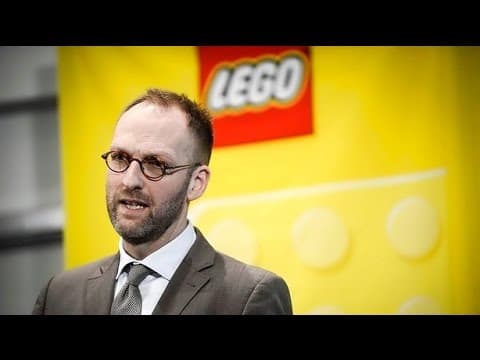
[0:01]Hi, I'm Adam Burns and welcome to Meet the Boss TV. This week, Billund in Denmark, where I've come to find out about the building blocks for better leadership. So I couldn't resist it, from Jørn V. Knudstorp, CEO of LEGO. Most companies don't die from starvation, they do they die from indigestion. Do you take responsibility or do you blame it on some external factor? If that's your major reason for how your business develops, what the hell are you doing in the job?
[0:38]Jørn V. Knudstorp is make no bones about it, the man who rescued LEGO. The multicoloured bricks of our youth had diversified almost to the point of destruction under the group's traditional family ownership. Jørn V., a former McKinsey consultant, joined LEGO in 2001, became the CEO in 2004, and moved fast to put this 78-year-old Danish toy maker back on a firm financial footing. Growth followed quickly. He said his vision is based around the LEGO brick, that is our heritage and it is our future. But in this modern, more fickle and certainly more digital marketplace, how important are those heritage values? They are extremely important, and sometimes when I speak about our vision, I call it a 2.2 version of the LEGO Group. Because, you know, LEGO actually began in a carpenter shop, it was a wooden toy. And only with the emergence of plastics after the Second World War in Europe, LEGO became a global pioneer in plastic intrusion or molding. And that of course became the future of the company from early 1960s and onwards, and you, if you like, you could call that LEGO 2.0. So when we talk about the digital age, I talk about a 2.2 version of LEGO to signify that we are not leaving the physical world, but we're taking the best learnings from that and continuing with that as our actual main stay and core business. But we're adding the digital revolution to that. When you joined, LEGO was in, you know, a degree of trouble, and it had perhaps diversified almost to the point of destruction. How do you now, because the brand is back up and running again, it's doing incredibly well, which must mean the opportunity after opportunity is coming your way, as more and more people again start saying, oh, we could do this with LEGO. How do you make sure you don't repeat those mistakes? Exactly. No, but I agree. I think actually it's a golden rule in business that most companies don't die from starvation, they do they die from indigestion. Because there's so much opportunity if you start open your eyes to it. One of the rules I stick to is you can really only build an agency to your core business every three to five years. Because it's such a major undertaking in terms of culture and capabilities. And that's what we did wrong in the past, rather than doing one adjacency every three to five years, we did three to five adjacencies every year. So I think that's what nearly killed us. The other thing it does, by the way, of course, is that people lose focus on their core business as they pursue these new adjacencies that become the new sexy thing to do. And so for me, you know, a major paradigm shift is the core business is what is the most exciting, and what we need to continue to reinvent every year and make sure we build our business on in the future. And of course you've done, I mean, a tremendous job at LEGO, not that you need me to tell you that. What have been your key lessons around adapting the enterprise? I think it was obvious that the strategy was wrong, but actually I didn't know, we didn't know what the right strategy would be. Because it looked like it was the right strategy on paper. So we actually for the first two years of this new transformation of the company, said look, we don't have a strategy, we just have an action plan. Which is a plan of detailed actions we intend to carry through, and by doing that you start building confidence again. Only then did we develop a new strategy for LEGO, which then is the second phase of adaptation. And I think the major distinction we made, and maybe we could do it because we're a family-owned business, is that many companies in this situation in my experience will say, let's grow. Once we get growing, we'll get profitability. We said for the next three years, there's gonna be no growth. In actual fact, we did grow a little bit, but we said there's gonna be no growth, but productivity will be manifold increased. So it's kind of like if you look at a national economy and a government goes out and say, there's not gonna be any growth in the economy, there's not gonna be any growth in consumption by consumers in this country. But what we're gonna do is we're gonna make this country far more competitive than it is today. That's what we did with the LEGO Group. That clear plan was yours, I'm guessing that was that was your. Yeah, but here's here's some here's a point that I really like to to explain is that that plan is a super generic plan. It says we'll spend a couple of years to stabilize the business and restore execution. We're gonna spend three years restoring profitability, and then eventually we're gonna get back to organic growth. You'll find such a plan in any management consultant's handbook. You know, it's even on the first pages of that handbook. Some people have looked at the plan and said, well, that must be the Knudstorp survival plan, you know, it's my name. And I said, no, look, it's super generic. Leadership is not about these conceptual ideas. The difference between the good and the bad leadership, did you actually do it? And it's like your New Year's resolutions, right? Everybody has a New Year's resolution, I need to eat more healthy, I need to get some exercise. But that's not the insight. And too many leaders think, oh, I must lose weight is the insight. That's not the insight. The insight is actually making it happen through 8,000 people. Absolutely. So how did you, uh let's let's look at that inside, let's look at that, you know, what you did fiscally and and in a very human aspect. How did you coalesce particularly perhaps your executive team at time around your vision? I think the the the major thing I learned, and this was a challenge for me because I'm a very sort of cerebral kind of thinker, you know, I think a lot and it's actually not about you you believe you need to think your way into a new way of acting. But actually what you do is you act your way into a new way of thinking. And so it was about less talk and more action, so what do you do? Well, you know, we closed offices, we sold off businesses, uh we shut down activities, we started introducing measures, so for instance in the factories where we weren't really in control, rather than introducing an IT system and you know, elaborate reporting, we put the reporting up on a whiteboard. And we create something we still use to this day, we call the visual factory. So every Friday morning at 7:00 a.m. we'd get together and the managers and his managers would write down how the factory was performing in front of all of us. Green numbers for good outcomes, red numbers for bad outcomes, and people look at that and they say, when are you gonna put it in an IT system? And I say, it's never gonna go into the IT system. Because it's all in the doing. The sharing of data and how are we doing, it's a social mechanism that starts driving change, because once you've written that red number up there, you don't need to be told, I need to change that, you start changing it. My favorite motto is that the CEO needs any avenue to the truth that he or she can find. And some of those avenues are candid dialogues with employees. Which mean nine out of 10 times they may tell you something you know, or something you consider vaguely relevant. But if you dismiss those nine times, you never get the tenth time where they tell you something that's really, really crucial. And you were never aware of, and if they didn't tell you, maybe you'd only learn two, three years later, and then, you know, of course it's too late. Absolutely. So we'll talk about these avenues to the truth a little bit more, uh, in a moment, but I wanted to touch back, you, you said that you were more cerebral. Yes. More more a head than a the than a than a hand, I suppose. Um, how did you change that? You know, you say it has to be internal, you have to make this change. What did you do to change yourself? Yeah. What I did was I spent very little time in my office, I joined these visual factories, even though people would say, whoa, we're discussing capacity in factory number five right now, and the CEO's here, that's a bit awkward, he's never, you know, been here before. And it's not like I then walked in and said, I say, I, you know, I believe you should turn that machine off and turn that one on because I had no clue. And that would be delegating to the highest level of incompetence to have me do that, but it was more sending a signal. This is so important that we do this process well, that I'm actually here to observe what you do this process well, and I, by being in the room, I send a signal that this is important for all top managers, so everybody would come in. It's about being there, it's about acting also for the for the CEO in this case. Jørn V is clearly a very innovative thinker and capable of bringing that innovation into and around some of LEGO's very core business processes. So why, I wonder, does he feel that more companies don't act in that way? My wife is a a GP, a medical doctor, and she's often looked at me, and she said, explain this to me. So you had worked for the company three, four years, and you became the CEO. I'm a medical doctor. I get to go to school for nearly 10 years, spend seven, eight years working, training and working. To just become a bloody GP. It's, you know, becoming a medical doctor, like an airline pilot, you have to fly thousands of hours to maintain your license and certificate. But people become managers overnight. Where's their practice, you know, they are not practitioners, where's the where's the practice of leadership?
[10:17]And, you know, apart from the joking and that she's give loved to give me a hard time, that's something I really reflected a lot on is that I think, as a CEO, you are the minister of culture, but you are first and foremost the minister of leadership practice. I would expect any leader, in fact, I know any leader in Walmart, which is one of our major customers, so obviously, are extremely customer-price conscious. And it's natural to me because that's what their business is all about, saving people billions of dollars by the way they do their business. So if I offer a cup of coffee to a Walmart executive when he's visiting my office, he leaves a dollar on the table, because he's not gonna pay for the fact that LEGO dishes out coffee for free. And I love it, because it's it's a complete alignment between what their business is about and how they lead it. In my research, I came across a quote from you which said that a company needs a unique reason to exist to get its strategy right. I think we've talked about what that unique reason is. But I'd like to to ask you perhaps, how has that unique reason directly impacted some real-life business decisions that you've made? Oh yes. No, but I think first off, I mean, uh, for me, it it is a, it was given to me by a good friend who said, you know, I'll talk to your new CEO. And he asked me two very simple questions for two years. He said, just explain to me, what went wrong with LEGO? And secondly, why do you actually exist? And, you know, in the beginning I was like, ah, what is this silly conversation about? But I realized, of course, that it's about the two most fundamental aspects of leadership. Do you take responsibility or do you blame it on some external factor like currency or financial crisis or poor weather? Because if that's your major reason for how your business develops, what the hell are you doing in the job? Right, so great question. And the other one, why do you exist? You know, if you produce pizza here in the local town where LEGO is born, you are not having a business model that's globally applicable, because when you move over to the next town, somebody else already built a pizzeria and you have no reason to exist there. You are not unique anymore. And when we talk about rediscovering LEGO and coming back home and and establishing the core business of LEGO, that's what it was about is what really makes LEGO unique and what makes LEGO really unique is that there is no building system like the LEGO building system in the world. It makes children able to put two pieces together, and there are, you know, thousands of different uh available pieces, but they all fit together and it is as if they're glued and you can play and build with them. And yet you only have to be one and a half years old to take them apart again. We had forgotten that, it's so obvious, it's so in your face, but nobody in the company was talking about that. They were talking about how we could do things that were not that, because then we could get new growth. And so that question, getting back to the simple thing that makes you really unique. And then everything else evolves from that question. Aha, so if that's what we're doing, then we need of course to really be world masters of molding techniques, because it's all in the quality of the molding, whether you get the power of two plastic pieces to fit. But not fit harder then you can actually take them apart again. That takes millimeters of precision.
[13:46]And since we do 30,000 pieces every minute, 24 hours a day, 365 days a year, 25 billion pieces a year, it's quite important that that quality is not occasionally right, but consistently right in every print. It's also important, since you do about 10,000 different pieces of those 25 billion prints, that you know exactly where they are, that they're ready for Walmart on Tuesday at 5:00 at their dock. What does that mean in terms of when they should be warehoused in Mexico or US, being molded in Denmark, Hungary, Czech Republic, China or the US. And also it's quite important that that not that that they are available, but somebody has figured out how are they optimally produced without having too much inventory, the right procurement cost and all that stuff. Then you start getting to, oh my God, managing that business system and that business model is where the competitive advantage of this business really lies. Then you say, okay, I need the enterprise architects, I need the engineers. And then you start getting this sense of, what is in the core? Where are my strategic capabilities? And you realize, of course, well the canteen operation, and I mean it's a trivial example. The canteen operation is not a core activity, so somebody else might do that, and so you outsource that if that makes sense and so on. So you actually drive the design of your business model and business system around this notion of, why do we exist? And I, you know, I wish I'd come up with it myself, somebody else gave it to me, thank God, but the I I I thought it was a really crucial question and one that is worthwhile to really penetrate over several years and keep asking yourself, why are we doing this? Do we do this better than anybody else? What does it mean for how we set up shop here? You said earlier that the CEO needs any avenue to the truth that he or she can find. How do you, or or do you in fact actively seek out dissenting voices? Oh, absolutely. And and I think there's this notion that when you are the CEO, you have people who actually run the business, you don't really run the business. You know, you've got to make sure you have a strong organization that's capable of making the decisions it needs to make. So in a way, you're not the chief organizing officer, in a way, you are the chief disorganizing officer, you are responsible for reinvention. You're responsible for questioning organizational design. You are responsible for questioning whether processes need to be reinvented. So you you're talking there about uh, you know, being the chief disorganizing officer. I was talking to somebody the other day who, um, had been reading about the, I think his name's Railsford, I'm not sure. He is the the guy that ran the British, Great British Olympic cycling team. And he talks about there being eight kind of key driving factors in an in an athlete's performance. And what he does is incrementally he will improve each one. So maybe he improves them all by, you know, 0.1%, 0.2%, but the mass of that leads to a huge kind of change. Is that sort of similar to your theory?
[16:55]Absolutely. I I I I'm pleased to hear that, I completely subscribe to it. Optimizing performance is not about one big lever, it's about seven, eight different things that you need to push and you're always sort of trying to up your game. I think what's behind that is also, I bet in such a cycling team, there are some who are better at being at the front of the peloton and some will be at the back. Some are great on mountains, some are better on downhill. So it's also when you deal with such high-performing individuals, you gotta find out, so to speak, in football terms, whether they're midfield, attack or defense. And if you don't know, you haven't pushed them hard enough, because nobody is great at attack and defense at the same time. Uh, we live in a 24/7, always on, always connected world, always consensus building, in contact, etc. But if you don't make time for yourself to plan change, then of course your leadership is nothing more than a reaction to change. How do you make time for yourself to plan? Well, what you do, which is harder to do than just say it is that you have to build your defenses. I I have periods where I don't get disturbed by phone calls, where I don't get disturbed by emails, and that means sometimes there is a long log of things that are fairly important. Some of them maybe even urgent that I'm not touching because I want to make sure I have room for the not urgent but extremely important stuff. You actually turn off your blackberry at some point. Oh yeah, absolutely. Oh, absolutely. Leave it in the car is a great solution. But you may also just have a day where you tell your staff, you say, look, you know, I I'm not reachable. I'm I'm gonna spend some time reflecting today. Or, you know, but but you you need to carve out that time, and it is hard. Because you will say no to things where you're thinking, ah, shoot, you know, I I actually really ought to do this, but you don't. How do you then balance, $64,000 question I suppose, your work-life balancing? How does that work for you? Yeah. Well, I think actually, my take on that one is, there isn't, you know, you will not get a good work-life balance while you're in this job. You know, if you're Wayne Rooney, I suggest you're not saying on Sundays, look, I can't play on Sunday, I'm a family man. And there are certain things that come with the job. I I'm the CEO of a company that's international, it does 2% of its business in its home country. If I had expected every day to be home for dinner and never travel, I'm just in the wrong chair. So there's something about either you're passionate about what you're doing and you're living your dream and then you pay the consequences. Uh, what I've done for myself is that I I feel like I have two major passions in my life. It's the LEGO family and it's my own family. I'm a father of four young children. And so that's where I spent my time. I don't play golf, I don't make many holidays. I'm not, you know, I'm just not doing all the stuff that a lot of executives are doing. Forget about it. It's impossible. People live an impossible dream when they talk about that. Or you take a job where you can have that work-life balance and you just decide yourself that your dream with that job is to fulfill a pretty narrow responsibility, which I think is totally respectable. But don't become a CEO and expect your life to be like that. Jørn V., thank you very much indeed. Thank you. For more fantastic interviews directly related to your business, be sure to explore Meet the Boss TV.


