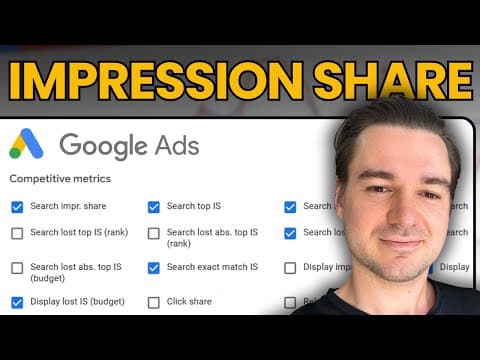
[0:00]Hello everyone, welcome back to the channel. In this video we're discussing one of the most underutilized metrics on Google Ads, your impression share. We will also cover types of impression share you should track and how, tips and strategies for improving your impression share, as well as common mistakes around impression share that you should avoid. So, without further ado, let's get started. What exactly is impression share? Impression share (IS) is the percentage of impressions your ads receive compared to the total eligible impressions. It helps you understand if your ads could reach more people by increasing your bid or budget. It's calculated by taking your actual impressions, dividing by your eligible impressions and multiplying by 100 in order to turn it into percentages. For example, if your ads could have appeared 1,000 times based on your targeting, but only showed up 500 times, your impression share would be 50%. Sounds pretty straightforward. So, why does impression share really matter? Some of you might be thinking, I care about clicks and conversions, not impressions, and you're absolutely right to focus on those metrics. But, impression share is actually a very powerful metric because it reveals one critical insight. Specifically, by monitoring your impression share, you can identify areas in your account where you are able to scale and expand on the one hand. And on the other hand, you can identify areas that you have already maxed out and there is no reason to keep pumping more and more budget into those campaigns or those keywords. For example, if you have a profitable campaign and your impression share is just 30%, this means that this campaign has a lot of room to grow. In this case, you can increase your spending, grow your impression share, and drive more profitable traffic. On the other hand, if your impression share is already pushing close to or even above 80 or 90% in your continuously increasing your bids and your budgets, trying to scale, you might be wasting your budget because there is very little room for you to scale within the auctions you're currently eligible to participate in. Types of impression share you should track. While Google Ads does give you the overall impression share number on your campaigns overview graphs. There are actually multiple metrics related to your impression share that are available in your columns under competitive metrics.
[2:41]First, you have search impression share and display impression share, which measure impression share on search and display networks specifically. Google also tracks your search top impression share and absolute top impression share. Search top impression share is the impressions you've received among top ads, meaning the ones that appear above their organic results, divided by the estimated number of impressions you were eligible to receive among top ads. While absolute top impression share is the impressions you've received in the absolute top, meaning the very first ad among top ads, divided by the estimated number of impressions you were eligible to receive among top ads. Note that all these metrics are based on estimates, so you're naturally going to see some variability in your impression share metrics over time, even if you change nothing in your account. Tracking search top impression share and search absolute top impression share is crucial because, unlike your average search impression share, these metrics provide clear insight into exactly where your ads are appearing on the search results page and this allows for more informed decisions about your bidding and your ad optimizations. Plus, if you're troubleshooting any drops in your account performance or you're seeing drops in your click-through rates, drilling down to metrics like search top impression share or search absolute top impression share will often reveal the reason for said underperformance. And from my experience, I can tell you that the higher on average your ads appear among the search results, the better your click-through rates are going to be. In addition, you also have metrics like search and display lost impression share budget and search and display lost impression share rank. These lost impression share metrics show the percentage of time your ads weren't shown on the respective network, either due to insufficient budget or low ad rank. For example, if your search lost impression share budget is 0%, it means that you are not missing out on any impressions due to insufficient budget. But, if your search lost impression share rank is 40%, for example, this means that in 40% of cases your ads were eligible to show but didn't show because of lower ad rank. Finally, the last metric that Google gives you is the search exact match impression share, which is specifically about the search network for search terms that match your keywords exactly or were close variants to your keywords. So, if you have a broad match keyword flowers, the exact match impression share metric will tell you how often your keyword shows when a user searches for just flowers. And this is also extremely valuable because you can then determine whether your impression share is low on all searches or only on those searches that broadly match your keywords. When it comes to your shopping campaigns, as you know, Google can show multiple products from the same advertiser, to avoid double counting, all products get impressions in your analytics, but only the top ranked one is going to participate in the impression share calculation. And for Performance Max campaigns, impression share is calculated using both search and shopping impressions, by adding impressions of search plus shopping and dividing by total eligible impressions from search and shopping. Now, with all the background information out of the way, let's discuss how you actually increase your impression share. First of all, the number one place you should look is your lost impression share budget and lost impression share rank. The budget one is pretty straightforward. If your lost impression share budget is more than 0%, you can easily increase your impression share by increasing your budget. On the other hand, if your lost impression share rank is high, it means that you should work on improving your ad rank. I've made a separate video about how to improve your ad rank, so I recommend watching it if you want to learn more about ad rank. But, it essentially boils down to two things: your bids and your ad quality. So, if you want to improve your ad rank and thus grow your impression share, you either need to increase your bids or improve the quality of your ads. One of the main things when it comes to improving your ad quality are your headlines, so I've prepared a list of my top 10 irresistible Google Ads headlines that you can use to improve your click-through rates and as a result, your ad quality as well. You can get the list for free at the link in the description. So, in a nutshell, those are the three main things you can do to grow your impression share without changing your targeting or removing any keyword. Number one, increase your budget, only if lost IS budget > 0%. Number two, increase your bids, and number three, increase your ad quality. One mistake I see all the time is trying to target too many keywords with a limited budget. This spreads your impressions thin and tanks your impression share. So, my additional tip is to be ruthless about pausing keywords with low impression share and poor performance. If you're working with a limited budget, it's much better to concentrate your impressions on top value keywords and audiences instead of spreading your budget too thinly. The same also applies to your audience targeting. By narrowing your focus to your best performing locations and audiences, you can achieve a higher impression share without increasing your budget.
[9:26]So, anticipating the question I get all the time, what's a good impression share number to aim for? Generally speaking, 60 to 70% is considered a healthy impression share for most campaigns, but this really depends on your specific goals and circumstances. For branded campaigns, where competitors might be beating on your brand name, aim for 90 to 95 plus percent such impression share to protect your brand. For competitive and non-branded keywords, even 40 to 50% might be a reasonable target if you're in a highly competitive industry. Remember, the goal isn't to maximize your impression share for its own sake. It's to maximize your results within your budget constraints and really use impression share metrics as diagnostic metrics to help guide you in scaling, optimizing and improving your campaigns, rather than chasing a specific impression share target. It's really about finding the right balance of visibility, relevance, and cost effectiveness for your specific business goals. So, now you know everything you need to know about impression share on Google Ads. If you found this video helpful, please hit that like button and subscribe for more Google Ads tips and strategies. Thank you so much for watching. I will see you in the next one.