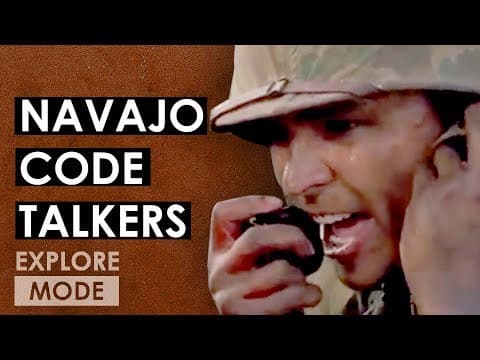
[0:00]The year is 1942. The Second World War is at its height, and since Japan's attack on Pearl Harbor, American strikes on outposts in the Pacific have increased. Japanese and German forces were tapping into American military communication lines intently, but their decrypting methods weren't yielding any results anymore. Why? All messages were being encrypted by Navajo Code Talkers.
[0:39]You see, codifying messages is standard practice during wartime. What wasn't standard practice was deciphering a Native American language that had no written alphabet to begin with. Navajo was one such language. You're watching Explore Mode, and today we're learning about Navajo Code Talkers: First things first, what are code talkers? Well, code talkers were people recruited by the military during wartime to encrypt messages using a little-known language. The term is usually used in reference to Native American code talkers who served in both the Second and First World War, transmitting tactical messages using an encoded version of their native tongue. The first American Indian language used as code in the First World War was Choctaw, the language of a Native American tribe originally from the southeastern United States. 19 Choctaw soldiers joined American infantry forces and passed on messages using their native tongue. The language was so foreign to enemy forces that stories tell of Germans tapping into American communications and thinking that they were using a special device to record their voices underwater. But by the time the Second World War came, many Japanese scholars had already studied Native American languages, so the US had to think of other options. That's where Philip Johnston comes in. The story goes that Philip Johnston, the son of missionaries who worked in a Navajo reservation, was flipping through the pages of a newspaper when he saw that American troops were looking for a newer and harder to decipher Native American language-based code. They were already working with Comanches, Choctaws, Hopi, Cherokee, among other Native American languages. Having grown up listening and speaking Navajo, Johnston knew it was the perfect language to encrypt the Marine Corps messages. Why? At the time, Navajo was an unwritten language, which means there was no alphabetical representation of its sounds. That made it almost impossible to transliterate. It could only be interpreted by native speakers. The recruitment process was complicated. The Marine Corps had to find Navajo men who were both bilingual and met the physical requirements to join them. Some Code Talkers volunteered to participate in the program, others were drafted, and many falsified documents because they were underage, some as young as 15. Apart from participating in boot camp, the men had to develop the code themselves.
[3:17]Literal translations were useful but easier to decipher, so they had to come up with a new method. The Marine Corps decided to use substitution instead.
[3:29]There were two types of codes, Type Two codes and Type One codes. Type Two codes were direct translations. Type One codes worked with substitution. Coders assigned a Navajo word for each letter of the alphabet and spelled out entire messages to each other. So for example, spelling out the word code would work like this. They replaced the letter C with Mosy, the Navajo word for cat. The letter O was replaced with Neshja, the Navajo word for owl. The D would be Tchahi, or dog in Navajo. And E would be Ze, or elk in Navajo. Mosi Neshja Tchahi Ze, CODE. They also created special code words for certain implements of war. For example, the code word for patrol plane was Gaagii, or crow in Navajo. A minesweeper was called Chaa, the Navajo word for beaver. One of the reasons that made Navajo a difficult language to decipher, apart from the fact that very few people spoke it at the time, is the fact that it's a tonal language. That means that differences in pitch and inflection can change the meaning of a word. Navajo has four tones for its vowels, low, high, rising, and falling. Other tonal languages in the world include Chinese, Vietnamese, and Thai. The Navajo Code Talkers memorized all substitutions during training, and according to the CIA, they were able to encode, send, and decode a message in just two minutes during drills. The Navajo code had proven to be a success. Roughly 400 Navajos participated in the Code Talker program, and their efforts were key to the success of allied forces in crucial moments, such as the Battle of Iwo Jima, where they sent over 800 messages back and forth without a single mistake. Major Howard Connor, who was the signal officer of the Code Talkers at Iwo Jima, is quoted as saying, "Were it not for the Navajos, the Marines would never have taken Iwo Jima." Joe Yoyomia was a Navajo soldier fighting in the Philippines when Japan took over in 1942. He was captured and imprisoned. Once the Japanese figured out he was Navajo, they sent him to a prison in Japan and demanded him to try to decode the messages they had intercepted, but it was impossible. Kiyomiya spoke Navajo, but he wasn't trained in Navajo Code. To him, the messages were as confusing as they were to the Japanese. Of course, his captors were not pleased with his performance. Kiyomiya endured months of torture, but he not only survived life as a POW in Japan, he also survived the Batan Death March and the bombing of Nagasaki. Kiyomiya is quoted as saying, "I salute the Code Talkers, and even if I knew about their code, I wouldn't tell the Japanese." The Code Talkers returned to America quietly. No one but their peers knew of the critical role they played in the war, mainly because the program remained classified until 1968. Up until that time, the code was still used to relay classified information during the Korean and Vietnam War. The first public recognition of the Code Talkers would come decades later in 2001, when then President George W. Bush held a ceremony honoring 21 Code Talkers with gold and silver medals. Three of the remaining Code Talkers were honored again in 2017 by President Donald Trump. The Navajo Nation today extends 27,673 square miles, covering areas in Arizona, New Mexico, and Utah. 250,000 Navajo people live in it, and they have their own flag and presidential elections. According to a 2010 census, 170,000 people speak Navajo in their homes. However, many fear the language will eventually be replaced by English as the number of fluent speakers is dwindling. As for code talkers, few are still alive today. But their legacy and their service will live on. If you liked this video, hit the thumbs up button. If you want to explore even more with us, make sure to hit the subscribe and bell button, so you get a notification whenever we upload a new episode. See you next week and in the meantime, keep your explore mode on.


