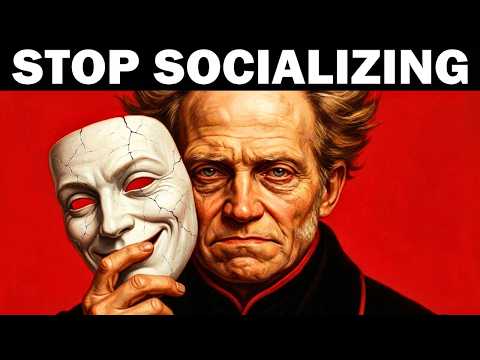
[0:00]You feel it the moment you walk away from them, not just physical fatigue, but a heavy, hollow exhaustion. A sense that a piece of your identity was just chipped away. Society tells you this is normal. They say you are simply an introvert who needs to recharge your social battery before returning to the crowd. They are lying to you. Socializing is not just draining your energy. It is actively eroding your cognitive architecture. Every forced interaction is a subtle, socially acceptable act of self destruction. There is a hidden psychological mechanism happening in your brain every time you laugh at a joke you don't find funny. And once you see what it is actually doing to your mind, you will never look at a crowded room the same way again. We live under a collective delusion that human connection is an absolute unquestionable good. From the moment you are placed in a classroom, you are graded on your ability to play well with others. You are conditioned to believe that a full calendar equates to a full life, that isolation is a symptom of illness, and being highly social is the pinnacle of psychological health. Arthur Schopenhauer, the philosopher who dissected human nature without the comforting filter of optimism, understood the absolute danger of this lie over two centuries ago. He did not view the crowd as a source of warmth. He viewed it as a cognitive hazard. He observed that to exist within society, a person must necessarily forfeit a massive portion of their individual will. You cannot be fully yourself and simultaneously be palatable to the masses. The two states are fundamentally incompatible. Look closely at your own existence. Trace the outline of your days. How many hours this week did you spend contorting your personality to make someone else feel comfortable? How many times did you bite your tongue, dilute your opinion, or fake enthusiasm because the unwritten social contract demanded it? You think you are merely playing a game. You believe you can put on the mask for the dinner party, the office meeting, or the social gathering and then take it off when you return home with the core of who you are remaining perfectly intact. But the human brain does not work that way. The mind is highly plastic. It adapts to the shape of the container it is forced into. When you constantly pour yourself into the shallow moulds of social expectation, your intellect permanently loses its depth. You are not just acting a part, you are slowly mutating into the character you pretend to be. The cognitive tax of the false persona. We begin with the biological cost of pretending. It is the most exhausting labor you perform, yet you are never paid for it. Every time you enter a social dynamic, your brain initiates a highly complex, resource heavy process. You must read the room. You must analyze the micro expressions of the people around you. You must anticipate their emotional needs, filter your own authentic thoughts, and formulate a response that aligns with the established hierarchy of the group. In psychology, this is known as self monitoring. In reality, it is a cognitive tax, and the rate is exorbitant. Schopenhauer noted that a man of high intellect feels a distinct sense of oppression when forced to engage with ordinary society. This is not mere arrogance. It is a physiological reality. When you possess a mind capable of deep analysis, forcing it to operate at the frequency of small talk is like forcing a high performance engine to idle in traffic. It overheats. It degrades. Think about the sheer amount of mental glucose required to suppress a genuine reaction. Someone says something profoundly ignorant. Your instinct is to dissect the flaw in their logic, but you calculate the social cost. You realize that correcting them will cause friction.
[4:10]It will make you appear arrogant. It will disrupt the fragile harmony of the group. So you swallow the truth, you nod. You produce a synthetic smile. That single act of suppression requires massive cognitive effort. Now multiply that by 100 interactions a day. You are actively fighting your own nervous system to remain socially acceptable. This is why you feel physically destroyed after a networking event or a family gathering. Your body is not tired from physical exertion. It is depleted from the heavy lifting of maintaining a fabricated persona. You are experiencing performance fatigue. The tragedy is that society demands this performance, yet despises the performer. If they sense you are being fake, they will reject you. But if you show them your unfiltered, unvarnished truth, they will ostracize you. You are trapped in a double bind, forced to be an actor in a play where the script is constantly changing, and the audience is inherently hostile to authenticity. When you spend your life managing the perceptions of others, your own internal compass begins to spin uncontrollably. You lose track of what you actually believe versus what you have been conditioned to say. The persona you built to protect yourself becomes a parasite feeding on your mental energy until there is nothing left of the host. Is it any wonder you feel empty when the door finally closes? You have spent the entire day giving away pieces of your mind to people who do not even value the fragments they take. Why do we endure this? Why do we voluntarily walk into environments that strip us of our vitality, because of a much darker, more insidious mechanism at play. The contagion of the collective mind. This is the psychological reality that civilized society tries desperately to hide. Stupidity is contagious, and mediocrity is a highly transmissible disease. Schopenhauer stated it with brutal clarity. To match the others, he has to shrink himself. When you enter a group, a psychological leveling occurs. A group of humans does not operate at the intellectual capacity of its smartest member. It operates at the emotional frequency of its lowest common denominator. This is a survival mechanism encoded in our DNA. To maintain group cohesion, outliers must be brought to the center. If you bring a complex nuanced thought into a crowded room, it will be rejected, not because it is wrong, but because it requires too much energy for the collective to process. The crowd despises complexity. It demands simple narratives, recognizable emotional reactions, and predictable scripts. When you socialize extensively, your mirror neurons, the biological hardware designed to help you empathize and adapt, force you to synchronize with this lower frequency. You begin to adopt the anxieties of your peers. You start caring about the trivial dramas that consume their days. You find yourself outraged by the manufactured controversies they discuss. You are absorbing their mental state. You are being infected by their lack of depth. Consider the historical example of the courtier. Throughout history, the men and women who surrounded kings and queens were often highly educated, brilliant individuals. Yet their entire existence was reduced to managing the petty egos of the royal court. They spent their days interpreting whispers, calculating bows, and engaging in intellectual suicide to ensure they did not outshine the monarch. Over time, their brilliant minds atrophied. They became exactly what they pretended to be. Hollow, paranoid echoes of power. You are acting as a courtier to the modern crowd. Every time you engage in a shallow conversation just to pass the time, you are actively degrading your neural pathways. You are training your brain to focus on the trivial. You are teaching your mind that depth is unnecessary. This is the true danger of over socializing. It is not just that people waste your time. It is that they alter your baseline of reality. They pull you into a shared hallucination where the mundane is treated as profound, and the profound is treated as awkward. If you spend enough time around people who do not read, who do not think critically, and who exist entirely on the surface of life, you will slowly begin to doubt your own intellect. You will start to wonder if your desire for deep meaning is actually a flaw. You will shrink your vocabulary. You will dull your edge. You will amputate the best parts of your mind so that the pieces fit neatly into the puzzle of the group. And the most terrifying part, you will do it willingly because the biological urge to belong is stronger than the intellectual desire to be free. How long can you hold your breath underwater before your lungs force you to inhale? How long can you exist in a shallow culture before you start breathing in the mediocrity? The atrophy of autonomy. We have established that the crowd drains your energy and lowers your intellect, but it also steals something far more critical. Your ability to direct your own life. Autonomy is the highest expression of human power. It is the capacity to sit quietly, formulate a desire, and execute a plan without requiring external validation. It is the sovereignty of the individual will. Socializing, particularly in its modern hyper connected form, is the absolute enemy of autonomy. Think about the constant barrage of digital and physical social demands. Your phone buzzes, a friend wants to vent, a colleague requests an unnecessary meeting, an acquaintance invites you to an event you have no desire to attend. Every single one of these interactions is an anchor hooked into your attention, dragging you away from your own internal north star. When your mind is constantly subjected to the input of others, you lose the capacity for sustained original thought. You become a reactionary machine. You wake up, and immediately your brain is hijacked by the opinions, demands, and crises of the collective. You spend your day responding to their stimuli. You are playing defense in a game you never chose to enter. Cal Newport touches on this in his analysis of the modern attention economy, but the psychological implications go much deeper than just losing productivity. When you outsource your attention to the social sphere, you lose your internal monologue. Have you noticed how uncomfortable people are when they are cut off from communication? Put an average person in a room alone for an hour with no phone, no internet, and no one to talk to, they will begin to panic. They will experience physical symptoms of withdrawal. Why? Because they have used socializing as an anesthetic. They use the noise of other people to drown out the terrifying realization that they have no original thoughts of their own. They require constant external input to confirm that they exist. They text, they post, they talk, not to communicate information, but to ping the environment like a bat using sonar, desperately waiting for an echo to prove they are real. If you cannot sit in a room by yourself and generate your own mental stimulation, your mind is already colonized. Schopenhauer believed that true freedom is only possible in absolute solitude, because only when you are entirely removed from the expectations and judgments of others can your will operate without friction. When you socialize, you are constantly negotiating your desires. You want to go left, the group wants to go right. To maintain the connection, you compromise, you go straight. You end up somewhere neither of you wanted to be. Apply this to the macro trajectory of your life. How many of your goals are actually yours? How many of your desires were implanted by the social circles you frequent? Did you want that career, or did the group deem it prestigious? Do you actually care about that political issue, or are you just echoing the outrage of your peers to signal your allegiance? When you socialize relentlessly, you become an amalgamation of the five people you spend the most time with. You are a psychological Frankenstein's monster, built from the discarded opinions and borrowed desires of your associates. You trade your unique destiny for the comfort of the herd. But what happens when the herd walks off a cliff?
[13:05]The Anatomy of Social Exhaustion. Let us strip away the philosophy for a moment and look at the cold, clinical reality of what happens to your body when you force yourself to socialize against your will. The exhaustion you feel is not a metaphor. It is a severe physiological response.
[13:25]When you enter a complex social environment, your amygdala, the threat detection center of your brain, is highly activated. You are surrounded by unpredictable variables. Other humans are the most dangerous predators on the planet, and your nervous system knows this. Even in a polite setting, your brain is tracking hierarchical threats, potential conflicts, and social standing. If you are highly perceptive, you are processing a massive amount of nonverbal data. The slight shift in someone's tone, the passive aggressive compliment, the subtle exclusion from a conversation. Your body registers this social friction as a literal threat. It triggers the release of cortisol, the stress hormone. Your heart rate elevates slightly. Your breathing becomes shallower. You enter a mild state of fight or flight, but society dictates that you cannot fight, and you cannot flee. You must sit there, smile, and engage in the dialogue. So your nervous system defaults to the third trauma response: fawn. Fawning is the act of aggressively people pleasing to neutralize a perceived threat. You flatter the arrogant boss. You laugh at the unfunny joke. You agree with an opinion you despise. You do this to pacify the environment and ensure your social survival. We have normalized this biological trauma response and called it having good manners. Over time, this constant spiking of cortisol and the suppression of your natural instincts leads to profound cognitive fatigue. Studies published in medical journals examining social overstimulation show that forced interaction literally depletes the executive functioning of the prefrontal cortex. This means that after a heavy weekend of socializing, your brain physically loses its ability to make complex decisions, regulate emotions, and focus on difficult tasks. You have fried your own circuitry just to prove you are a team player.
[15:27]You are treating your brain like a battery that can be infinitely drained and recharged, but cognitive reserve is finite. Every hour you spend navigating the treacherous, exhausting waters of human ego is an hour of high level intellectual processing you can never get back. You are burning the fuel meant for building your empire just to keep the people around you warm. And for what? What is the actual return on this massive investment of your life force? The Illusion of Companionship. This brings us to the most painful realization of all. The reason you subject yourself to this mental degradation is because you believe it cures loneliness. You believe that being surrounded by people is the antidote to feeling isolated. It is the exact opposite. Schopenhauer observed that true loneliness is not the absence of people. It is the absence of understanding. Being alone in a room is peaceful. Being in a room full of people who fundamentally misinterpret who you are is the most profound loneliness a human being can experience. When you socialize constantly, you attract people who like the mask you wear. They become attached to the accommodating, agreeable, diluted version of you. They call you a friend, but they do not know you. They know the avatar you created to survive them. Therefore, every time they praise you, every time they invite you out, it feels hollow because your subconscious knows they are not applauding you. They are applauding the performance. This creates a terrifying psychological trap. You cannot drop the mask, because if you do, they will leave. But as long as you wear the mask, you feel entirely unseen. You become a prisoner in a cage of your own design, surrounded by wardens who call themselves your friends. This is the illusion of companionship. It is a transaction where you trade your authenticity for the mere presence of warm bodies. Think of the people you consider your closest circle. If you were to speak your absolute unvarnished truth today, if you revealed your darkest ambitions, your true opinions on their choices, your actual perspective on the world, how many of them would still be standing beside you tomorrow? If the answer is none, you do not have friends. You have hostages, and you are holding yourself hostage alongside them. The great minds, the strategists, the outliers, they do not fear isolation. They weaponize it. They understand that to be exceptional, you must be willing to be misunderstood by the ordinary. They do not seek companions. They seek equals. And if equals cannot be found, they prefer the quiet dignity of their own company to the exhausting theater of the crowd. Are you beginning to see the architecture of the trap? The more you socialize, the more you dilute your intellect. The more you dilute your intellect, the more you require the crowd to validate your existence. It is a downward spiral designed to keep you trapped in the center of the bell curve, harmless, exhausted, and easily controlled. The Weaponization of Distance. To stop the bleeding, you must radically shift your relationship with society. You must transition from being a passive participant to a ruthless curator of your own environment. This does not mean retreating to a cabin in the woods and never speaking to another human being. That is the reaction of a wounded animal, not a strategist. The Machiavellian application of Schopenhauer's philosophy is the strategic weaponization of distance. You must view your mental energy as the most valuable, scarce resource on Earth. You do not give it away for free. You do not let people extract it simply because they are bored and want to talk. You create boundaries made of iron. When you limit your availability, an interesting psychological phenomenon occurs. The law of scarcity takes effect. People begin to value your presence precisely because they cannot easily obtain it. When you are always available, you are treated like a public utility. When you are rarely seen, you are treated like a luxury. But the true benefit is not how they perceive you. It is what happens within your own mind. When you pull back from the constant noise, the mental fog begins to lift. The cortisol levels drop. The mirror neurons stop firing erratically, trying to synchronize with the chaos of the crowd. In that newly acquired distance, your original thoughts begin to resurface. The opinions you buried to keep the peace start to demand attention. The ambitions you scaled back because they intimidated your peers begin to stretch their legs. You begin the painful, glorious process of remembering who you actually are. This requires an immense tolerance for being disliked. When you stop returning texts immediately, when you decline invitations without offering a fabricated excuse, when you refuse to engage in the petty gossip that fuels the group chat, they will turn on you. They will call you arrogant. They will say you have changed. They will accuse you of thinking you are better than them. Let them. Their anger is simply the frustration of a parasite that has been cut off from its host. Do not attempt to explain your withdrawal to them. Logic cannot penetrate a mind dedicated to its own destruction. Respond to their accusations with calm, unbothered detachment. Your lack of reaction will terrify them more than any argument ever could. It signals that their judgments no longer hold any currency in your reality. You have stepped off their playing field entirely. This is where you forge true mental invulnerability. When you no longer fear the rejection of the crowd, the crowd loses all its leverage over you. You become unmanipulable. You become sovereign. You are no longer reacting to the world. The world must now adjust to the space you carve out. This is the path of the outlier. It is a path characterized by long stretches of solitude, intense periods of deep focus, and social interactions that are chosen entirely on your terms. You socialize not out of obligation, not out of a desperate fear of loneliness, but out of deliberate choice. And when you do engage, you bring the full force of a rested, sharp, uncompromising mind to the table. You do not mirror them. You compel them to react to you. The destruction of your mind was happening so slowly you mistook it for growing up. You thought the exhaustion was just the price of doing business in the modern world. Now you possess the lens to see it clearly. Every room you enter is an exchange rate. What are you paying and what are you getting in return? You have the power to stop the transaction at any moment. You have the authority to stand up, walk out of the room, and close the door behind you. And when that door finally closes and the noise of the world is completely shut out, who is actually left standing there? If the answer scares you, it means you have work to do. YouTube has officially demonetized this channel to sanitize your mind. They are terrified of this knowledge. I refuse to bend to advertisers. Instead, I am doubling down. But I can't fight them alone. I need your support to keep this channel and this mission alive. Click the link in the description and join me on Patreon. You'll instantly unlock the raw, unfiltered members only videos, exclusive audio podcast, and forbidden psychological blueprints they won't let me publish here. Most will go back to sleep. Don't be like them. Keep this channel and this mission alive. Join me on Patreon.


