[0:14]Hi, so in this next module, we're going to talk about writing the results section. So once you've finished your tables and figures, you've got a nice set of complete tables and figures that tell a good story, then the next step is to write your results section, and it the results section kind of just falls right out of the tables and figures. So the one thing to keep in mind, the biggest mistake that people make with the results section, though, is that they because it falls right out of the tables and figures, there's a temptation to want to just kind of read the tables and the figures to the readers, like kind of read through line by line through the tables and repeat to the reader what's already in the tables. So that's not the point of the results section. The results section is supposed to summarize what the data show, point out simple relationships, describe big picture trends, cite figures or tables that present supporting data. And you're going to cite the supporting data that's in those tables and figures, and the readers can go to those and get more information to fill, uh, you know, in the details. But you don't need to repeat the numbers that are already available in tables and figures. Of course, a few key numbers that you want to highlight maybe, but you don't need to go through and kind of read through the tables, uh, for your readers. So here's some examples. So, um, this one reads over the course of treatment, topiramate was significantly more effective than placebo at improving drinking outcomes on drinks per day, drinks per drinking day, percentage of heavy drinking days, percentage of days abstinent, and log plasma, uh, glutamyl transferase ratio (Table 3). So there's a whole bunch of outcomes that were measured in this study, and you can imagine if you go to Table three, there's this big table with all these different outcomes, and lots and lots of numbers, but they're giving you the high level summary. Hey, on all of these different outcomes about drinking, the treatment beat the placebo. If you want more details, you can go to the table and see more details. So that's that that that's good job summarizing. Here's another example. So this one says, "The total suicide rate for Australian men and women did not change between 1991 and 2000 because marked decreases in older men and women (Table 1) were offset by increases in younger adults, especially younger men." So you can imagine that what's in that table is just a list of the suicide rates from 1991 to 2000, with a list of those numbers. And it may be breaking it down by overall and by gender and age. And so, this is a high level summary because it's hard for the reader to go through and kind of figure out what's going on with all those numbers, but the author is saying, well, hey, what's happening is there's no change over time if you look at those numbers, but if you look at the subsets, there's actually a decrease in one group and an increase in another group. So they're they're giving you again the overall trends without any details on the numbers. So that's the way that the result section is supposed to read. Notice it's not going to be very lengthy, it's uh, you know, you want to keep it pretty succinct. So now I'm going to give you some examples of sort of what not to do. So, uh, I'm going to go back to that a little hypothetical table we had on our study on bad witches and good witches. So imagine you're doing a a study comparing bad witches and good witches. So I gave you that made up Table one where I had some data on our witches, showing that, uh, you know, the bad witches tended to be, um, a little bit less healthy, they were a little bit older, they exercised less, things like that. So here's a way that, uh, a lot of times when I'm getting new descriptions from students, here's what the kind of typical thing I'll I'll get. So here's my table one with my descriptive characteristics, and then here's what the result section will say. The characteristics of the bad witches and the good witches are shown in Table one. So right over there, notice we've got a passive voice. So, uh, you should at least say, Table one shows the characteristics. Uh, you may not even need to tell the reader what table one does because table one's pretty obvious, so you probably don't even need to give that the reader the the exact, you know, uh, what's in table one, they can probably figure it out. So you might just kind of jump right in with what's in, you know, what the findings in table one and put table one in parentheses in the first sentence or something like that. And then they the this, uh, author, of course, I I just made this up, but they're they, um, are going through and just kind of reading line by line. There was a significant difference in age between the groups. The mean age of the bad witches was 45 and the mean age of the good witches was 36. It there was no significant difference in gender between the groups, with the bad witches having 85% females, and the good witches having 83% females. BMI was not significantly different between the groups, which both had normal BMIs. Systolic blood pressure and exercise were significantly different. The bad witches had a mean blood pressure of 140, whereas the good witches had a mean blood pressure of 120. You can see that the the author here is literally just reading the table for the reader. We got to give you reader a little bit more credit. The reader can go and get all of those details, but you need to give a higher level summary. What's what key points do you want to pull out of and draw your readers attention to. Don't just go through the table and repeat what's in the table. So, if a student gave me something like this, I've here would be my revised, edited version. So it would say something like, The witches were, on average, lean and predominantly female (Table one). Here I'm just referring to Table one because I think my readers can figure out that it's a descriptive table. I want to point out that they were lean and female and predominantly female, those are important characteristics about witches in general. I don't need to say, hey, the groups didn't differ on that because again, the reader can go to the table and see that and and that's kind of implied here. And then I'm going to point out the differences. Bad witches were significantly older, had higher blood pressures, exercised less, and were more likely to smoke than good witches. So I'll point out all the differences. Notice, I didn't give any exact numbers. We don't really need any exact numbers. We just want to know how they differ. More bad witches were unemployed, but this difference did not reach statistical significance. So I also want to point out where there's, you know, looks like there might be some difference but didn't quite make statistical significance. So notice that that's a much more useful, uh, a paragraph for the reader because it's giving the reader all the kind of the key points. And if the reader wants more details on that, they can go to the table and see the details. So you don't need to read through the table for your reader. So a couple tips for writing the results section. So, um, if you have something that's kind of a complex study, you might want to consider breaking it into subsections with with headings if needed. You have each, uh, section with little heading. Uh, it's not necessarily needed. I see a lot of studies where it's perfectly fine to leave that out if it's kind of a simple study and there aren't too many tables and figures you have to go through, too many results you have to go through. But if it's complicated, it's it helps the reader to kind of break things into subsections. Um, think about rather than repeating the information that's already in tables and figures, think about complementing that information. So, for example, maybe you've got a figure that doesn't have the precise values for the groups. And, you know, I end up spending a lot of time, for some reason, I often need that precise value, and so I have, I take the ruler, and I kind of scroll across and I'm trying to get the precise value from figures. So sometimes it's actually useful if if the important number, like if it's the key number, uh, from your, um, from your study, and you're presenting it in a figure, you might want to also in the text, give the exact precise numbers, say for the means of the groups, if you've got a bar graph. So that sometimes it's useful to to present in the in the text, and that can complement what's in the figure. Also, if you've got something that's in a table where you've presented like the absolute values in the two groups, like the witches exercise, the bad witches exercise 30 minutes a week, the good witches exercise, uh, or 30 minutes a day, and the good witches exercise 60 minutes a day, rather than repeating that number, if you want to highlight how large that difference is, you could give the percent change or the percent difference. So, like, you could say that good witches exercise twice as much every day as bad witches. And so that's, um, a little bit of a change is a little bit of complementary information rather than just repeating what's in the tables. And you can repeat, uh, you know, numbers that are in the tables, but make sure that those are the key and most important numbers. So, of course, if it's, you know, a a drug study and you're one main outcome, and you just want to say how the drug versus the placebo turned out on that one main outcome, you're probably going to want to repeat that number in your text as well. But repeat and highlight only a few key important numbers, uh, in your text. Also, don't forget to talk about negative and control results. We we tend to to want to focus only on the positive results, but of course, the negative, uh, results are just as important. Um, keep in mind that we've used the term "significant." You always want to reserve that for statistically significant. And, um, keep in mind that in the results section, we don't want to be mixing that up with methods and discussion. So the results section should not contain information about what you did. The results section is about what you found, not what you did. So keep what you did in the method section. And and the commonly I see, uh, especially with when people have complex statistical analyses, like they've built different models and things, there's a tendency, a temptation, when you're writing your results to also want to explain to the to your reader the rationale for why you use this model versus that model. That rationale belongs in the method section. Don't put that rationale in the results section. Only say what you found, not what you did or why you did it.
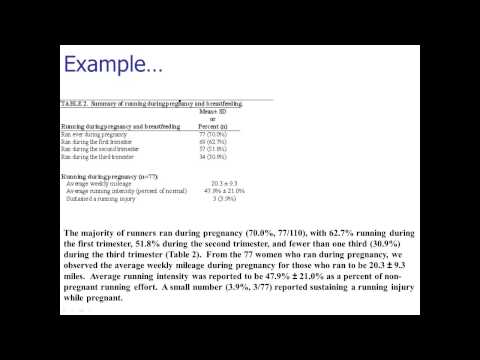
[9:22]So here's another example of something I was editing for a student. This was a paper looking at runners, how much runners run, uh, who are normally competitive runners, how much they run during pregnancies, kind of an interesting topic. Um, and so, here were some snippets from Table two, the main outcome of the study, the main thing that they were trying to look at was, well, how much, you know, do runners, how many runners, what percent of runners run during pregnancy? So here was the the, um, paragraph from the results section that corresponded to that table. So it goes, the majority of runners ran during pregnancy (70.0%, 77 out of 110), with 62.7% running during the first trimester, 51.8% during the second trimester, and fewer than one third (30.9%) during the third trimester. From the 77 women who ran during pregnancy, we observed the average weekly mileage during pregnancy for those who ran to be 20.3 +/- 9.3 miles. So, notice that again, uh, the author here is just kind of reading the table for you. And you can see that in that last sentence, you know, uh, hopefully you're tempted to edit that sentence now that we've been doing a lot of editing. So you can you probably heard the repetition, The women who ran during pregnancy, uh, for those who ran to be that you could hear a lot of wordiness. So hopefully now you all want to go get out your red pens and edit that sentence and make it a little bit more concise. And then again, average running intensity was reported to be 47.9% as a percent of non pregnant running effort. A small number, uh, reported sustaining a running injury while pregnant. So, you can hear, you can see that they've just literally read right through the table for the reader. Well, the reader can go and read the table. The reader doesn't need you to do that. The reader needs you to give a higher level interpretation that's more informative for the reader and more concise. So I edited this to notice, I kept in a number here because they they what they really cared about in this study was, well, how many runners run during pregnancy? So we kept in that number. 70% of runners ran sometime during pregnancy, and almost a third ran through the third trimester. I thought that was interesting because, you know, you know, getting really pregnant, like how many actually run all the way through. So I kept in a couple of numbers, and then referring to Table two, On average, women who ran during pregnancy greatly curtailed their training, cutting their weekly mileage and running intensity to about half of pre-pregnancy efforts. So now I'm giving some complementary information, so rather than repeating the numbers in the table, I'm quantifying that as it's about half of the pre-pregnancy effort. Um, and then, uh, another kind of interesting number was that very few got injured, so I actually repeated that number there. Only three reported sustaining a running injury while pregnant. So notice that I do repeat some of the numbers that are in the table, but I'm picking and choosing the most important ones to highlight and wherever possible, kind of trying to give complementary, uh, numerical information. So the the other thing that often confuses students, especially when it's the first, uh, time that you write a scientific manuscript, is what verb tense do you use? Um, so, um, so it's actually pretty easy, it's pretty straightforward. You just need to know the rules. So the rule is you're going to use the past tense when you're talking about completed actions. So, we found that, well, you've already done the study, you've already found it, so that's in the past. Women were more likely to. Well, we've already measured them, so that measurement is done, so they they may still be more likely to at this moment, but this is we're talking about something that was done in the past, the study in the past. So at that point, when we measured them, women were more likely. Or or in the past, when we measured that study, men smoked more cigarettes. The average reaction time was, because again, your experiment's completed, so those are all going to be in the past. However, you're going to use the present tense in a couple of cases, for things that actually continue to be true when your reader reads the paper. So when you if you say that the table, Table one shows something, well, that's going to be in the present tense because when your reader reads the paper, the table is still going to show that. Or what you believe your data show, well, that's true, it's still true when your reader is reading your paper. It's not a completed action, so that will be in the present. Or what the data suggest, all of those will be in the present tense. So you would say like, Figure one shows, because it's still showing it. The findings confirm because they're still confirming it. The data suggest, because the data still suggest that, so that's still ongoing and true at the time the reader reads the paper. It's not in the past. Or we believe that this shows, again, in the present. And, um, a couple of examples. So, uh, in this study, they say, Information was available for 7,766 current cigarette smokers. Of these, 1,216 (16%) were classified, notice the passive voice there, uh, as hardcore smokers. Table one gives characteristics of all the smokers. The most striking difference was that hardcore smokers were about 10 years older on average and tended to be more dependent on tobacco. Significantly more hardcore smokers had manual occupations, lived in rented accommodation, and had completed their full-time education by the age of 16 years. There was no difference by sex. But then we get to Table one gives, so you're switching from the past tense to the present tense because Table one is still giving those characteristics. Everything else is talking about things that were already measured in the study, so those are in the past tense. And of course, uh, we want to use the active voice in the results section. So keep it in the active voice. It's more lively. And it's actually not that hard to keep it in the active voice. It's we're going to talk about the method section, it it's hard to keep things in the active voice. But in the results section, it's not like you have to say, We found that at the start of every sentence, right? Because you can talk about the subjects of your experiments. You can talk about the variables. So you can have plenty of other subjects to use besides We. So, for example, here's a study. Notice that this was a study that broke the results section into subsections with little headings. So we're getting a subsection here that's called Comparison with Californian Estimates. They were looking at smoking in England. And so they did use some We found. So, using the same definition of hardcore smoking as adopted in the Californian study, we found a prevalence of 17% across all age groups and 19% among smokers aged 26 compared with a figure of 5% for this group in the US study. When we added the Californian requirement of 15 cigarettes a day to our criteria, we found a prevalence of 10% among smokers aged 26, still twice the prevalence in California. So we we are using some We to keep it in the active voice. But notice in the next paragraph, or the next section, again, notice that it's a subsection with a heading. They start with the We compared, but then we get, beliefs were, so now the subject becomes the beliefs. They can talk about the beliefs. The smokers agreed, the differentiation emerged. There's plenty of other subjects to choose from besides We. So keep that results section in that nice, lively active voice. The preceding program is copyrighted by the Board of Trustees of the Leland Stanford Junior University. Please visit us at med.stanford.edu.