[0:00]Are there any general questions about the syllabus, the course, the homework, the first homework, or anything that's been presented up till now.
[0:10]Okay. For the homework, which will be due on Monday.
[0:18]Uh, I will have office hours later today and then on Sunday. Um, and yeah, I'm thinking about setting up an email alias for questions specifically on the homework, so you don't have to send a private email to me. I can share it with others or with the other Tas if you have any questions. So if you're not able to make it to the office hours, you can still ask me questions on the homework directly. But my hope is that most of those questions would be resolved during the office hours. And my goal would be to actually post the solutions to the homework on Monday evening, after it has been due and all the grades have been set to your account. All right. Um, today we are going to start talking about sets, which is probably going to be a revision to many of you, but we are going to dive a bit deeper than what you may have seen in high school or if you have seen sets already. So we're going to define sets, set building notation, we're going to talk about specific, uh, operations on sets, and specific symbols related to sets.
[1:00]All right. So to begin with, let's define what a set is.
[1:06]A set is a collection of things.
[1:14]And the things in the set are called elements. So it's a very simple concept.
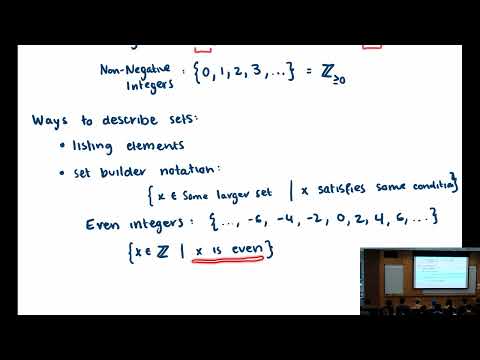
[1:21]There are different ways to describe sets. For example, if I wanted to describe the set consisting of 1, 5, and 7, I could just list them. I can write 1, 5, 7. It doesn't matter the order, so it's unordered, and the repetition doesn't matter. But usually with sets, we don't care about the repetition or the order. I could also write a set of names, say, a set called Bean and Charlie. These are my two dogs. Um, and if I wanted to write for example, the integers, the integers are all the negative numbers, all the positive numbers and zero. So I would write dot dot dot, -3, -2, -1, 0, 1, 2, 3 dot dot dot. And we usually denote the integers with a Z with a double line in the middle. You can also specify a subset of the integers, for example, the non-negative integers, which consists of 0, 1, 2, 3, dot dot dot. And we usually denote that with a Z with a subscript of greater than or equal to 0. All right. Um, so these are ways of listing the elements, which is one way to describe sets. So we have listing elements, and the other way is set builder notation.
[2:41]For example, in the last lecture, we talked about all integers that satisfied an equality. So using set builder notation, we can write a set of all X, such that X is an element of some larger set, and then X satisfies some condition. So this vertical bar reads, "such that." This E-looking symbol reads, "is an element of."
[3:00]So let's take a look at the even integers. We could list the even integers as dot dot dot, -6, -4, -2, 0, 2, 4, 6, dot dot dot. Or using set builder notation, we can write all X such that X is an element of the integers and X is even. Or we could be a bit more formal, and write all X such that X is an element of the integers and there exists a k in the integers such that 2k equals X. All right. Um, next we are going to look at more commonly used sets. The real numbers, denoted by R, which you are probably familiar with, and also the rational numbers, denoted by Q. The rational numbers are all fractions, all numbers that can be written in the form m over n, such that m and n are elements of the integers, and n is not equal to zero.
[4:12]This definition of rational numbers is quite important, and it will be revisited later on in the course. And the last very important set are the complex numbers, usually denoted by C, which consist of a + bi, where a and b are elements of the real numbers, and i squared equals -1. Again, if you are not familiar with complex numbers, we are going to have a brief review on these during the next few lectures. All right. So, um, here are some common symbols related to sets. So this E-looking symbol, which we've already seen, means that A is an element of X.
[4:45]And the same symbol with a stroke through it means that A is not an element of X.
[4:55]This C-looking symbol that can also be underlined or not underlined means that X is a subset of Y. So if we have this diagram, this means that for all A, if A is an element of X, then A is an element of Y. If it is underlined, it means that X is a subset or equal to Y. If it is not underlined, it means X is a proper subset, meaning that there is an element in Y with A not equal to X.
[5:22]We also have the reverse symbols, so Y contains X and Y properly contains X.
[5:33]And the definition for two sets to be equal, X equals Y, means that for all A, A is an element of X if and only if A is an element of Y. So if A is an element of X, then A is an element of Y, and if A is an element of Y, then A is an element of X. So a simple proof of this is given two sets A and B, if A is a subset of B and B is a subset of A, then A equals B.
[6:04]Since A is a subset of B, if X is an element of A, then X is an element of B. And since B is a subset of A, if X is an element of B, then X is an element of A. So since X is an element of A if and only if X is an element of B, we have A equals B.
[6:27]This is a basic rule of proper subsets, and the opposite is not always true.
[6:36]Next we are going to look at constructing more sets using given sets. So let A and B be sets. The union of A and B is defined as all X such that X is an element of A or X is an element of B.
[6:58]The intersection of A and B is defined as all X such that X is an element of A and X is an element of B.
[7:10]And the difference, A - B, is defined as all X such that X is an element of A and X is not an element of B. So the union is denoted by A U B.
[7:33]The intersection is denoted by A intersect B, and the difference is denoted by A - B.
[7:44]And the exclusive or B, usually denoted A XOR B, means that X is an element of A, or X is an element of B, but not both.
[7:59]All right. Um, next we are going to define an ordered n-tuple. An ordered pair is a list of two things, A, B, and we care about the order. Let N be an element of the integers greater than or equal to 0. Then an ordered n-tuple is a list of N things, a1, a2, all the way up to an, where we care about the order. For example, if N equals 5, we have a list of five things, a1, a2, a3, a4, a5.
[8:42]Given sets A and B, their product A times B is all ordered pairs a, b, such that a is an element of A and b is an element of B. For example, if A equals Bean, Charlie, and B equals 1, 5, 7.
[9:05]Then the product A times B is Bean, 1; Charlie, 7; Bean, 5; Charlie, 5; Bean, 7; and Charlie, 1. And the product B times A is 1, Bean; 5, Charlie; 7, Bean; and 1, Charlie; 5, Bean; 7, Charlie. As you can tell, these two are not the same, which is why we care about the order.
[9:37]So if we have A1 times A2 times A3, this means we have a list of three elements, a1, a2, a3, such that a1 is an element of A1, a2 is an element of A2, and a3 is an element of A3. This is not the same as A1 times the product of A2 and A3. This is a key difference. This is the difference between an n-tuple and a nested tuple.
[10:04]For example, the real numbers product with the real numbers would be R2. And if you have three real numbers product with each other, it would be R3.