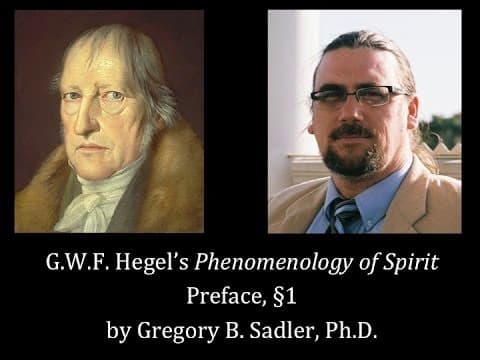
[0:15]Hello, I'm Gregory Sadler, and this is the beginning of a new series of videos, which I'm going to be shooting, each of which should be about 25 to 35 minutes long, that are going to be focused on Hegel's Phenomenology of Spirit. We're going to go through the entirety of this work, passage by passage, by passage. I'm trying to to not skip any of the portions of it, even the portions that seem almost indecipherable. We're going to dig into them and make sense of them. This is for me a a sort of new experiment. I've done a lot of video lectures, as as some of you may know. Um, I've put together a number of courses ranging from existentialism to intro to philosophy, to ethics, to religion in America, and I'm constantly bringing out new material. But I've been asked for a long time, when are you going to do Hegel? That may sound like a strange thing, but I suppose YouTube viewers of of philosophical videos are are an unusual bunch. And so people have been asking for this for quite a while. I've shot a few videos on Hegel in in my intro classes, strange enough place to do that. I think some people would see that as a a recipe for disaster, given how how dense and difficult Hegel is. But, um, nonetheless, that's that's what I did. He is one of my my favorite philosophers, and this is really one of my favorite books of all time of philosophy. I rate him up there with Plato and Aristotle, Augustine, Anselm, Descartes, we could go down the list of of top-notch philosophers, and Hegel is among them. So, what I'm going to be doing with this is is rather experimental. Um, I'm not sure how long it's going to take me, how many videos it will require. But what I'm going to do is go through each one of the the sections, and there are a total, when we get to the very end, there are 808 sections. So, each of them is, you know, a paragraph or sometimes a page worth of of writing. We're going to go through each one of those. Uh, I'm going to read it and then I'm going to comment on it. And the commentary may be explaining what's going on in the passage, it maybe making sure that we we don't miss the references from that passage to earlier passages. It may be talking about the historical context because Hegel doesn't do a lot of naming of names in in this book. Um, which is different than some of his other works. Uh, so there's there's a lot of different possibilities. I'm going to be switching back and forth, you're going to see me sitting here reading the passage to you. Uh hopefully I'll have text up on the screen along with me, and then I'll be shooting in front of a chalkboard for the what would be the lecture portion of this. And I've been thinking about this for for quite a while, what exactly I wanted to do and what would be the best format, uh, for for doing something like this on on Hegel specifically. Because he is such a complex thinker, not only by temperament, but by design. He thinks that that is integral to to the practice of philosophy, at least as he understands it. So, what I'm doing here is not really teaching a class per se. Uh because we don't have the the back and forth student interaction. Of course, we do have the comment section, which people are welcome to to leave comments, and uh when people ask questions, I'll try to respond as best as I can to them. Sometimes they may be actually directing people, well, go back and and take a look at this this section or this video. Um, I think you could look at this as something like the core for a self-directed study. If Hegel is somebody who you've always wanted to understand, and he is well worth understanding because he really does in many respects, um, set the agenda or at least part of the agenda for the whole of 19th century and a lot of 20th century philosophy. He is somebody who, if you want to get a good education in philosophy or even in the humanities or the history of ideas in general, you you need to grapple with that at one point or another. So if you're if you're interested in doing a kind of self-directed study, this could be the core for that. Um, perhaps by the time that we're finished with this, this will have generated some sort of community of inquiry around which we can design some other projects. I'm not sure. This is all very, like I said, experimental. We're going to see what happens with this, and I'm just going to keep producing them, uh and what happens with them, I suppose depends in part on the viewership. So, like I said, what we're going to do is it's going to go back and forth from text to commentary. I'm going to be providing the commentary. I do have some some secondary sources who I particularly like, but I'm going to try to minimize my references to them. But I I thought it'd be good to mention them right off the bat. Two of them are the these these classic French commentators on Hegel, uh Alexander Kojève and Jean Hippolyte. Uh, Kojève influenced a lot of the French thought on Hegel. Hippolyte did as well, um, but Hippolyte is Kojève you could think of as as a lot of fireworks and very interesting uh, play of ideas. Hippolyte is a bit more of a careful, scholarly attitude and approach towards it. There are other thinkers who I I particularly enjoy reading on on Hegel. And they would include, you know, Stanley Rosen, for example, um, Adrian Peperzak, who also writes a lot on on Levinas, and on Christian philosophy, um, Heidegger, Martin Heidegger has a unfortunately only discusses uh certain parts of the phenomenology. But I'm I'm going to bring these things in very infrequently because I don't want this to try to turn into a, you know, uh, web of erudition. I really want to focus on Hegel's own text as as such. And I think that it's it's important to point out this is one of several different translations that are available in English. There's another one that you'll see translated as the Phenomenology of Mind. Um, I may on occasion, if if I think that the translation in some of the passages of this bring up them. If I think that the translation is a little bit more felicitous, you know, a little bit closer to what we want, I may bring them up, but but I'm not going to to guarantee that. We're going to be using this in part because this is a decent translation and it's readily available. So if you want to get yourself a copy of this, if you're going to follow along with this entire course, I I think that's a good idea. Um, so, without any further ado, we're going to start moving now into the very first part of the phenomenology, the preface, and we'll start with the very first section. It is customary to preface a work with an explanation of the author's aim, why he wrote the book, and the relationship in which he believes it to stand with other earlier or contemporary treatises on the same subject. In the case of a philosophical work, however, such an explanation seems not only superfluous, but, in view of the nature of the subject-matter, even inappropriate and misleading. For whatever might be appropriately said about philosophy in a preface, say a historical statement of the main drift and the point of view, the general content and results, a string of random assertions and assurances about truth, none of this can be accepted as the way in which to expound philosophical truth. Also, since philosophy moves essentially in the element of universality, which includes in itself the particular, it might seem that here more than in any of the other sciences, the subject-matter itself, and even in its complete nature, were expressed in the aim and final results, the execution being by contrast the unessential factor. On the other hand, in the ordinary view of anatomy, for instance (say, the knowledge of the parts of the body regarded as inanimate), we are quite sure that we do not as yet possess the subject-matter itself, the content of this science, but must in addition exert ourselves to know the particulars. Further, in the case of such an aggregate of information, which has no right to bear the name of science, an opening talk about aim and other such generalities is usually conducted in the same historical and uncomprehending way in which the content itself (those nerves, muscles, etc.) is spoken of. In the case of philosophy, on the other hand, this would give rise to the incongruity that along with the employment of such a method its inability to grasp the truth would also be demonstrated.
[9:50]This first paragraph in the phenomenology is quite famous for Hegel's insistence that really you can't write a preface as the first thing that he's saying, writing his preface.
[10:05]So, a lot of people have played around with this and and uh, you know, Derrida for example, uh made a a lot of hay out of this in talking about the the impossibility of Hegel's own position. Um, but Hegel really is earnest about this. What you're going to find is that he he can be quite sardonic, he can be quite ironic. Um, he can he can make a lot of very biting comments, um, withering sometimes through out this preface. Because he's he's looking at other philosophical approaches of of his own time and showing where they're wanting, showing where they've fallen short, showing where they thought they got it right, but actually only partly got it right and in and thinking that they got the whole of it right, got it wrong.
[11:00]And this is something that actually, if you take away Hegel from it and take away his own particular way of doing philosophy, I think that quite a bit in this very first part of the preface would actually still make quite a good bit of sense when we're thinking about how philosophy differs from other disciplines, let alone differs from other genres of literature. So he starts out, you know, wondering, can you actually write a preface to a philosophical work? Now, what does that mean? We're talking about a work that in some way is going beyond the sorts of things that we're normally looking at, you know, a work of philosophy, for example, cannot be what we used to call a coffee table book. You know, those those nicely illustrated large books that you set on the coffee table. Why would we call them a coffee table book? Because they're the kind of books that somebody would sit at a coffee table, and while they're sipping some coffee, maybe, you know, killing some time, they could page through. Philosophical works are not like that. You have to apply yourself to them, because somebody else in writing them applied themselves. They work in the medium of complex and articulate thought, at least that's if they're good philosophy. If they're just, you know, regurgitated, uh, dogmatic statements, that's not really philosophy in the sense that that Hegel is talking about. So, can a a preface, can some sort of here's what what is going on, here's what to expect, can that sort of thing, that sort of warning, that sort of advertisement, be be effectively written? For philosophy, Hegel says, no, it's actually inappropriate and misleading. And, you know, this should give us some pause, because he, like I said, he himself is writing a preface. And philosophical works generally have a preface, a forward, an introduction, often times they're not even by the person who wrote them, they're by some, somebody else who's connected with them or famous, and you get them to write the uh, the piece. So what is Hegel actually driving at? Why does he say this? He says, whatever we might appropriately say about philosophy in a preface is not going to work. What are the sorts of things that we usually say in a preface? Hegel uses this term historical. And he doesn't just mean in the sense of of history books or history courses or history as a discipline. He's using this in a broader sense to mean something like a narrative. You know, if you look at a lot of book's prefaces, you see things like, uh, I never would have written this book, except for having gone to this conference and then having got a grant from this, this, uh, institution or agency, and then this person got me thinking about that. And all of those things are are rather contingent. Um, they're they're accidental. They could be faithfully accidental, to use the the great, uh, uh, skeptic and and hermeneutic scholar, Odo Marquard's phrase. Um, but they're contingent. There's no internal necessity in them. If you were to ask somebody, well, why'd you write this book, they could say, well, let me tell you this story about how the book got written. And that's that's all fine for radio interviews, and for meet the author sort of things. But when we want to know, why did you write this book of philosophy, we don't want to hear, Hegel thinks, we don't want to hear, well, you know, I had I think I had a book in me that needed to get out, or I had these experiences that got me reflecting. We want to hear something more general, something that's not so contingent, something that is, in certain respects, more universal. So, um, what else do we often find in prefaces? Let's call them generalities and watered-down bits, you know, bon mots. Uh, to good words, to use a certain uh, way of of parodying this. Um, often times you'll you'll see them, you know, engaging, they'll say, in this book, you know, I'm I'm really concerned with the development of a of of religion in the last two centuries in America. And here's the things I was really interested in. Obviously, I'm going to do more of this in the work itself, but really big picture, here's what I'm about. Well, that's pretty general. Notice, that's not universal in any sort of philosophical sense. It's just kind of general, and it doesn't tell you much of anything. So for a philosophical work, what would you say? You know, think about Plato's dialogues if they had a preface to them. Let's say he had a preface to the Republic. It would run something like this, well, you know, these people got together, Socrates was going down to the Piraeus. There's so there's the historical part, and then he got roped into a conversation that they wouldn't let him out of, unfortunately, there happened to be this this firebrand through Simius there, some more contingent stuff. And then they started talking about justice. And justice is a topic that's very important to all of us, and we should all be highly concerned with it. Now there are different theories of justice available, and this book will discuss some of them. We might summarize them as might makes right or egoism or virtue ethics. And you notice you're throwing around terms, and they're saying here's what we're going to do in this book. But they're not actually doing it. They're just referencing it, they're just generalizing about what's going on. They're not actually giving you any of the meat. And you might say, well, it's a preface, what do you expect? But Hegel is saying, look, a work that's going to be philosophical, it has to have a philosophical preface as well. That's why it's so hard. So then he says, um, you know, philosophy, it moves essentially in the in the element of universality. And he says, universality includes within itself the particular. Now, this is something that's that's very important in terms of Hegel's own philosophical approach. And I I want to stress this at the beginning because this is going to come up over and over again. So philosophy, universality. So really what we need to do is not just, um, contrast the universality with the particular.
[18:27]But I'll put two particulars down here. And why am I putting two particulars down here? To signify that what we're dealing with is is a whole range of particulars that are supposed to somehow come under the rubric of the universal. This this is what allows us, this provides us with intelligibility. This is what we actually experience. And there's I'm going to use this word an awful lot because it's it's an essential part of Hegel's idea. There's a dialectic, there's a back-and-forth relationship between the universal that allows us to understand things and the particulars, which is what we actually experience. Both of them require each other. No, no particulars, no universal. No universal, no particulars as such. Just, you know, an amorphous mass of as James called it, booming, buzzing, confusion. You need both of these. Philosophy is particularly connected with universality. It's aimed at trying to figure out, well, what are the universals, and what can we know about them? And how are they connected to them? And and are there, you know, are they connected to each other in such a way that perhaps one is a universal of universals? These are the sorts of things that philosophy has to be concerned with, according to Hegel. So he says, um, you know, philosophy, it moves essentially in the in the element of universality. And he says, universality includes within itself the particular. Now, this is something that's that's very important in terms of Hegel's own philosophical approach. And I I want to stress this at the beginning because this is going to come up over and over again. So philosophy, universality. So really what we need to do is not just, um, contrast the universality with the particular. But I'll put two particulars down here. And why am I putting two particulars down here? To signify that what we're dealing with is is a whole range of particulars that are supposed to somehow come under the rubric of the universal. This this is what allows us, this provides us with intelligibility. This is what we actually experience. And there's I'm going to use this word an awful lot because it's it's an essential part of Hegel's idea. There's a dialectic, there's a back-and-forth relationship between the universal that allows us to understand things and the particulars, which is what we actually experience. Both of them require each other. No, no particulars, no universal. No universal, no particulars as such. Just, you know, an amorphous mass of as James called it, booming, buzzing, confusion. You need both of these. Philosophy is particularly connected with universality. It's aimed at trying to figure out, well, what are the universals, and what can we know about them? And how are they connected to them? And and are there, you know, are they connected to each other in such a way that perhaps one is a universal of universals? These are the sorts of things that philosophy has to be concerned with, according to Hegel. So he says, um, you know, philosophy, it moves essentially in the in the element of universality. And he says, universality includes within itself the particular. Now, this is something that's that's very important in terms of Hegel's own philosophical approach. And I I want to stress this at the beginning because this is going to come up over and over again. So philosophy, universality. So really what we need to do is not just, um, contrast the universality with the particular. But I'll put two particulars down here. And why am I putting two particulars down here? To signify that what we're dealing with is is a whole range of particulars that are supposed to somehow come under the rubric of the universal. This this is what allows us, this provides us with intelligibility. This is what we actually experience. And there's I'm going to use this word an awful lot because it's it's an essential part of Hegel's idea. There's a dialectic, there's a back-and-forth relationship between the universal that allows us to understand things and the particulars, which is what we actually experience. Both of them require each other. No, no particulars, no universal. No universal, no particulars as such. Just, you know, an amorphous mass of as James called it, booming, buzzing, confusion. You need both of these. Philosophy is particularly connected with universality. It's aimed at trying to figure out, well, what are the universals, and what can we know about them? And how are they connected to them? And and are there, you know, are they connected to each other in such a way that perhaps one is a universal of universals? These are the sorts of things that philosophy has to be concerned with, according to Hegel. So he says, um, you know, philosophy, it moves essentially in the in the element of universality. And he says, universality includes within itself the particular. Now, this is something that's that's very important in terms of Hegel's own philosophical approach. And I I want to stress this at the beginning because this is going to come up over and over again. So philosophy, universality. So really what we need to do is not just, um, contrast the universality with the particular. But I'll put two particulars down here. And why am I putting two particulars down here? To signify that what we're dealing with is is a whole range of particulars that are supposed to somehow come under the rubric of the universal. This this is what allows us, this provides us with intelligibility. This is what we actually experience. And there's I'm going to use this word an awful lot because it's it's an essential part of Hegel's idea. There's a dialectic, there's a back-and-forth relationship between the universal that allows us to understand things and the particulars, which is what we actually experience. Both of them require each other. No, no particulars, no universal. No universal, no particulars as such. Just, you know, an amorphous mass of as James called it, booming, buzzing, confusion. You need both of these. Philosophy is particularly connected with universality. It's aimed at trying to figure out, well, what are the universals, and what can we know about them? And how are they connected to them? And and are there, you know, are they connected to each other in such a way that perhaps one is a universal of universals? These are the sorts of things that philosophy has to be concerned with, according to Hegel. So he says, um, you know, philosophy, it moves essentially in the in the element of universality.