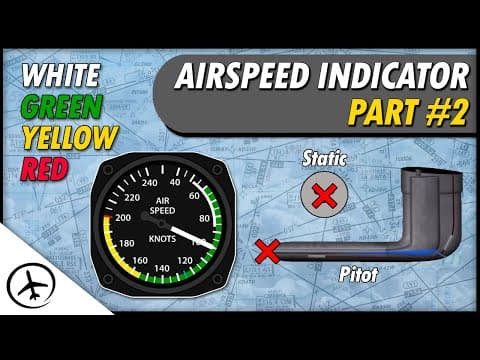
[0:05]Today, we will talk about the color coded markings of the airspeed indicator, as well as the pitot-static system blockages that may occur. Now, as we said in the previous video, the airspeed indicator topic is divided into two videos. In Part 1, we talked about its principle of operation, the errors and corrections that should be applied to it, as well as the different speed terms used in aviation. In this second part, we will focus on the different color markings of the indicator, as well as on how the instrument reacts in case of a pitot tube or static port blockage. So, with that being said, let's begin with the color-coded markings of the instrument. In light aircraft, with a maximum takeoff weight of less than 12,500 pounds, or 5700 kilograms, the airspeed indicator includes a series of colored arcs, which represent specific operating ranges and speed limitations. Specifically, the colors used are white, green, yellow and red. The color white represents the flap operating range. The green represents the normal operating range. The yellow corresponds to the caution range. And finally the red, denotes the never exceed speed. Let's see a little more in detail the different colored arcs. Starting with the white one. As we previously said, this arc represents the flap operating range, and therefore, it denotes the speed range in which the flaps can be operated without causing any structural overstress or damage. The speed at which the white arc starts is the VSO. This is the stall speed of the aircraft in landing configuration, which is normally determined under the following conditions. Maximum certified weight, flaps fully extended, and power idle. On the other hand, the speed at which the white arc ends is the VFE. This is the maximum speed with flaps extended. If the aircraft exceeds this speed with the flaps extended, it can cause structural overstress or even damage. So the pilot must always make sure that the air speed is kept within this arc when operating with flaps extended. However, there are some exceptions to this rule. Since many aircraft have different VFE speeds, depending on the flap setting being used. If that is the case, the white arc will end in the most restrictive VFE, and therefore some flaps settings may still be used above this arc. Let's go now to the green arc, which represents the normal operating range. This is the airspeed range in which the aircraft can be operated in a clean configuration under normal conditions. The term clean configuration means that the landing gear and the flaps are fully retracted. The speed at which the green arc starts is the VS1. This is the stall speed of the aircraft in a specific configuration. This configuration is determined by the manufacturer, and normally corresponds to. Maximum certified weight, flaps fully retracted, and power idle. Now, the speed at which the green arc ends is the VNO. This is the maximum normal operating speed, although it is also sometimes referred to as the maximum structural cruising speed. And as its name suggests, this is the maximum speed at which the aircraft would fly under normal conditions. Since if the aircraft flies above this speed, it will have more limited tolerances in terms of structural integrity. This means, in other words, that when flying above VNO, the pilot must exercise extra caution in order to keep within the structural limits of the aircraft. With this being said, let's continue now with the yellow arc, which represents the caution range. This is the speed range in which the aircraft should be operated only in smooth air and with caution, especially during maneuvers or when moving the flight controls. The reason for this is that the yellow arc starts right at VNO. And as we previously mentioned, beyond this speed, the structural tolerances are more restrictive. The speed at which the yellow arc ends is the VNE. This is the never exceed speed. If the aircraft flies above VNE, it can experience permanent structural damage, hence its name. Let's continue with the last one, the red line, which represents the never exceed speed. And as we said before, this is the maximum structural speed of the aircraft, and it must not be exceeded under any circumstances. As we can see, this is the only color represented by a line, rather than by an arc. Let's see a little summary of the different colored arcs and speeds. The white arc starts at VSO and ends at VFE. The green arc starts at VS1 and ends at VNO. The yellow arc starts at VNO and ends at VNE. And finally, the red line represents only the VNE. Up to this point, we have seen what does an indicator dial consists of, in a single engine aircraft. However, in twin engine aircraft, we will find two additional markings. The first is the blue radial line, which represents the VYSE. This is the best single-engine rate of climb, and is marked with a blue line as we can see in this example. This speed will allow the aircraft have the highest gain of altitude per unit of time, and therefore, is a very important speed to take into account in case of an engine failure, since in that situation, the performance is very limited. Now, something to note here is that the VYSE does not have a fixed value. It varies depending on conditions. So, the speed marked in the instrument with the blue line, corresponds to the actual VYSE, only under the following conditions. Sea level, standard conditions, maximum certified weight, and flaps retracted. If any of these conditions change, the VYSE will also change. So the pilot must take this into account when operating the aircraft in different scenarios. The other instrument marking that we will find in a twin engine aircraft is the red radial line, which represents the minimum control speed. This is identified as the VMCA, and it is the lowest speed at which the aircraft can maintain directional control, when the critical engine is inoperative. However, this speed does not have a fixed value either, since it varies depending on conditions. So the speed marked in the instrument with this red line, corresponds to the actual VMCA, only under the following conditions. Sea level, standard conditions, maximum certified weight, flaps and gear fully retracted, and maximum power in the operative engine. Again, if any of these conditions change, the VMCA will also change. With this we end the explanation about the colors and markings of the instrument. Let's now continue with the pitot-static system blockages. As we mentioned in the video about the pitot-static system, the pitot tube has two holes. A main intake in the front, and a drain hole at the rear. With this design, there are different types of blockages that may occur. Specifically there are three possible cases. A main intake blockage. A drain hole blockage. Or a blockage of both holes. In each one of these cases, the indicator will react in a different way. So let's see each one in detail. Starting with a main intake blockage. In this case, the dynamic pressure can no longer enter the tube. The residual dynamic pressure remaining in the tube escapes through the drain hole. Only static pressure remains inside the tube. This makes the airspeed reading drop to 0. But let's see why. Here we have the instrument operating normally, the static port connection provides static pressure to the instrument case, and the pitot tube provides total pressure to the diaphragm. Remember that the total pressure can be expressed in terms of a combination of dynamic and static pressure inside the diaphragm. And since the static pressure is equal inside and outside the diaphragm, the expansion or contraction of it, will depend only on dynamic pressure. Now, if there is a blockage in the main pitot intake, the following will happen. The dynamic pressure that was inside the diaphragm will escape through the drain hole of the pitot tube, leaving only static pressure inside. Then the diaphragm will contract, moving the needle to indicate zero. Let's now move on to the second case, here only the drain hole is blocked. In this case the total pressure continues to enter the tube through the main intake. So we could say that the airspeed reading will be relatively normal. However, one thing to keep in mind is that water can accumulate inside the tube, which may lead to large measurement errors over time. Now, let's look at the last case. Here we have both holes blocked. In this case air pressure no longer enters the tube. The pressure trapped inside the tube gives a false airspeed indication.
[9:34]Now, as long as the aircraft maintains altitude, the airspeed indicator will freeze, indicating the last speed measured before the blockage. On the other hand, if the aircraft climbs or descends, the airspeed indicator will act as if it were an altimeter. This is due to the change of static pressure with altitude.
[9:56]If the aircraft climbs, the airspeed reading will increase. And if the aircraft descends, the indication will decrease. Let's see what is happening inside the instrument. Here we have the system operating normally. The static port provides static pressure to the instrument case, while the pitot tube provides dynamic and static pressure to the diaphragm. Now, in the event of blockage of both pitot holes, the pressure inside the pitot lines will be trapped. This means that the dynamic and static pressure inside the diaphragm will remain constant. This is why the airspeed indication freezes if the aircraft maintains altitude. In this situation, if the aircraft descends, the static pressure provided by the static port will increase, since as we know, the atmospheric pressure increases as we descend. With this, we can now observe that the static pressure inside and outside the diaphragm is different. In this case, the higher static pressure outside the diaphragm will cause the diaphragm to contract, causing the instrument to indicate a lower speed. On the other hand, if the aircraft climbs, the opposite will happen. In this case the static pressure outside the diaphragm will reduce, causing it to expand, and therefore making the instrument indicate a higher airspeed as we can see in this example. This is why we say that in this type of blockage, the instrument will act as if it were an altimeter. Now, once a pitot blockage has been identified, the question is, how to solve it? Well, in most cases, this blockage has occurred due to ice, so it is convenient to activate the pitot heat in order to melt the accumulated ice. So far, we have already seen what happens when the pitot tube gets blocked. Let's see now how the instrument reacts to a static port blockage. In this case, as long as the aircraft maintains a constant altitude, the airspeed reading will not be affected. However, if the aircraft climbs or descends, the airspeed indicator will act contrary to an altimeter. So, in other words, we have exactly the opposite reaction to a pitot tube blockage. In this case, if the aircraft climbs, the airspeed reading will decrease, while if the aircraft descends, the reading will increase. Let's see why this happens more in detail. Here we have the airspeed indicator operating normally. Now suppose the static port gets blocked. In this case, the static pressure at the time of blockage will be trapped inside the instrument case, so in other words, the pressure outside the diaphragm will remain constant. Here, as long as the aircraft maintains altitude, the diaphragm will expand and contract normally depending on dynamic pressure changes. However, if the aircraft descends, the static pressure entering through the pitot tube will increase, while the static pressure trapped inside the instrument case remains constant. So in this case, the diaphragm will expand, making the instrument indicate a higher speed. The opposite happens if the aircraft climbs. Here, the static pressure entering through the pitot tube will decrease gradually, while the static pressure trapped inside the case remains constant. This causes the diaphragm to contract and therefore make the instrument indicate a lower speed. Now, once a static port blockage has been identified, the question is, how to solve it? Well, in most aircraft we can find an alternate static source, which allows static pressure to enter the system. Therefore, when suspecting a static port blockage, this alternate static source must be activated. However, there is something to keep in mind. It is that the static pressure provided by this alternate source is slightly different from the real one. So it is necessary to consult the correction tables for the airspeed indicator published in the aircraft manual, regarding the use of the alternate static source. This correction table considers the aircraft configuration and ventilation in order to show the corrected speed values. And it is important to make sure that the table being used is for the alternate static source, instead of the normal one. I hope the information presented in this video has been useful. If so, don't forget to share, like, subscribe, and leave a comment down below. Thanks for watching.


