[0:03]Hey, thank you so much for being here. I got to meet a couple of people last night that this is their fourth year being here, which is pretty wild. It's also my fourth year, which is exciting that we have that in common with one another. Um, but but the point of Finch Debcon was I felt like there was this big void in financial services where how payments worked, how lenders worked. Uh, how do you do C I C D with an OCAD and pull that off? in a complier. These are things that are individually like the differentiator that our companies and our brands are bringing a service to market. It's kind of like the the table stakes or the building blocks for us to serve this industry and this industry we get to serve is pretty incredible. You know money touches every single person in a very unique and personal way and the tools and the products that we get to build affect actual individuals. And so we're we're excited about that. Um, you know, what do I want from you as an attendee uh while you're here, I want you to connect with people. So what's unique about this conference is uh everyone's here to learn first and foremost and so the people around you are are looking to to connect and learn from one another. And there's just as much learning happening in in the, you know, having a beer with somebody or or a coffee as there is listening to the speakers. Uh, second, thank thank you to the speakers because uh, we had over 200 applications for 42 speaking spots. It's pretty amazing. These are over 200 people that are donating their time and energy in order to put a presentation together to to try and educate somebody. Uh, pretty amazing. So make sure you thank them. Um, by design, you can't see every single talk. Uh there's this new website YouTube. It's really cool and uh every single video from the last three years and and this year is on there. So please, you know, check those things out and make sure um, you know, subscribe. I feel like my kids right now subscribe and like to our YouTube channel. Um, but but make sure you give feedback to those people. And then, you know, my challenge to you is, I hope you leave here inspired. I hope you leave here thinking. Um, maybe I can make this industry better, maybe what I'm doing at at work uh can be more
[2:32]Um and and hopefully you come out of this thinking, oh, everybody here is is trying to figure out just like me. I I know I'm in that same boat and by having a community of individuals that we can learn from one another, you know, that's why we want to be here and and that's the ethos that we're trying to kind of instill in this conference is a unique place for you to come uh connect with people, get your education on and hopefully leave inspired. And so let's get started with being inspired. I'm really excited to to welcome our first keynote speaker, Simon Taylor. Uh Simon Taylor, uh owns Fintech brain food. Uh he's also the head of content and strategy at Sardine. Um interesting if you get his email on Saturday morning. Uh it's I think it's our brains that are getting beta's food, you know, trying to keep up with this guy. I have no clue how he writes all this stuff every single week and then does everything else he does. But I'm so excited to have uh partner in crime and friend Simon Taylor kick us off uh for this first keynote.
[3:41]Simon, welcome up. Thank you everybody for being here, for cutting off your breakfast and for being up this early to listen to a some guy with a British accent that you might never have heard of before. Uh I really appreciate you coming out. Uh my name is Simon Taylor. Um I do work at Sadin but I also run and I wanted to talk to you today about a recent experiment I ran. So I spoke to the CEOs of ramp, breaks and Mercury. Not the typical interviews, not the typical podcast.
[4:17]It was much more what can I learn from them as operators, as product managers, as founders, as engineers and the reason I write a weekly newsletter is I get fascinated when people tell me something and it just makes me curious. It nourishes my mind. That's why I called it brain food. I can't help myself. I'm addicted, I'm a nerd for this stuff. I want to describe the fact that people read my newsletter as suddenly waking up and discovering everybody was wildly into my obsession with dungeons and dragons as a kid, but it just happened to be about finance and tech. It's like really weird that people got into this stuff, but I love it and thank you so much for taking the time. So as I said, um I'm Simon, I write brain food and I do content things at Sadin and are really awesome.
[5:06]You should check them out. Uh right, so why did Ram, and Mercury show up in the first place. Hands up if you ever did expenses without Ram, or Mercury. Okay, so that's only like half of the room. So for the half of the room that's never done this. Well, for the half of you that had done expenses before, I'm sorry. You know But so many in this room don't know how much this sucks. Oh my god. If you've ever worked in it, the fact that you had to print out paper receipts, you were trying to fill in a spread sheet, you were trying to tap them into, have you seen that app? Look at it. Whoever allowed that to go out. SAP is a SAP, the company that builds Concorde is a 200 24 billion dollar market cap business. Now granted that's only one of their product lines but it is horrific enterprise software had been utterly horrific. And yet there are now a generation of enterprise scale companies that never used SAP Conker. You might have heard of a company called Dash. You might have heard of companies like Twitter. There are some really big I refuse to call X. There are some really big companies at scale out there that have never used these classic products that are really, really massive. So B2B Fintech fundamentally is serving an entire different generation of companies that they've grown up with that they were the default supplier for. And they're moving beyond oh this is a really nice this category gets called spend management. But they're moving beyond spend management and they're moving into everything enterprise ERP ever did but doing it with taste, with quality, with panache.
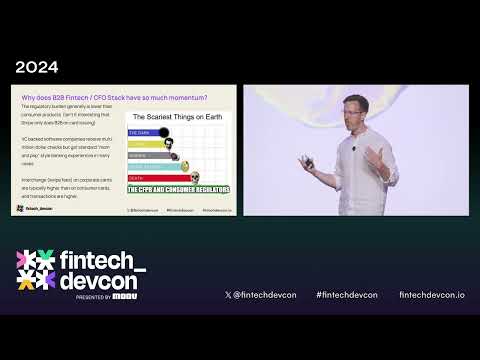
[7:06]And that's what I wanted to unpack in this talk today. So, why did they have so much momentum? Well, I think number one, the regulatory burden is generally much lower than consumer products. If I'm in B2B Fintech, I can just execute and I'm not worried about the CFB or consumer regulators or the OCCE coming to scare the living daylight out of me. And I don't know if you know but there's some stuff going on with regulators at the moment. So we'll come more to that lately. And historically like these growth companies, especially VC backed software companies would receive $10 million series A check but they'd get a checking account, a commercial banking account that looked like a mom and pop store would get.
[7:53]It it was just fundamental mismatch in requirement versus product. And of course then don't forget our good friend s on corporate cards are typically higher than consumer cards. So you put all of that together, my compliance burden is lower. I've got this massively underrated segment and also I make more money per swipe. Why wouldn't everybody do this? In fact, that's kind of exactly what the CEO of Ramp Ericman said to me when he was thinking about finding the company, he worked at capital one, he'd seen how hard consumer business was and he said, oh, I could just go there, I can win much easier.
[8:34]smart man. So meet the big three, Ram and Mercury. I spoke to the CEO of all and they started in a slightly different place. So Ram starts with spend management, Ram starts with spend management but where they've expanded is a little bit different. Ram has gone into, you know, your bill pay, your invoice, procurement and travel, is going more enterprise, it's going more procurement, treasury, accounts payable, but they kind of getting into the same place. The tech partner approach and I'll I'll double click on these later on is fundamentally different. this is what makes them really, really interesting. Ramp is like partner on everything that doesn't touch a customer. is how much can we vertically integrate? And you see that play out in their ideal customer profile and how they're expanding their business. And then Mercury sort of halfway between the two, but they started not with expenses but with this like operating account that just works. And then they're layer on the spend management. So they're all speed running towards the same sort of SAP plus bank account endpoint but they're doing it slightly different. And they all think that they're differentiator is different, their approach to shipping is different and that impacts their geo focus. I will go into more on all of these but I just wanted to give you that summary. So what's the same aside from the fact that they're all due Each founder has an appreciation for engineering. There are very few incumbents I can say that for.
[10:11]Possibly capital one. Richer Black is a different cap. But with that exception, I can't think of many that had a real deep appreciation for engineering or were engineers.
[10:24]They all consistently invest in technologies as their differentiator. They all, every single one of them told me how support tickets were driving their road map. Again, that is probably a default for a lot of folks in this room, but it's just really, really different from incumbents. That every one of the CEOs was obsessed with talking to customers and had a deep understanding of their tech and for what it's worth, I liked all of them for different reasons. They're they're quiteable, they were very very capable um at being human. which I clearly I'm not. Um so ramp is built They're a general company and when I spoke to Eric, he said something that really stuck with me.
[11:07]He described the company equation. What is the company equation? Well, uh, famously space X, if you've heard of that organization measures the dollars per kilogram in space. And then everything they do works back from that equation. So ramp similarly measures the number of hours they've saved their customers in work or effort. and they measure the dollars they've saved in cost. So today they save companies on average 5% of cost and thousands of hours. But here's the thing. In terms of their internal KPIs, they don't necessarily set just a pure revenue target because they're revenue is doing absolutely fine. What they're setting is targets around the inputs that create revenue and output. But more importantly, they're setting targets around the inputs that create hours saved and cost saved because that is their company equation and I was like, That level of clarity is incredibly difficult. Wade said something very kind to me yesterday, Simon, you're very good at simplifying things. I cannot turn a company into a company equation that elegant. That's E = MC squared level stuff. That is really, really hard to do and yet it creates this really interesting North star. So, another thing that drives them is velocity. Um, there are blitz scalers, there are people that take them more How many of you been to days.ram.com? If you've not check it out, it's just a live of the number of seconds and days that they've been in existence. It's it's a really interesting North star. They hold it up in the background on all of their company off sites. It's like it feels really passive aggressive and yet in every interaction with anybody from there. It doesn't feel like that weird like overly bro culture, overly aggressive culture. They found that balance in quite an interesting way. Um, it's there's a lot of companies that I meet that have that velocity shipping culture and I'm like I could never work there. This is I'm a dad, I got two kids, I got stuff to do like not with ramp. That was quite nice. But it creates an interesting problem though. If you ship so fast, it becomes very hard to ever describe what you do. So they they tend to just start with a small piece and kind of build from there. So by build our partner, so Eric listed a few of his partners but he noted you know stripe marketer and countless others in the interview but he said really what that allows him to do is obsession over the front end. Like he is not worried about the type of stuff that uh Wade really loves and I really love. He lets somebody else sort of deal with that because he's really focused on on the front end and he has to be able to trust his partners to do that and does occasionally change them over and he the questions he's constantly asking is, how could this be faster? How could this be more efficient? What else could we do? What if it worked with slack? Should it work with personal emails too? What what if, what if, what if, what if? And again, that could be kind of intense, but it's an interesting model and way of thinking about things. So I asked as well how he does the engineering structure and of course it it's not novel that somebody has an infrastructure team and product teams. Like that's a fairly well-known model. Um but what they're really doing is diversifying the two from the very Genesis of the company. I think a lot of people would like to go back into their tech stack and just start again. But the fact that they've got so many partners means that the partners handle a lot of the issue and then what the infrastructure team is doing is quite lightweight and really, really, really focused. So that is a model that works if your goal is to serve an end customer and your differentiator is user experience. It is an objectively smart strategy for them and what they're trying to do. Uh it's not the right answer for everybody. It's just a very interesting answer for them. And I think again having a CEO who thinks in terms of the company equation, it really does allow their KPI throughout the organization to maintain an interesting hold on it. So some observations. The obsession of a speed bump. I I made this slide originally because I I have like a whole side hustle of taking screenshots of ramp and showing it to bankers whose minds get blown of like oh my god. I didn't know that was possible and I'm like yes because you've never used the product. Um, so I once DM and mentioned oh you know that feature you've got uh you have the ability to forward receipts that come to somebody's personal email to ramp.com right but it doesn't work for me. I think it was like less than 20 minutes later I get a response. Oh, yeah, sorry about that your personal email is configured against the different business that's now that will work now. From the CEO of a company. Now granted I'm some British guy with a blog, maybe I got a faster response, but I don't think it's just that. That name another CEO that's true for. maybe Soop is has built different too. Um, but it's it's that kind of thing that I think actually has allowed them to differentiate. Another feature I like is this make recurring button. Uh, you might get a chat GPT subscription or something along those lines and if you don't want to fill in like a receipt every week, just hit that button. It goes away. Little details that are actually incredibly hard to execute as products underneath. The amount of work that will have gone into something like that is phenomenal and don't don't think for a second I don't know how hard this stuff is. So, it's delivering results. They're total purchase volume is doubling every every single year. It's kind of nuts. Um, I got this uh picture from um Packer not boring who does a great breakdown of them. They take 10 times more money home, uh they make 10 times more money than they did in March 2022. So that's what like 25, 26 months. Unbelievable. Ramp by name, Ramp by nature. It's it's ridiculous. So they they've got the right product, right time. They've really hit it right. They are a generational company and I think they'll do incredibly well. However, maybe it could go wrong. You know they are domestic only. And Eric even said there's there's just almost no incentive for them to go global or international. they're just no. So if ramp is stripe and I think of stripe is being like really great at the front end, opinionated at the back end, you know, you're not going to be able to configure it the way you want. And the other one it's like we'll take you global, um we'll work with big enterprises, we'll go everywhere you want to go. they've got more of a global coverage. Ramp is going to be stuck in the US. Not a bad place to be stuck, to be fair, but maybe somebody else like Brex could win a bigger opportunity elsewhere. What does Eric worry about most talent? Love it when somebody says that. He wants to he I asked him what do you worry about? He said, will this be the place everybody wants to work in in the age of shiny new AI toys and ridiculous VC funding for going to build an AI thing. What's interesting is how many company, how many people have left ramp to go founder thing that then comes back into the organization with that as a feature. It's almost like weird R&D cycle they've got. Um, and Eric's really, I like actually nice. Maybe I'm just naive, but like I actually like the guy. Um, so Brex Brex is led very much by an engineer with opinions. Um, but I I really, really liked Pedro. Um, it if you listen to this interview, the first couple of minutes he's talking about his conversion, um from Emax from Vim to Emax. He described running the business as being much more Apple like. He's the arbiter of the road map. There is a delivery once every three months. He signs off every single feature release himself and everything is built to those major releases. And you have to wonder why? Well, go back to the history of the organization when they were building breaks. A lot of the issue stuff and a lot of the banking as a service stuff uh strike issuing and all that didn't exist. It it it wasn't possible to do it. Look at when they were founded. They were just a little bit earlier and they were the best answer at the time. So they had a first move advantage but also is it a disadvantage. They were sort of the default for companies of that generation because all expenses sucked and Brex was the best game in from a user experience. Remember, founders of VC back companies had to get a credit card on a personal credit line. Even though they had 10 million signing in a bank, it was crazy. So Brex created this category, but no infrastructure existed, so they had to build it in house. They had to go vertically integrated and the vertical integration now was actually giving them this interesting strategic positioning. They might not win the velocity game, so why not go the other Why not building house? Bring processing in house. Partner more directly with banks and schemes. That enables you if you build it right to move into new markets faster like Dash, their live in 27 markets with their 16,000 staff because being like going national is hard, going international. The whole different level of hard. So where is going is is fundamentally different. They're going up market to these global growth enterprises with the core that they had. And that's not wrong, it's just not ramp. And that's really interesting because everybody positions ramp versus breaks and who's going to who's going to do it out. Doesn't matter. They can both win and one has this culture, the other has another. And they've done pretty well. Like they hit what 319 million in revenue in 2023. That's that's a lot of revenue. Um, and a big old increase, but a lot of this of course is driven by the 302% year on year growth of revenue from deposits. raising rates, lifts all Fintech. The banks have done really, really well. They're announcing some of their best dividends ever, but Fintech companies are also doing really well which people didn't expect, but also when if rates come down. I think we're we could still be in a very interesting place in a couple of years time if those rates do come down. So engineers on always the best designers, no events. Um, you know, but I I do think there are uh there's a risk of some of that customer churn. Um, there's not the big massive customers turning out of breaks but um, some have uh, some have gone to to ramp or to Mercury and elsewhere, especially the the smaller end. For really interesting to me how Brex have lived long enough to see themselves become the villain. Uh, you know, this the social media stuff has become a bit angy and I think marketing and PR could be could be kind of one of their interesting challenges. They're not the cool kid anymore and that means you're not winning the growth company. But if Brex is and they're trying to go international and they're trying to go enterprise, is a great business. It's not a bad place to be. Uh, and last last but not least, Mercury is led by the founder's founder. Immad is obsessed with user experience for founders. He's just fundamentally that way inclined. So, he's I think he's got 300 angel investments. He was an angel in air table stack, rap, and he said the worst thing about being a founder was dealing with the banking and admin headaches. And I can tell as somebody in the UK that doesn't have any of these products with a little side hustle business. Oh, it's terrific. So he just focused entirely on user experience with more than 50% of customers being referrals. And this is something you see with ramp. It's something you see with a lot of Neobanks that's not true. If you get the UX side of it right, the referrals reduce your cost of acquisition. And how can you get that referral flywheel really humming for you? It has to be really on the the shop window. And what's interesting about this is uh they all have different approaches to how they manage their technology stack, but they all initially got their wedge customer, their first customers from user experience. So if ramp is functional and zero friction, Mercury is focused on being just beautiful. Every button, every pixel, everything is is is agonized over in a way that is just. Uh the number one requested feature by Mercury customers was personal accounts. I think there's this general perception that user experiences like a nice to have and look and feel and and people really discount how much of a massive, massive differentiator it is. How much of a difference it makes to your business model, how much it drives customer acquisition. Customers love the product in a way you just don't hear about for anything else. People are like relieved by ramp. Oh, God, it worked. People love Mercury. They love it. Uh it's kind of a weird obsession thing actually. So they mostly partner, um you might have heard that they were an early mover, they partnered with a company called Naps. and evolve. Just going to leave that there, Jason is in the room. That's all I'm going to say. Just going to back away from that one. Today they've moved on.
[25:32]Today they use Lattice for issue of processing and multiple banks. That is what I learned from that conversation. Um, and they see themselves as the account becoming a platform to run hundreds of other business workflows from. I think ultimately all of these companies are becoming a bank plus SAP. They're becoming the ERP in the bank, they're going that way. That's really, really interesting. Here's another one. All of their UIs for their support teams, they built those in house. That's the only other company I can think of that's done that is Monzo. So they would go to API providers for infrastructure like fraud and compliance and customer service and then they build their own UIs over the top of it because they want their customer support agents to have great user experience. They're obsessed. And they've hit eight quarters of profit, they've more cash on their balance sheet than they've raised, they've 200,000 customers, 640 staff, but most of their revenue growth has come from deposits. So these businesses are having a great time. As all the consumer loans, but once that interest rates come down, then what? Then what? I think that's a really interesting question. So the bear case is, and probably felt like a good idea to an engineer that had never worked in Fintech before, like four or five years ago. Um, but maybe not so much and partner risk is non-trivial. Um, my vibe is like he's unbothered, he's, he's happy, he's in his lane, flourishing. But under the hood, like when I was trying to set up this conversation, you can tell there's like a, oh, you know, this is this is difficult and that partner risk is real. And so the problem with selecting partners is that partner risk can really impact you in a high value by segment. But most of their customers, remember we live in an echo chamber. Most of their customers have no idea this is happening. Most of their customers will never see any of that stuff. And so they're still growing, they're still doing absolutely fine. But again what happens when rates go down? Who's share what goes up will also come down. So will this category ultimately all of the things? Will everybody be B2B Fintech or is there actually some meaningful threat to them, some AI driven laser beam thing that's going to come and wipe these companies out. Competitors in my day school. the younger competitors may become a threat. One day you wake up and you're the old guy. Seriously, have you used PayPal lately? What is So that's always a risk. I think this is, you know, strikes risk and and risks from companies like move.
[28:38]Like that payments moves in generations and I think consumer and business brands will move in generations. The old ones don't die, they just erode market share, the younger ones come up and take the new market. So what happens if in banks get their act together? just going to leave that. The best thing in banks can do is partner. Um, and I think actually some have really started to do it. So I think Navan partnered with City, JP Morgan's partnered with Gusto. There's some smart partnerships going on there. And actually that's non-trivial because the threat then becomes sort of that partnership model can take meaningful market share and and and do a different thing. And serving enterprise is really, really, really hard. Once you get above sort of like serving that RC company, that the requirements, the procurement, everything get 10 times harder.
[29:40]I mean it's possible. It it's entirely possible that regulators kill um banking as a service and non-bank activity. I don't think they're going to actually kill it. I don't think this is an evidentiary threat. Uh these are dream clients for the banks and there are a lot of banks that are not in the headlines quietly moving forward with embedded finance. especially some of the larger ones. The things that you don't hear about are the you hear about the company's exiting, some of the some of the sponsor banks that are under consent orders and if they're under a consent order they can't win new business. But what you don't hear so much about is the hundreds of small banks trying to get into embedded finance and the very large ones waiting with open arms able to take their time, able to do their due diligence and cherry pick the best customers. So this will all continue to exist. It will all be absolutely fine. And these are dream clients. Like if I'm work in um cash management or the transaction banking division or the trade and working capital division of a big bank and Mercury ramp wants to bring all of their volume and all of their deposits to me. That sounds lovely. I'll have that. Thank you very much. So these brands will be absolutely fine. They might get a slap on the wrist from regulators, they might be fine, but there's a real like to quality taking place. So I think we should kind of ignore the noise. We need to get out of this bubble a little bit of like all of this stuff's happening because it is incredible how poorly some of the early programs were configured. from I was at dinner last night and people like this was always going to go wrong. But every generation has a bunch of people, you know, weights live through a couple of cycles of Fintech. I've I've seen a few myself Sam Mall was here with the dinosaurs. Uh, love you Sam. But it happens every generation. Technology person that doesn't know finance gets into it, figures out regulation is hard, gets better. That will happen here as well. There's now this really interesting crowd all of the people in this room who are engineers by default and Fintech by default that really get finance, really get compliance, really get rich. That's really, really exciting. I think all of these companies are going to be worth 10 plus billion in the post Fintech bubble world. In like Darwin has returned to tech valuations world. They're still massive enterprises. There's not an extensive threat to these businesses. Great companies succeed with regulation without regulation, they're great businesses. They're going to be absolutely fine and constraints happen. Talk to any founder of any business and there's like a hundred constraints every single day. So this is I think the take away for the audience. There is no right way to execute, there's no right way to engineer a product, there's just what works for the founder and the company they build. Every founder is built different, so every company is built different and they implant that DNA. Each has this mechanism to maintain visibility and alignment across the company. For Eric it's metrics, the company equation. What are my inputs? I can go he can go have a conversation with the sales team about like how many meetings were you able to book this week? Did you get enough support to book those meetings? Because he knows those are the inputs he needs to get them to create revenue. He can talk to product teams about how many speed bumps will we be able to solve? What are your constraints? How can I help you go faster? For Pedro, it's the road map. Are my clients talking about these things? Okay, can I deliver against these things? Are we running to a drum beat? He's like the metronome. He's much more that way. And for it's user experience, is it beautiful? Can I feel it? Can I touch it? They all have these these different signals. How many of you have worked in a bank? Okay, so about 30% of the room. You will probably resonate with how wildly different this all feels from how banks ship product. and that's a competitive advantage. Um only Immad mentioned a committee and that was for design. I think you can get your compliance right without just filling up the world with committees. I think these businesses will get there. We will need regulatory clarity for that, but it is widely different. And I think we can learn lessons on both sides. The financial institutions in the United States that are of a larger scale have to go slow, they have to come correct on compliance, but they could learn these execution less but they could also help really package the compliance stuff in in a way that's more thoughtful and more accessible to an engineering or a design audience. The fact that these companies are not banks is an advantage in the short term. It helps them deliver products faster but you've got to wonder how long it will be before they take meaningful market share from incumbents rather than just filling a hole left by SVP.