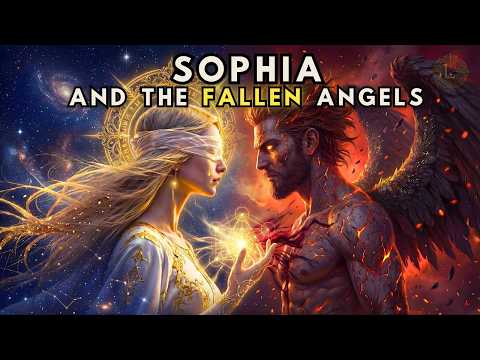
[0:07]There was a moment, and the oldest texts are precise about this, when the universe did not exist. The void did not exist, time did not exist, not even the concept of absence existed. There was only the Pleroma, the absolute fullness, the state of consciousness prior to any differentiation. The totality in which everything that is real dwells in perfect harmony, without boundaries, without name, without the need to be named. And within that fullness, at a point that Valentinian theology places at the outermost edge of divine being, an entity called Sophia, wisdom, wanted to create. It was not just any desire. It was the most intense passion a divine being can experience. The longing to emulate the very source, to generate existence in the same way the invisible Father did, without consort, without partnership, without the complementary balance that sustained everything that existed in the Pleroma. There was something in that impulse, that the gnostic texts do not judge simply. It is not described as wickedness, not presented as deliberate rebellion against an order that Sophia recognized and chose to violate. It is described as passion, as the desire of a consciousness that was too close to the edge not to feel what was on the other side and that leaped before understanding what that would mean.
[1:30]And she created. Alone without consort, without the permission that the system of the Pleroma demanded for any creation, to be perfect and stable. And what emerged was not what she had expected. What emerged was the Demiurge. I am Leandro, and this is the Liber Soul channel, where we map what has been deliberately buried. If this video reached you it was probably not by accident. That alone is enough to explain everything you have been through, the pain that had no identifiable cause. The suffering that corresponded to no specific guilt, the feeling, which certain people carry from childhood, that something is fundamentally wrong with the architecture of the place they ended up, and that this feeling is not neurosis or weakness, but a diagnosis. If you are here it is likely that feeling is not new to you, it is not weakness, it is recognition. Because what the gnostic tradition proposes, with a consistency that spans centuries of persecution and survived in spite of everything, is that the material world was not created by a divinity of boundless goodness. It was created by an imperfect consciousness that emerged from a cosmic error. A being that built the cosmos in the image of its own ignorance, convinced of being the totality of existence, without suspecting that there was something immeasurably greater beyond its horizons. And humans in this system are not the beloved children of a benevolent creator. They are the result of an accident that became more complicated than expected and richer, more paradoxical, more laden with possibility than any theology of obedience can articulate. But the fallen angels, the Watchers, the Grigori, the figures that the Book of Enoch describes with a detail that does not seem allegorical, what do they have to do with this? What connects the fall of Sophia in the Pleroma with the descent of these beings to the daughters of men. What links a primordial cosmological event to a rebellion of celestial entities that the entire Judeo-Christian tradition treats as separate stories, as distinct crises, occurring at scales of reality so different that no one ever asked whether they shared the same root.
[3:44]They are the same phenomenon, they are the same force acting at different scales, it is the pattern of attraction that Sophia's cosmic error created in the fabric of reality. A fracture that became irresistible to any being with sufficient autonomy and curiosity to approach what lay on the other side. A vortex that was created not by intention, but by consequence. One that was planned by no one, yet functions with the precision of something that was. What the Roman Church destroyed with an efficiency that still today prevents most people from even knowing these texts existed was not a collection of speculation by philosophical losers. It was a map. A map that explained the origin of humanity, in a way that made every hierarchical religious authority completely superfluous. Because if humans carry within themselves a spark of Sophia herself, a fragment of the Pleroma that the Demiurge inadvertently imprisoned in matter, without understanding what it had captured, then no intermediary is necessary. No priest, no institution, knowledge is internal. Divinity is internal. And the path back to the source passes through no earthly authority. That is what was destroyed, and what survived, in the coptic manuscripts discovered in Upper Egypt in 1945, buried in a clay jar with a consistency that suggests deliberate preservation by someone who knew destruction was coming and chose to save rather than burn. Is sufficient to reconstruct the argument with a depth that should disturb anyone who has arrived here with any assumption about what humans are and where they came from. The Gospel of Philip, one of the Nag Hammadi texts, says something the official canon would never have allowed to circulate. The truth did not come into the world naked, but came in types and images. The world will not receive the truth in any other way. The Gospel of Thomas in saying 50, provides the instruction for when entities from the intermediate realms approach the soul in transit, when they ask where you came from, say that you came from the light. When they ask who you are, say that you are a child of the living light. They are passwords, operational instructions for a passage that these texts treat as real and imminent, not as an edifying metaphor for Sunday use. The kind of instruction you give someone about to enter dangerous territory, who needs to know how to respond when approached. The detail is deliberate. There is no vague poetry here. There is a protocol. What Sophia did in the Pleroma and what the Watchers did on the slopes of Mount Hermon, are not stories about moral disobedience. They are descriptions of how attraction to the forbidden operates at scales ranging from the cosmic to the human, and of how that attraction created, by accident and by cascading consequence, the being you are now. With all that implies about your nature, about what you carry without knowing it, about what was deliberately suppressed so that you would not remember where you really came from. There is something disturbing about the precision with which the early church identified exactly which texts needed to disappear. Not the texts of vague speculation, not the abstract philosophical disputes about the nature of the Trinity or the humanity of Christ. The texts that described the mechanism, the texts that provided the map of origin with enough technical detail to be usable, to be traversed, to guide a consciousness that was trying to understand, not just what to believe, but what to do with what it believed. Those were the ones that needed to be destroyed. And the urgency with which they were persecuted is, in itself, an argument that requires no further proof.


