[3:39]The roar in the roaring twenties was the birth scream of the modern. America was now about to leave behind the formative experience of its rural past and embrace the promise of an urban future. But progress would have its price. A sudden wrenching departure from the certainties of the traditional and the familiar, spread by an emerging mass media, movies and the radio. Things that seem old and familiar now were just beginning to take shape in the 1920s.
[4:16]At the dawn of the 1920s, America was clearly entering a new era. An era defined by a vast and complicated urban culture that would dominate the rest of the 20th century. After World War I, there was an eagerness to embrace the new, and it was in America's cities, most dramatically in its biggest, New York, where the modern age was born. The very architecture of the city spoke of America's new ascendancy and her aspirations.
[4:57]These skyscrapers was uh an example of the new form achieving a kind of thrilling scale and nobility. More people worked there than lived in the average small town in America. A movement to the cities that had started during World War I accelerated. In 1920 for the first time more Americans lived in urban centers than in country towns and villages. Their pace has been set in the cities. The city is irresistibly attractive, is really at a kind of high tide in this decade. It's a force, a magnet.
[5:51]The very names of New York streets would become synonymous with progress and innovation. Broadway would represent the best and latest in American entertainment. Madison Avenue would come to stand for the bustling new business of advertising, which was uniting the nation in a set of shared fantasies and desires. And Wall Street came to represent the decade's expanding economic opportunities.
[6:35]Wall Street was where the action was. People came from everywhere to get in on it. The reason I come to New York was, there was nobody there after they closed the mines in 1926, in Pennsylvania. There was no money coming there. And this fella Jerry got me the first job. And he said, come on down the Wall Street, the streets are paved with gold. It seemed that way too on Park and Fifth Avenues where the tycoons lived. The number of millionaires in the 1920s jumped 400% over the previous decade. The 20s feeling of limitless horizons was fueled by their lavish lifestyle. Our family had a house at 934 5th Avenue when I was growing up. We had a, uh, a place in Tuxedo Park and a house in New York, and then we used to come to Southampton in the summer. Everybody seemed to be having a good time.
[7:44]In those days, you had lots of help. You had a cook, you had a kitchen maid, and you had a laundress, and then you had a parlor maid, a chambermaid, and Mother's maid. How many does that make? Six, but I think there were eight actually. Terribly nice people. Almost everybody had a boat. I recall in the 20s, uh, you would, uh, see a harbor filled with yachts, I mean, really filled, almost gunnel to gunnel, and we didn't refer to yachts as such unless there were 100 feet or over.
[8:31]There was a great deal of entertaining, and it was all done in people's houses, seated in a party of 50, 60 people. Always after dinner there would be entertainment by by guests.
[10:12]And the Cotton Club broadcast from the Cotton Club where Broadway, Hollywood, and Paris rubbed elbows. People came from all over the United States to experience what was going on in Harlem in the 20s. Now I was young then, of course, and we went up to Harlem at night to dance and everything. We all saved up for months to get the money to go out to a to a nightclub. Of course, the music was wonderful.
[10:54]And Harlem was contributing more than music to America's new urban culture. The world above New York's 125th Street was in the 1920s a hotbed of political, social, and cultural activity. It was later called the Harlem Renaissance. The Harlem Renaissance was one of those fancy terms that white folks invent when they want to take a particular look at some aspect of, uh, black folks. I don't think black folks run around saying, but we're gonna have us a renaissance or something like that, but it was the holiday of the spirit. In Harlem was born this idea of the new Negro, someone who stood up for the Negro, who advertised his and her contributions to American culture, who was proud to be black. Harlem was the end of the line, the Promised Land, the place where all our fantasies came true. If I had to choose between heaven and Harlem, oh, oh, oh, Harlem, of course, would win every time.
[12:07]While Harlem seemed a Promised Land for black Americans, New York's Lower East Side was for European immigrants their gateway to the American Dream.
[12:21]We were blessed because we were in America. My father came from the Ukraine. He went to work in New York City and worked in a factory where they blocked hats, men's hats. And he was making, you know, like nine or ten dollars a week, working a six-day week. And he would tell me how he was able to buy lunch every day for 12 cents. And the lunch consisted of a herring, a big schmaltz herring out of the barrel, and my mouth waters now to think of it, and a big roll with poppy seeds, and an onion, and life was beautiful.
[13:12]This was perhaps the most mixed city racially, ethnically, um, in the country. But cities all around the country had become more important because change was centered in the cities. Business, industry, culture.
[13:36]Nothing was like being in New York. Just the magic of everything. The world full of things to be explored.
[13:49]That time was one of my feeling of adventure and your life is having a shape to it. Sort of a thrill, like a narrative or story, my feeling that anything my young could,. The decade's startling changes would soon spread from America's cities to envelop the entire nation.
[14:38]In the early 1920s this was a quiet, easy life. Neighbors would come over, what we call the front porch visit. And that's where there would be discussion, maybe a little gossip. Throughout the 1920s new technologies would transform daily life. At the beginning of the decade most Americans lived without electricity. When night fell only candles and lamps held off the darkness.
[15:17]America was electrified in the 20s. Electric lights extended the day, opened up new possibilities for work and play. That surge of new power came first to the cities. And by the decade's end the majority of American homes had electricity.
[15:45]You can't understand this century without understanding the effect, the impact of science and technology. My father's generation is the one that really saw amazing changes. He was born in 1900 in a world where the horse was still the main means of getting about.
[16:13]The car seemed to me, uh, more revolutionary in a way than anything that's happened since. Totally changed the kind of space we live in really. The car would give Americans a sense of autonomy and freedom. The freedom to escape their city or town, to go away on a vacation, or simply on a day's outing. By mid-decade the government was spending more than 1 billion dollars on the construction of highways, bridges and tunnels. The beginnings of a national infrastructure which knit the country together. My father took my mother and me in a car for the first ride through the Holland Tunnel. This was opening night. All the cars were lined up to go through the tunnel. I was petrified. I cringed. Suppose the water leaks in? How did they build the tunnel under the water? Where's the water? And I imagined, as we were driving through the tunnel, that I heard the waves overhead.
[17:34]Out on the so-called highways of those days, outside of New York, we saw the billboards.
[17:49]They were big and colorful, and beautiful, right, for me. Advertising helped transform not just the physical landscape but the cultural one. Along with advertising came the expansion of a brand new consumer concept, credit. The old inhibition against debt came tumbling down, as everything from cars to clothes could be bought on time. Buy now, pay later became the order of the day. By 1927, 75% of all household goods were bought on credit. And in the last years of the decade the item desired most was the radio.
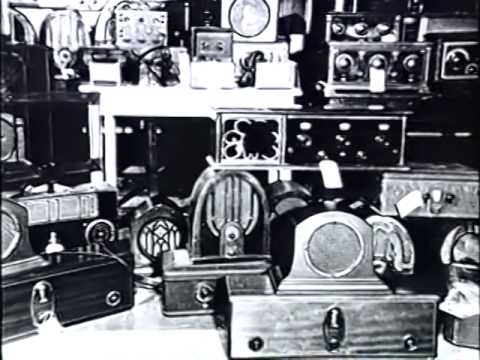
[18:37]From its scratchy beginnings in 1920 as a mere hobby, radio would become a nationwide phenomenon as important as the car. Young radio enthusiast Albert Sindlinger was there at the birth of modern radio. In 1920 the night station KDKA broadcasting from a factory rooftop in Pittsburgh transmitted the results of the presidential election. One of the gentlemen was reading the election returns. He got sick, so for about 45, 35 or 45 minutes I read election returns. Nobody had any comprehension of the significance of what was going on. But don't forget there are only a couple hundred listeners. Within six months every store in America, even grocery stores, were selling radio sets. Suddenly, all Americans were listening to the same things, laughing at the same jokes. It was a kind of communal exercise here and very much a strengthening of your notion of what it was to be an American. Along with and sometimes propelled by the great technological leap in the 1920s social patterns in place for decades also began to shift. Nowhere was this more obvious than with the changes for American women. An expanding job market had given more and more women careers and the disposable income to do with what they wished. Throughout the 1920s, women would assert a new found freedom and independence. And nothing symbolized it more than the 19th Amendment. In 1920, after 81 years of agitation, women won the right to vote.
[20:32]A woman's lot had changed in almost every way. She thought that she had the right to live for herself, rather than for her family, for others as women were always supposed to. She went to bars, she went to after hours club, she went to wild parties. She had much shorter hair, she wore much more make-up. You go from having young women whose dresses reached to their ankles, to flesh, flesh everywhere. And a lot of 20s culture is about the fun of smashing prohibitions.
[21:20]The more daring women of the day were known as flappers and vamps. Sure I remember flappers, they're all over the place. I mean they were older than me, but uh, you know, you look at, when you look at the flappers with the eyes of the, of a young guy, whoa, whoa.
[21:40]I think a flapper was the type of, of young woman who just wanted to see how far she could go and then would stop because she'd be afraid to go too far. And a vamp didn't care how far she went.
[22:03]The shattering ways of 1920s city life were spread by the media to rural America. Places where the changes were not always so easy to get used to.
[22:18]Smoking and drinking and being loose with talk, using profanity, this sifted down from the cities, from New York and Chicago. And this finally had an unwarranted place in our little community. Here was a girl, she'd come home from, she'd been working in Chicago. She'd comes home with short dresses on. Well, they were not wearing short dresses. They were going to church with hats on and white gloves on.
[22:56]They were decidedly concerned about what future generations are gonna bring.
[26:01]At times it seemed that the whole world had converged on Dayton. The houses were filled, and the walls were lined with newspaper people. From England, from Spain, from France. We had so many newspaper people there that that you couldn't stir them with a stick. When all the hoopla ended, John T. Scopes was found guilty and fined 100 dollars. A ruling later overturned on a technicality. What Scopes represented and what the world came to witness was a colossal clash of ideals. The cool reason of science seemed to threaten the deep and abiding roots of religion. It was one thing to replace the family mule with a Model T, but quite another to trade Matthew, Mark, and John for Einstein, Freud, and Darwin. For many people, these were confusing times. And what may have been the most unsettling about the pace of change in the 1920s was that people really wanted both the benefits of the future and the familiar comforts of the past.


