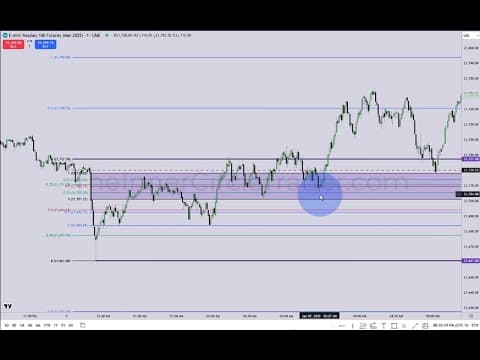
[0:00]The topic tonight is going to deal with the Midnight opening range. So I'm going to share with you one of my secret weapons tonight, okay? Uh, it works obviously in Forex and it works in futures. And I'm going to showcase tonight something that I've never shown anyone because it's never been my interest to share some of my, you know, best kept secrets. When I coded this algorithm, I wanted to have advantages in being able to implement daily highs, daily lows, know where the lay of the land's going to be, and then as a boundary marker for the daily range high and low, then I could operate in the meat in between very easily. Be able to have a an opportunity to just delve into the plethora of opportunities and setups that would be between those boundary points. So, I want you to think about how I taught the opening range in the morning session. That's being specifically aimed around the 9:30 to 10:00 in the morning 30 minute interval. So that segment of time, that is the algorithmic opening range. So, pull up your sleeves, grab a writing utensil and get ready to take some cool notes. This concept here that starts it all off, okay? So this is the Midnight opening range. So at midnight we have this beginning reference point. So that's the beginning, and this is the end at 12:30. So now all you have to do is find where is the opening candle at midnight, right here. That candle, the low and the high. There's three reference points there that are very, very crucial to me as a trader. So that's the midnight opening price for power three. Power three is your daily range candlestick formation. This high is the midnight opening range, high, and this is the low of the midnight opening range, okay? So in this drop here, from the high down to the low of the midnight opening range. I want to look for inefficiencies, order blocks, breakers. That is your first reference point. largest degree of displacement takes place.Notice that? Now, sure, we had a CB over here, but this one right here, much more pronounced, okay? Much, much more prominent.It, it really jumps off the chart. So now we have this extended through and now this displacement, the algorithm will refer back to that. It'll go right back into that range and how will it use it? Well, we have gradient levels here, the lower quadrant, consequent encroachment, which is the midpoint of the range high and low that creates this single sell side and balance, buy side and inefficiency and the upper quadrant level here. Now, by having this information, we can go forward and use things like fibs that give you mathematically derived projections to where the daily highs and the daily lows will form. So if you take the high here of that opening range at midnight, we can get projections that will take us above these relative equal highs. How high can it go?How high can it go if it's going to sweep above this level here? And how low can it go when it starts to break lower, should it do so? And we apply the fib both directions. So here's negative 0.5. negative one, and then we have the standard deviations that are projected lower. Now, what is that measuring?Like what is it that you're actually getting from that? You're getting the range low of the midnight opening range, if the market trades above it, then it can go one half of one standard deviation, or one standard deviation. So think like measured move. How hard and fast it goes to that degree of premium or discount is relative to an economic calendar event during London, okay? So this is all helping you trade London session. That's that's what it's really based around. This is a very easy brass tax approach to finding the one or two levels that generally, not all the time, but generally, will deliver what you're going to be looking for for a daily high or a daily low. We have relative equal highs over here. So this one here is enough to do that.It trades up into it there. But for right now, I want you to look at what we have in London, okay? We have the standard deviation based on this inefficiency. If we take the the range from low to high, that's this low here to that high, half a standard deviation, one standard deviation. If we use the inefficiency, we can do the same thing there where we can take those levels and now we'll plot them from low of the inefficiency to the high. So this inefficiency here, if we use that same idea of standard deviations from that, we can also get very, very precise elements to how the algorithm will rebook and redeliver to premium and discount. Even inside of that midnight opening range.What do I mean by that? Well, this is first presented displacement, okay? The displacement in and of itself is a PDF array. Remember, we already had an inefficiency offered here, here, okay? So it's not that it's, you know, sell side and balance in in of itself. It's a very large one, and it's occurring inside of the midnight opening range. So it jumps off the chart.It's the first presented displacement.Notice that? So, what happens when I add these same levels that are here? What if I add that to this inefficiency on the upside? You get the 50 or half of it. That's this level here.Look what the bodies are doing.You see that? Look at all this.The close of that candle, the open of that candle, all this consolidation around there. Look at the bodies here, here, and it moves away from it. And then we have the negative one stair deviation here. What is it doing?It's creating this delivery of that high. Look at the bodies working around that and all the consolidation around here. And it runs away from it there. Now, what happens when you use this same idea and we add it to the rejection below this inefficiency. You start from the high down to the low. negative 0.5. You can see how we're working this level here, and then finally at negative one standard deviation. We see it here, here, here, and then rallies and starts working inside of that displacement in and of itself. So we can see there's boundaries that can be created with this.So the markets are absolutely not random. Watch what happens when we trade outside the band of this range. Notice we're we're probing below it here, but it's only going one standard deviation of this inefficiency with that low right there. Look at it.It's controlled. It's only allowing one standard deviation outside of this when it went lower. I'm not interested in seeing it go below that low because I don't think it's going to do it because this inefficiency told me that this one standard deviation down here is is about as far as it'll go once it trades to my target three. So once we get back inside of this inefficiency that's in purple, then I can start looking at the quadrants, the consequent encroachment, and then the high and the low of the actual inefficiency. So you can see the low of the inefficiency here.Again, that's this candlestick's high. It's supporting it here, rallies up to upper quadrant, trades back down. It trades this outside of it here, but then goes right back into the middle and starts consolidating around the consequent crutchment or the midpoint of that purple area. Then the market trades one more time lower and now it's allowing price to go outside the range of this inefficiency because it's it's enticing. It's luring traders to go short and it's probing for liquidity below this low and anything that's around here. they'll probe at and try to see if they can get that. But they got a short-term low here, they worked below that, and then rallied back up inside of that purple shaded area, which is the first displacement in the midnight opening range. The market rallies back up, trades through the high of the opening range at midnight here, then back down to consequent encroachment. So we go to the low of that inefficiency again here.What time of day is that? It's 2:41.That's London open. So we're looking at this rallying higher.We took this period of uh short-term highs here that buy side was taken here. And then where does it go right back down into that first displacement in the opening range at midnight. creates a short-term low, it trades below it again and goes right to the lower quadrant. Look at that.You can't get any planer than precision. So the market does what?What is it going to do here?Delivers on 3:30 macro. I tell you very specifically, at 3:30, that's your sweet spot. So at 3:30 the market starts to run away from lower quadrant of the first displacement in the midnight opening range. The market rallies aggressively up to some random projected level, negative 0.5, and then creates a retracement, makes a higher high, fails to take that high and then we trade back down into the first displacement again. Stops dead in it to high at 5:00.Now London session is done, okay? What's going to take place now? We focus on the day session. Now what we'll do is we'll we'll scrub over to the 9:30 session here. And notice how we traded up in the electronic trading hours right ahead of the New York opening bell at 9:30. See how the price trades up here? Look at this.That's that negative one standard deviation on the midnight opening range. See how that delivered that? And then you have this nice turtle soup rally up, and then breaks down. You see that? Now, inside of this area here, okay? I want to refer back to a reference point that's found in regular trading hours. And I want you to look at this little area right here.
[12:15]You see that?So right here, that's the opening price here, and the difference between where we settled previous day at regular trading hours. You see that?Boom, boom, those two reference points there. So now watch, if I highlight that volume imbalance.
[12:39]Now, because I have this here, I can go back to electronic trading hours.Having this regular trading hours reference point, the volume and balance. And extending it forward, and we're going into the 9:30 opening here. The market takes a dive. Trades look where the bodies are.You see that?That's that midnight opening range. See how it did that?See how it's re respecting that? And the market does what?It rallies right back up into that same area and then look where the body stopped in my volume and balance. My reference point that I say, you can go no further, you stop right here. And the market breaks down once more. And it does something that I've taught in 2024, inversion fair value gaps. And if we look at that, a volume and balance right there. The idea is we've already made a run and created the high, and then it bumped it here at 9:30. The high of the day is getting raided, then it trades lower. Everybody wants to dog pile on and go short, then they send it right back up to that imbalance, that volume imbalance. And then we have this move lower. And this is an inversion fair value gap. So once we trade through it, coming right back up into the bottom of it, look at the bodies.Is the body respecting the halfway point? Yes, stopping dead in its tracks.Boom, lower she goes. And here once we traded down into consequent encroachment of the midnight opening range. It's the 30 minute interval between midnight and 12:30 Eastern time. We went to consequent encroachment, trade back up to the high. Look what price it's touching. That's midnight opening price.Power three. So we can say that right here, that's the high of the day, this candlestick. The open is here, and one more time to pass back up into a premium. We break lower, inversion, fair value gap.Michael gets short, rides all the way down, slices through the midnight opening range. And look what it does.It leaves it aggressively.It's no longer interested in coming back to to test it as a resistance or premium array. That's what it's indicating.The market's extremely heavy. So look for lower prices. Take a look at the forex pair, and here's pound dollar or cable. We're going to look at the midnight. So we have midnight candle right there. And then we're going to do the same thing with 12:30.So that's that's your range, okay? And what you're doing is you're getting three reference points there. You can add the fourth one being the highest high and the lowest low and uh the opening price. But we're looking at this candlestick here. Since it's a down close candle, that means the open of that body is your midnight opening price. So there's your midnight opening price for power three. Then we're going to look at the low in between these two vertical lines.What's the lowest low?Right here. All right.So we have opening price, low, and the high. So now with this range here, what can we do? Well, we can grade it from low to high. Okay?And it'll allow us to do what? We can see price runs and more specifically, inside this range, we're going to highlight that. And then now, we can do things like, uh, run standard deviations off of this where there's one standard deviation.
[16:32]Then we can do uh the displacements like this is the first one here. So that's your first displacement higher, leaving this consolidation here. So you can take that and project that into the day as well. kind of like treat it like it's the first presented fair value gap. Notice it's also encapsulating the the opening price at midnight. You see that? So there's a couple things there that are agreeing and also this is consequent encroachment of this entire range at the midnight opening range. So there's a couple things that are converging in their confluence in this little small little uh range of price action. You can see how we have the market reaching higher. And then it dives back down into negative 0.5 here. Look at the bodies here. And then look what it creates right there. Relative equal lows. You see that?That right there is a trap. They're just letting that look like it's just real good support. And then they rally higher up. And the market rolls away from that and then drops right down into, oh oh, what's this time? 3:29. In forex, I taught you the sweet spot for London session is exactly 3:30. And that's when the algorithm comes in, fires off. And what's it doing?Oh, it's this randomly trading down into that first presented fair value gap inside of the midnight opening range. And then takes off. No, it rallies, trades right back down into the midnight opening range, and then sends price higher. And then works off of the negative 0.5 level and the negative one level. And it rips through, tears the face off of traders that are short here. Way up here. So you can see that there's a benefit, obviously, to having this information and knowing the time, okay? Listen to me, the time that the trades should form and deliver. So anyway, the market trades lower, and what does it do here? Comes all the way back down into this area here. Look at this, look at the bodies respecting that. It's almost like it's been told behave this way. And then it rips outside of it, which is normal.It's in it's introducing the idea that, okay, it's going to keep going lower, and then it doesn't. It comes right back into the range, works the upper quadrant level, and then look at the bodies. Look at that, lower quadrant level, rips higher, comes right back to the opening range at midnight. Look at that, isn't that beautiful? If it's going to come back down here and go higher, what's the easiest low hanging fruit objective if you're a forex trader? And you want to trade that at 8:00 in the morning during the New York open kill zone. Here's buy side. It's easy.Trade from here to there.Booked, done, done and dusted. There's so many setups here.So many things that you can build off of. But the main thing is this, are you looking for the moves that really like to launch and take off, and rip the faces off of traders that don't know any better? That's what I'm teaching you. That's exactly what I'm showing you right here. Daddy's pulled back the veil and showed you who's really informed. Because the price is always delivered by time based delivery mechanism. That is the algorithm. The market does, in fact, trade up here and takes that buy side out. Consolidates all time distortion, and then we have the market drop down here. What's coming at 10:00? Well, if you look at the economic calendar, we had the ISM PMI number and we had the Jolt's number at 10:00 a.m. Eastern time. Then that's what we're seeing here.The market dives down, and then at 10:00, it does what?It wicks through up to this CB here, which is also a breaker. High, low, higher high.There's your breaker.It trade right into that, hammered it. Just a wick outside because the wicks are allowed to do the damage. And then the market breaks aggressively lower, and it's almost like it was telling it way in advance at midnight that it wants to do these types of things. And it's normal for you to see all these things and say, man, this is really complicated. But I want you to think about how we're finding the framework with this information, the opening range gap. But that's your first beginning point. The framework that you use around the opening range gaps is derived by the midnight opening range. That's the 12:00 to 12:30 Eastern time. Before you even wake up to trade the New York session, you should have at least referred back to that that area of price action. And carry forward that information like you're seeing right here. Every significant price run.I promise you, every significant price run that's worth its measure in terms of significance. The move that every trader wants to be a part of. That's where my PDD rates shine.They just they fared out all those types of moves. There's nothing close to what you're learning from me. That's how deep this goes. That's how much precision and time based oriented price delivery. Just like that, all scripted, all coded, all codified. I have students all the time.Can you show me London?Can you do something with London?We you keep promising London, London, London. I just gave you the golden ticket to trade in the London session. You don't ever need to have me talk about the London session ever again.


