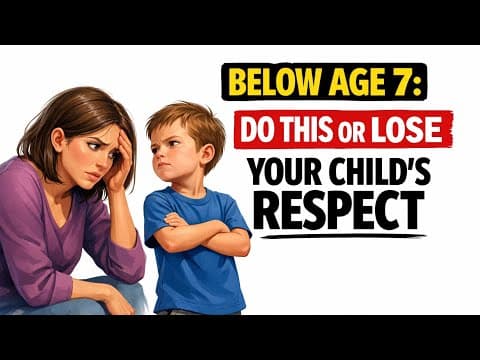
[0:00]a child who stops respecting your voice will eventually stop listening to your values and the painful part most parents don't notice when it begins. it doesn't start when your child becomes a teenager. it doesn't start when they begin to argue. it starts in the quiet moments when you give an instruction and they look at you and delay. When you speak and they test your seriousness, when your words slowly lose power right in front of you. And here is the truth many parents are not told. By age seven, your child has already formed a deep decision about you. Is this a voice I must respect or a voice I can negotiate with? If you get this wrong early, you will spend the next 10 years trying to fix what should have been built in the first seven. But if you get it right, you raise a child who listens without shouting. Respects without fear, follows guidance even when you are not there. So today, let's go deep, not surface advice, not recycled parenting tips, but the real psychological foundations of respect and exactly what to do before age seven. Part one, what respect really means to a child. Respect is not fear. Let's correct that first. A child who fears you may obey you in your presence, but will disobey you in your absence. True respect is different. It is when a child believes this person is consistent. This person means what they say. Following them is safe for me. Respect is built on trust plus structure, plus emotional safety, and here's the science. Between ages 0 to 7, a child's brain operates mostly in a subconscious absorption mode, they are not analyzing you logically. They are recording patterns, how you react, how you enforce, how you respond under pressure. So even when you think they are too young to understand, they are already deciding. Is this a leader or just someone who talks? Part two, the silent ways parents lose respect. Let me show you something deeply important. Parents don't lose respect in big moments. They lose it in small repeated patterns. One, empty instructions. You say, stop that. Nothing happens. You repeat it again and again. Your child learns, I don't need to respond the first time. Two, emotional parenting. Today you shout, tomorrow you ignore. Next day, you laugh it off. Your child becomes confused. There is no stable system here. And where there is no system, there is no respect. Three, negotiating authority. You give an instruction. Then you start explaining, pleading, convincing. Without realizing it, you shift from leader, negotiator. And children do not respect negotiators. They test them. Four, delayed consequences. The child misbehaves now, you correct later. The brain of a child under seven cannot connect delayed correction, so they learn nothing really happens. Five, over talking. Too many words reduce authority. The more you talk, the less weight your words carry. Part three, the psychology of respect before age seven. To build respect, your child must feel three things consistently. One, this parent is predictable. Children relax under predictable authority. When your response is consistent, your child stops testing you. Not because they are afraid, but because they understand the system. Two, this parent is emotionally stable. Children do not respect emotional instability. If your child can trigger your anger anytime, they subconsciously feel, I am more powerful than my parent. And once that happens, respect begins to collapse. This parent follows through this. This is the follows through. This is the foundation, not love, not shouting, follow through. When your words always match your actions, your voice gains power. Part four, the seven practical things to do before age seven. Now, let's move into deep actionable strategies. One, give fewer instructions, but enforce every one. Don't give 20 instructions you won't enforce. Give fewer but make each one count. If you say, put that down, make sure it happens. Two, use the first time rule. Train your child gently but firmly. Instructions are to be followed the first time, not second, not third. You may guide them physically if needed, but never normalize repetition. Three, replace shouting with presence. Instead of shouting across the room, walk to the child, get to their level, maintain eye contact, then speak calmly. This increases authority instantly. Four, make consequences immediate and simple examples. Misuse toy, toy removed, refusal, activity paused, disrespect, interaction stops briefly. No long speeches, just action. Five, model the behavior you expect. If you want respect, show respect. Speak calmly, keep your word, stay disciplined. Children copy what you do, not what you say. Six, create structure in daily life. Structure builds respect naturally. Simple routines like wake up time, clean up time, quiet time. This teaches the child life has order and they learn to function within it. Seven, stay calm under pressure. Most important, this is where most parents fail. Your child cries, screams, resists, and you react emotionally. But the parent who stays calm sends a powerful message. I am in control of myself and the environment. That is the root of respect.
[6:06]Let me tell you a simple story. A mother once said, my child only listens when I shout. But here's the truth, the child did not learn to listen. The child learned, only respond when the parent loses control. So the child waits, pushes boundaries until shouting comes. And that becomes the system. But another parent never shouted, never repeated instructions endlessly. Spoke calmly, acted immediately, stayed consistent, and the child learned something different. I should listen the first time. Same child psychology, different parenting pattern, different outcome. Part six, what happens if you ignore this? If this is not built before age seven, you may start seeing constant negotiation, selective listening, emotional power struggles, disrespect masked as strong personality. And by teenage years it becomes harder to correct. Because now you are not just correcting behavior, you are trying to rebuild lost authority. Seven, what happens if you get it right? But if you do this early, everything changes. Your child will respond faster, argue less, trust your leadership, carry your values internally. And the best part, you won't need to control them. Because they have learned to control themselves. Respect is not something you demand from a child. It is something you build into their experience of you. Before age seven, your child is not just learning words. They are learning. Does this voice guide my life or do I challenge it? And every day through your consistency, through your calmness, through your follow through, you are answering that question. If this message challenged you, good, because great parenting is not about comfort. It is about awareness. Subscribe for more deep practical parenting insights, because the earlier you build it right, the easier everything becomes.


![Thumbnail for 2016 서울패션위크에서 YG모델 이호정을 만나다! [oh Hot] - KoonTV by 최군TV funny](/_next/image?url=https%3A%2F%2Fimg.youtube.com%2Fvi%2FSqHgAly3Ajc%2Fhqdefault.jpg&w=3840&q=75)