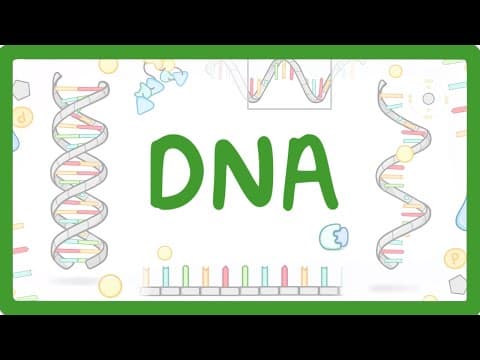
[0:05]Today's video is all about DNA. So we're going to run through the structure of DNA with a focus on nucleotides and complementary base pairing. And at the end, we're going to briefly go through how a gene can code for a protein.
[0:24]The first thing to understand about DNA is that it is made from two strands that are wrapped around each other in this twisting shape that we call a double helix. To understand the rest of the structure though, let's take just one of these strands and then show it as a 2D diagram as though it's been untwisted and laid out flat. So we're now looking at this section here of the original strand. Now, hopefully, you can see that DNA is actually a polymer because it's made up of lots of these tiny little units called monomers. With DNA, we call each monomer a nucleotide, and if we look at the nucleotide in more detail, we can see each one is actually made up of three different parts. At the top, we've got a phosphate, which is connected to a sugar, and then on the side, we have a base. Importantly, every nucleotide has exactly the same phosphate and sugar. But when it comes to the bases, there are four different types, namely A, T, C, or G, which stand for adenine, thymine, cytosine, and guanine. And this means that there are effectively four different nucleotides in DNA, one type for each of the four different bases. If you take a look at these two nucleotides here, we can see how they'd combine together to form a polymer. Basically, the phosphate of one nucleotide bonds to the sugar of the next nucleotide, and this process then keeps repeating for thousands of nucleotides so that the sugars and phosphates form one long chain, which we call a sugar-phosphate backbone. And if we look back at our full DNA molecule over on the left, the sugar-phosphate backbone is this outside part. So it's effectively forming a protective outer casing around those bases in the middle. If we look back at our single long chain, though, you can see that all the bases stick out to the side. And these are what hold the two strands in the double helix together. If we line up a second strand of DNA facing the opposite way, you can see how the bases could pair up and hold the two strands together. Importantly, though, only complementary bases can pair to each other. So A always has to pair with T, and C always has to pair with G. We call this concept complementary base pairing, and it allows us to figure out what the complementary sequence of a strand will be. For example, if we have a strand of DNA that reads A, G, T, G, C, T, T, A, C, then we can use this sequence to work out what the sequence of bases on the complementary strand must be. Because we know that A always pairs to T and G always pairs to C. So we know that the first base on our complementary strand must be a T because that's complementary to the A. Then the second base must be a C because that's complementary to G, then the third must be an A, then C, then G, and so on.
[4:13]As a last point, whenever you hear the term genetic code, it's the sequence of bases that they're talking about. And a gene is just a particular sequence of bases that codes for a particular protein. To do this, each group of three bases is called a triplet and codes for a specific amino acid. For example, A G T would code for one amino acid, while G C T might code for a different one, and T A C would code for a third.
[4:52]To understand how this helps us code for a protein, let's take a longer sequence of bases and work through the steps for how it would form a protein. First, ourselves would read this DNA base sequence as a series of triplet codes, which remember are three bases each. Then it would take the amino acids that each triplet codes for, and combine them all in that same order. Then lastly, this long chain of amino acids that we formed will fold up all by itself and form a protein.
[5:33]Now, the important thing about proteins is that because each type is made from a different sequence of amino acids, each type will have a unique shape, which allows it to carry out a particular function. So within each of our cells, we have loads of different proteins that carry out loads of different things. The main uses of proteins though are in enzymes, which act as biological catalysts to speed up the rate of chemical reactions, hormones, which carry messages around the body, and structural proteins, which add strength to our cells and tissues.
[6:17]Anyways, that's everything for this video. So, hope that made some sense and helped. And we'll see you again soon.


