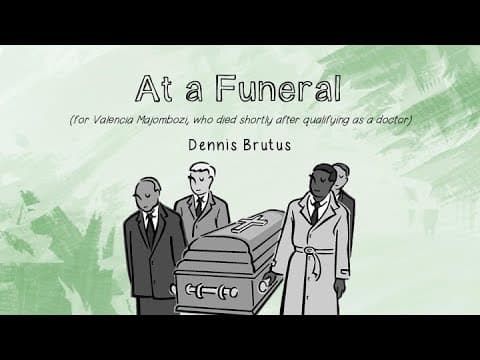
[0:02]Hello everyone. The following presentation is a poem titled At a Funeral, with the subtitle For Valencia Majombozi, who died shortly after qualifying as a doctor.
[0:17]Written by Dennis Brutus, this poem forms part of the new Grade 12 English Home Language Poetry curriculum for 2023 and the next few years to come.
[0:30]Here is a bit of background information to Dennis Brutus. You won't ever be examined on this, but it is good to know in order to place his poem in context.
[0:41]Brutus was born in Zimbabwe in 1924, but he moved to South Africa when he was four years old.
[0:49]He graduated from the University of Fort Hare and taught at various high schools in South Africa after 1948, which was when the apartheid regime began, but he was dismissed for his vocal criticism of apartheid.
[1:05]He was the co-founder of the South African Non-Racial Olympic Committee, which was an organization that was influential in the banning of South Africa from the Olympic Games.
[1:18]In 1961, he was banned from South Africa for his political activities.
[1:24]After years spent overseas, he was eventually unbanned by the South African government in 1990, when he returned to South Africa.
[1:34]He passed away from cancer in December 2009 in Cape Town.
[1:43]Let us take a look at a short summary of the poem.
[1:47]The poem is a tribute to Valencia Majombozi, a black South African woman who managed to qualify as a doctor after much hardship and sacrifice during the apartheid era.
[2:00]She died during an anti-pass law protest.
[2:06]This poem is about her funeral ceremony and what it symbolizes.
[2:12]Brutus presents the funeral as an occasion to rekindle his commitment to the struggle for freedom.
[2:19]He urges active resistance, and he ultimately concludes that death is a better fate than yielding or surrendering to the apartheid government.
[2:33]Let us read through the poem.
[2:37]Black, green and gold at sunset: pageantry and stubbled graves: expectant, of eternity, in bride's-white, nun's-white veils the nurses gush their bounty of red-wine cloaks, frothing the bugled dirging slopes.
[2:54]Salute! Then ponder all this hollow panoply for one whose gifts the mud devours, with our hopes.
[3:03]Oh all you frustrate ones, powers tombed in dirt, aborted, not by Death but carrion books of birth.
[3:12]Arise! The brassy shout of Freedom stirs our earth; not death but death's-head tyranny scythes our ground and plots our narrow cells of pain defeat and dearth: better that we should die, than that we should lie down
[3:33]The first two lines read, Black, green and gold at sunset: pageantry and stubbled graves: expectant, of eternity.
[3:43]Consider the words black, green and gold.
[3:49]These colors can be interpreted in two ways.
[3:52]Firstly, black, green and gold make reference to the resistance movement flag.
[3:57]In other words, the colors of the ANC flag are black, green and gold.
[4:02]The ANC was banned in 1961, so these words can symbolize an act of defiance and resistance.
[4:11]The second interpretation is that these colors could also refer to the academic gowns, caps and hoods worn by many of the mourners.
[4:24]Perhaps those academics who Majombozi knew from university.
[4:27]The black could represent the academic gowns, the gold an arts degree, and the green a science degree.
[4:37]This funeral is described as taking place at sunset.
[4:42]But figuratively, this could mean the end of a day, which is symbolic of the end of a life.
[4:49]The image of a funeral at sunset, along with its figurative meaning of death, creates a somber mood, and it establishes connotations of darkness and sadness.
[5:01]The speaker describes this funeral as pageantry.
[5:06]A pageant is a ceremony of splendid and rich display.
[5:10]However, it is all just for show.
[5:15]Think of a beauty pageant. It is all just a display of beautiful women, but nothing much else.
[5:23]This funeral, in the view of the speaker, is merely just for show.
[5:28]It does not make up for all the hopes and dreams that are lost with this young woman's death.
[5:35]To the speaker, all that this funeral is is pageantry and stubbed graves.
[5:43]Perhaps this could be a reference to the short-looking tombstones all around the graveyard, or even short grass around each of the gravestones.
[5:57]Symbolically, this could refer to how short this young woman's life was.
[6:00]These graves are described as expectant of eternity.
[6:05]We have personification here. The graves have been given the human quality of being able to expect or wait to hold more bodies for eternity.
[6:19]In lines three and four, we have a description of the nurses present at the funeral.
[6:25]Nurses from the hospital who knew Majombozi are present at her funeral, wearing their uniforms, which consisted of a white dress, a short white veil on their heads, and a red cloak around their shoulders.
[6:43]The color of the nurses' veils are described as bride's-white.
[6:46]The nurses being referred to as brides could symbolize the ideas of love and virtue.
[6:54]The nurses' veils are also described as nun's-white.
[7:00]The veil a nurse wears is called a wimple. The nurses' veils or wimples are symbols of holiness and purity.
[7:10]The nurses at this funeral are said to gush their bounty.
[7:13]To gush means to flow out quickly.
[7:18]The word bounty means something in abundance.
[7:22]In other words, the nurses are expressing their absolute grief for Majombozi's death.
[7:31]The color of the nurses' cloaks are compared to the color of red wine.
[7:36]These nurses around the graveyard in their red and white uniforms are said to look like bubbles of red wine rising and overflowing or frothing across the slopes or the hills where this funeral is taking place.
[8:14]A bugle is a type of brass musical instrument, almost like a small trumpet.
[8:20]The person playing this musical instrument at the funeral is playing dirges, which are sad, mournful songs.
[8:31]In these first four lines, the images of the massive crowd, its colorful appearance, and the movement and the sound of the people are created.
[8:43]This is definitely a large funeral.
[8:48]Line five begins with the single exclamation, salute!
[8:52]This single exclamation brings the movement and the sounds of the funeral to a still moment of respect and honor for the deceased woman.
[9:02]Once the moment of honor and respect has occurred, the speaker then instructs the reader to ponder all this hollow panoply.
[9:12]The word ponder means to think about or consider something.
[9:17]The word hollow means meaningless.
[9:21]Panoply means a splendid display or spectacle.
[9:27]In other words, the speaker is instructing the reader to reflect on this meaningless and worthless display that is Majombozi's funeral.
[9:37]This is by no means disrespectful.
[9:40]It is simply a shame that behind all of the fancy aspects of this funeral, a life of potential and opportunity has been lost at the hands of the apartheid government.
[9:53]Line six instructs the reader to ponder about the one, referring to Valencia Majombozi, whose gifts or talents as a doctor, and her ability to heal people, that the mud devours.
[10:09]We have personification here.
[10:12]The earth or the mud in which her grave has been dug is given the human quality of eating hungrily or devouring.
[10:21]The mud of the graveyard is compared to a hungry mouth.
[10:25]The personification emphasizes that all her talents and the hope of her people are now buried in the earth.
[10:36]The speaker addresses all you frustrate ones in line seven.
[10:41]These are all those who are opposed and who would want to frustrate something.
[10:47]To frustrate something means to thwart or prevent the success of something happening.
[10:53]In this case, the speaker addresses all those who want to prevent the success of the apartheid regime.
[11:01]The speaker describes the oppressed as having their powers tombed in dirt.
[11:06]Black people's powers, meaning their opportunities, talents and freedom, during the apartheid era are figuratively buried with the deceased woman.
[11:18]In other words, those who are oppressed by the apartheid government are politically dead.
[11:25]The oppressed have been aborted, their lives terminated before they are born, not by death himself, but rather by carrion books of birth.
[11:37]The word carrion refers to decaying flesh.
[11:40]Vultures are birds that feed on carrion.
[11:45]We could say metaphorically that the apartheid government is the vulture or carrion bird that rips at the flesh of those oppressed.
[11:55]The apartheid government does this through its issuing of carrion books of birth.
[12:01]These books refer to the passbooks issued to all black people during the apartheid era.
[12:07]It can be said that the life of a black person ends before he or she can even live his or her life.
[12:15]From the moment of birth, he or she is issued with a passbook.
[12:21]As I have mentioned before, this means that black people are figuratively dead because their freedom and opportunities are taken away due to passbooks and the oppression from the apartheid government.
[12:38]Line nine begins with another single exclamation arise!
[12:43]Here the speaker calls on all people of color to rise against the oppression.
[12:49]The speaker describes this exclamation as a brassy shout of freedom that stirs our earth.
[12:57]The word brassy can be interpreted in two ways.
[13:01]Firstly, this could be a reference back to the bugle mentioned in line four.
[13:07]Here the music from the bugle would not send the politically dead to their rest, but rather it would awaken them to action.
[13:17]Secondly, the word brassy can also mean bold or loud.
[13:23]The shout of freedom that stirs our earth could be a result of an uprising that will turn the abortion lives into a new birth.
[13:34]Note that like death in line eight, freedom is also capitalized.
[13:40]Here freedom is given the human quality of being able to shout.
[13:47]In line 10, it is not death but death's-head tyranny that scythes our ground.
[13:53]In other words, death itself is not destroying South Africa and its people.
[13:59]Rather, it is death's-head tyranny.
[14:03]The poet compares the apartheid government to the death-head wearing Nazis in World War II.
[14:11]The death-head symbol is typically depicted as a skull and crossbones.
[14:17]The word scythes could mean to cut with a scythe, which is a tool used for cutting crops or grass.
[14:24]Scythes also means to move through something rapidly and forcefully.
[14:30]Our ground refers to land.
[14:34]Perhaps in the context of apartheid, this could make reference to the Group Areas Act.
[14:40]The pronoun our could suggest the land of South Africa belonging to everyone.
[14:47]In simple terms, line 10 basically states that death does not cause destruction and death across South Africa, but rather it is the apartheid government that causes this death and destruction.
[15:04]The death-head tyranny that scythes our ground, in other words, the apartheid government, in line 11 also plots our narrow cells of pain, defeat and dearth.
[15:16]The word plots could have two meanings.
[15:20]The first meaning is to plan something. The second meaning refers to small pieces of land.
[15:27]Consider the repetition of the pronoun our.
[15:30]The land of South Africa that should be free to everyone is reduced to the ownership of narrow cells.
[15:39]These narrow cells are described as being of pain, defeat and dearth.
[15:43]This could be a reference to the graves in a graveyard, the prison cells, or perhaps even the small houses in poor areas in which people of color had been forced to live, as a result of the Group Areas Act.
[15:59]The word dearth means a scarcity or a lack of something.
[16:03]This could be a lack of basic human rights, freedom of movement, and basic needs to survive.
[16:13]Line 12 is the last line in this poem.
[16:16]The poem ends with a significant statement in which the speaker states, better that we should die, than that we should lie down.
[16:26]Remember that this poem was a response to the death of Valencia Majombozi.
[16:30]She died during an anti-pass law protest.
[16:35]The poet suggests in this line that it is better that she and many others die fighting for freedom and equal rights, rather than to lie down and surrender and accept the apartheid system.
[16:50]Note the pronoun we. This refers to the collective of those people who are against the apartheid system.
[16:59]This includes the poet himself.
[17:03]It is interesting to note that the poem does not end with a full stop.
[17:07]We can interpret this with the idea that there is no surrender to the apartheid regime and that resistance towards it has no end.
[17:20]In this poem, the themes of criticism of oppression, resistance and frustrated hopes are evident.
[17:28]The overall tone, which is the speaker's feelings towards the subject matter at hand, is of anger, dismay, frustration, and disappointment.
[17:41]Thank you for watching this presentation on Dennis Brutus's poem At a Funeral.
[17:47]My goal is to upload more Grade 12 poetry from the new set of poems, so please subscribe to my YouTube channel and give my Instagram and TikTok accounts a follow for more English content.


