[0:00]Welcome back to lecture two from chapter two. This of course, from the textbook Foundations of Earth Science, the eighth edition, written by Lutgens and Tarbuck.
[0:11]Chapter two, rocks, the materials of the solid Earth. So we learned about minerals, the different properties of minerals, and how we can identify minerals, the silicate minerals, the non-silicate minerals.
[0:23]Now we want to talk about what minerals make up, and minerals make up rocks, your igneous rocks born of fire, your sedimentary rocks born of weathered material.
[0:32]Other rocks, and of course your metamorphic rocks, which are essentially baked rocks from other types of rocks, and so that talks about the rock cycle as well.
[0:41]How these rocks form, the type of rocks that form in different environments, and that is going to be chapter two taking us into our study of Earth science.
[0:50]One of the underlying themes of Earth science is that Earth is a system. It's not just hydrology or the atmosphere or the geosphere or even planetary science.
[1:05]It is all of those systems working together and within each of those systems there are systems and cycles. And one of the primary cycles, of course, we study in Earth science is going to be the rock cycle.
[1:14]And that describes the interactions between components of the Earth's system, um the origins of igneous, sedimentary and metamorphic rocks and then how they are connected.
[1:24]How igneous can become sedimentary, how sedimentary can become metamorphic, how any of them can be melted and turned back into igneous and then once again sedimentary through weathering.
[1:38]It's a cycle that rocks move through, and it's continuous. Now it may it may take millions of years, but it is continuous and has been since the formation of Earth.
[1:43]Any any rock can be transformed into any other type of rock under the right conditions. The cycle is a circular thing, really no beginning or end.
[1:55]But just from the uh the point of academics, we'll give it a starting point, and that starting point's going to be magma. Magma is liquid rock, melted rock.
[2:03]Now it's called magma when it's under the Earth surface. Once it comes out on the Earth's surface, whether it's under the on the sea floor or on land, we call it lava.
[2:12]But starts as magma, and magma forms from melting in the Earth's crust and upper mantle. So in the crust and in the upper mantle, the melting of rock creates magma.
[2:24]Less dense magma will rise toward the surface. Magma then has those lighter elements and then more dense magma will fall toward the Earth's center or move toward the Earth's surface.
[2:37]Once of course magma gets to the Earth's surface, it erupts as lava, as I said, or it will cool within the crust, meaning magma that pushes up toward the crust, toward the surface of the Earth, or even the sea floor, will either break through the surface or break through the sea floor and erupt as lava, or it will cool within the crust.
[2:57]And it really makes a big difference in the type of rock that you have, depending on where what happens. Cooling of magma, cooling of liquid rock into solid rock, is known as crystallization.
[3:06]Those minerals that make up the rocks crystallize. They make form perfect crystals, they may form tiny crystals you can't see, they may form big crystals you can't see.
[3:16]Really depends on where they cool, how quickly they cool, but cooling is called crystallization. And of course, igneous rocks crystallize from magma within the crust, or lava at the Earth surface or again, on the sea floor, is also the Earth surface.
[3:32]Igneous rocks exposed at Earth's surface undergo weathering. The atmosphere decomposes rocks. There's lots of mechanical ways in which um rocks are broken up into smaller material.
[3:46]And perhaps sometimes it it dissolves uh in water. Loose material that it's uh the the result of weathering, loose material is called sediment.
[3:56]Sediment is transported by gravity, running water, glaciers, wind, waves, etc. Most sediment ultimately reaches the ocean, but some is deposited in other environments, lakes, swamps, um even reservoirs.
[4:11]Um but generally it moves toward the ocean. Once that sediment is deposited, it undergoes lithification, which is simply conversion into rock by either compaction or cementation, and sometimes it's a little bit of both.
[4:26]Compacting sediment until it becomes solid or cementation, just the cementing of loose sediment grains into solid rock. Now that rock, that sedimentary rock or the igneous rock that we started with that was that came from lava or from magma, either of those two rocks,
[4:41]if they are deformed or changed by heat and pressure, if and when they're buried deeply into the Earth, or they're part of the building of a mountain change, a chain, that is, a mountain chain, heat and pressure can change rock.
[4:57]Literally bake it in some cases or pressurize it. And those types of rocks, because there's change, undergo a metamorphism, and they're metamorphic rock. And then eventually, if you have enough heat, all rock will once again melt and generate more magma.
[5:12]So that's a general conversation about the rock cycle and this is the way it looks, and this is the type of illustration you may have seen since the fifth grade, but essentially you have igneous rock at the top, whether it's extrusive on the surface or the seafloor, or intrusive under the surface.
[5:31]Igneous rock that is weathered and turns into sedimentary rock, and sedimentary rock that is is then beaten or pressurized in mountain building and turns into metamorphic rock.
[5:40]But igneous rock can also be buried and pressurized and turned into metamorphic rock, and igneous rock can also be melted close to the mantle and turned into new igneous rock, and of course sedimentary rock can be melted and turned into igneous.
[5:55]Sedimentary rock can be turned into metamorphic. They can all be interchanged and moved from one place to the next. So rocks are not stable, unchanging masses over geologic time.
[6:01]The mountains we see, the rock outcrops that we see, they are not static, they change. That change may happen over millions of years, but they do change. The different stages of the rock cycle are occurring today just like they were occurring tens of, hundreds of and even thousands of million years ago.
[6:23]Like new igneous rocks are forming in Colorado, in Hawaii that is. In the uh the basaltic lava flows of Hawaii, Colorado Rockies are currently eroding and those and that erosion, that sediment's being moved to the Gulf of Mexico where it's being deposited.
[6:39]So eventually new sedimentary rocks are formed. So the rock cycle is ongoing and is occurring today. Rocks, as we've already said, do not always go directly from igneous to sedimentary to metamorphic.
[6:51]Um igneous rocks may remain deeply buried and then become metamorphosed or metamorphosed. So igneous can become metamorphic. Sedimentary and metamorphic rocks may be uplifted and eroded and turned into new sedimentary rocks.
[7:05]It it's all sort of an intertwined process, but the rock cycle is driven by internal processes and external processes. It's driven by the Earth's internal heat and the external processes of weathering erosion which are driven by the external processes of sunlight and gravity.
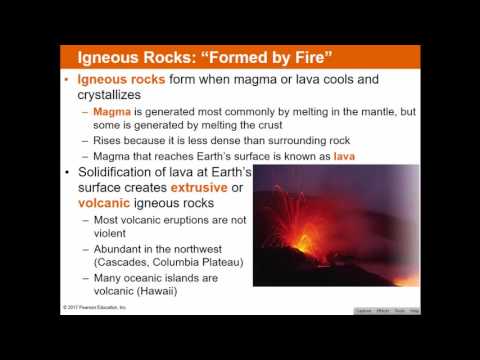
[7:24]Let's start by talking about igneous rocks. Rocks formed by fire. Igneous rocks form when magma or lava cools and crystallizes. Magma is generated most commonly by melting in the mantle, but some is generated by melting the crust.
[7:44]It rises because it heats up and expands like all substances heat up and expand, and it rises because it's less dense than its surrounding rock. Magma that reaches the Earth's surface, again, that's known as lava.
[7:58]Solidification of lava at the Earth's surface creates extrusive or volcanic igneous rocks. Most volcanic eruptions actually aren't violent.
[8:14]Um you have a lots and lots of um volcanic eruptions in the ocean, whether they're under the sea floor or at the surface, they're very mellow. Um and those are basaltic eruptions.
[8:31]Then you have the volcanoes of the Cascades and the Columbia Plateau. All very mild eruptions. Some eruptions, however, as we all know, are quite violent. Different types of magma create different types of volcanic eruptions.
[8:43]Most magma actually never gets to the surface. Most magma actually solidifies beneath the surface as intrusive inside the Earth's surface or plutonic igneous rocks.
[8:56]So you have extrusive and volcanic, that's on the surface, and then intrusive or plutonic, within the Earth. Um and then those rocks are then only ever exposed at the surface if they're uplifted or overlying material is eroded away.
[9:12]Lots of examples of that, Stone Mountain, Half Dome in Yosemite Park, Mount Rushmore, Mount Washington, all examples of granitic rock. Intrusive plutonic rock that cooled underground that was then exposed to the surface.
[9:27]So magma contains elements or ions including silicon and oxygen, gas, water vapor, confined by pressure, and some solid crystals. Crystallization occurs as mobile ions arrange into orderly patterns during cooling.
[10:20]As cooling continues, more ions are added to the crystals until all of the liquid becomes a solid mass of interlocking crystals. The rate of cooling strongly influences crystal size.
[10:50]Slow cooling results in fewer, larger crystals. Quick cooling results in a large number of small crystals. Instantaneous cooling quenching results in randomly distributed atoms, no crystal growth, and formation of volcanic glass.
[11:33]Volcanic ash is actually tiny shards of glass. Crystallization is also influenced by magma composition and dissolved gas. Igneous rocks are mainly composed of silicate minerals.
[12:16]Silicon and oxygen, aluminum, calcium, sodium, potassium, magnesium, and iron make up 98% of most magmas. Also includes small amounts of trace elements, titanium, manganese, gold, silver, uranium, etc.
[12:55]During crystallization, these elements combine to form two major groups of silicate minerals. Dark silicates are rich in iron and or magnesium and relatively low in silica.
[13:54]Light silicates contain greater amounts of potassium, sodium and calcium and are richer in silica. Igneous rocks can be divided into broad groups according to proportions of light and dark minerals.
[16:58]On the sliding scale for igneous rocks, rocks formed by fire, melted magma, solidified and crystallized as igneous rocks, whether intrusive or extrusive, whether crystallized underground or at the surface, goes from felsic to mafic and even all the way over to ultramafic.
[17:19]So felsic rocks are those rocks with a great deal of silica. They are igneous rocks of granitic composition. A lot of granite and they are made up almost entirely of these light-colored silicates.
[17:36]You got your quartz, your potassium feldspars. Felsic, the word comes from feldspar and silica. Most contain about 10% dark silicate minerals like biotite mica and amphibole.
[17:52]But they are as much as 70% silica. And they are a major constituent of crustal rock, and that 70% silica means they have very complex chains and structures of the silicon tetrahedron in the magma.
[18:07]And that means that gases cannot escape very easily, and it subsequently means that volcanic explosions of felsic rocks are very violent. Conversely, basaltic or mafic rocks,
[18:22]they contain at least 45% dark silicate minerals and calcium-rich plagioclase but no quartz. They get their name from magnesium and ferrum, iron, ferrous Fe. Um and they are darker and they're more dense, they're heavier than granitic rocks, because the iron content.
[18:41]They also have less silica. And because they have less silica, there's much simpler chains of silica in the magma, which means gases can escape more easily, and the eruptions tend to be much, much milder when you're talking about the basaltic rocks.
[18:57]Andesitic is somewhere in between, right? Falls between granitic and basaltic. A mixture of both light and dark colored minerals. Contain at least 25% dark silicate minerals.
[19:05]Amphibole and plagioclase feldspar. Associated with volcanic activity at continental margins. Ultramafic rocks contain mostly dark-colored minerals, olivine and pyroxene.
[19:35]For example, peridotite and dunite. Rare at Earth's surface. Main constituent of upper mantle. What can igneous textures tell us?
[20:14]The texture of a rock is described based on the size, shape, and arrangement of mineral grains. Texture can be used to make inferences about a rock's origin.
[20:25]For example, large crystals indicate slow cooling. Slow cooling is common in magma chambers deep in the crust. A rock with large crystals probably formed deep in the crust.
[20:35]Fine-grained texture cooled rapidly at the surface or in small masses in the upper crust. Individual crystals are too small to see with the naked eye. Coarse-grained texture solidified at depth while insulated by surrounding rock.
[20:50]Masses of interlocking crystals roughly the same size, large enough to be seen by the naked eye. Porphyritic texture. Different minerals crystallize under different temperature and pressure conditions. One mineral can reach a large size before other minerals start to form.
[21:07]Large crystals phenocrysts in a matrix of smaller crystals ground mass. Vesicular texture. Exhibits voids left by gas bubbles that remained when lava solidified. Form in upper zone of a lava flow. What can igneous textures tell us?
[21:36]So, uh that's the porphyritic there at the top with the ground mass and the phenocryst. You got the really small uh crystals in the ground mass, something that probably cooled much more quickly, and the phenocryst, larger crystals, probably cooled more slowly at depth.
[21:52]And then there's your your pumice or your uh your vesicular texture. So you've got some lava at the surface where gas where it's solidified before gas bubbles are actually able to escape. You get all those holes like Swiss cheese.
[22:06]And and those are the types of rocks that tend to be very, very low density. Some even float. Glassy texture develops when rocks cool rapidly.
[22:18]Ions freeze in place before they can arrange themselves in an orderly crystalline structure. So there's no crystals, therefore there's no mineral. So the glassy, whether it's uh the uh volcanic glass or whether it's uh even tuff or or volcanic ash, it's not a mineral.
[22:34]It's it's a rock, clearly, but it's it's a volcanic glass. And then the pyroclastic, fragmental texture. Composed of individual rock fragments ejected during explosive volcanic eruption. Um you know, you could have angular blocks within the rock pulled out the side of the the vent.
[22:50]You can have small fine grain, you can have molten blobs, or larger pieces. So that's pyroclastic. It comes from the actual explosion, the actual eruption, and it's pieces of different rock stuck together. So glassy texture. What drives metamorphism?
[23:03]Unordered atoms and resembles dark manufactured glass. Before metamorphism, confining pressure increases. Rocks deform by decreasing in volume. During mountain building, rocks subjected to differential stress are shortened in the direction of maximum stress and lengthened in the direction of minimum stress. Undeformed strata and deformed strata.
[23:20]Porphyritic texture. Composed of two distinctly different crystal sizes. Ground mass and phenocryst. Mineral grains that are large enough to be identified without a microscope. Coarse-grained. Fine-grained. Crystals that are too small for the individual mineral to be identified without a microscope.
[23:42]Vesicular texture. Extrusive rock containing voids left by gas bubbles that escape as lava solidifies. Pyroclastic, fragmental texture. Produced by the compression of fragments that may include ash, once molten blobs, or angular blocks that were ejected during an explosive volcanic eruption. Common metamorphic rocks.
[23:56]Metamorphic rock, texture, comments, and parent rock. Fine-grained. Tiny crystals and mica flakes, breaks in flat slabs, called slaty cleavage, smooth dull surfaces. Glossy sheen, breaks along wavy surfaces. Medium to coarse-grained. Scalloped foliation, micaceous minerals. Coarse-grained. Compositional banding due to segregation of light and dark-colored minerals. Medium to coarse-grained. Relatively soft on the Mohs scale, interlocking calcite or dolomite grains. Very hard, massive, fused quartz grains.
[56:17]So that was chapter two from the foundations of Earth Science textbook, the eighth edition, from Watkins and Tarbuck. Of course, chapter two on rocks, the materials of the solid Earth.
[56:26]We learned about the igneous, sedimentary and metamorphic rocks. As we move into chapter three, we're going to begin to talk about landscapes of the solid Earth, of the geosphere.
[56:35]That's going to bring into play mass wasting or the movement of material downhill under the force of gravity. And then how landscapes are shaped by that movement and, of course, the force of water. So we'll see you for chapter three, Landscapes, Fashioned by Water.