[0:13]Welcome to week four of writing in the sciences. I'm Kristen Sonnati from Stanford University. So in the first three weeks of this course, we talked about ways to improve your writing. We talked about some key principles of effective writing, how to write better sentences, and how to write better paragraphs. So in the first module of this week, we're just going to practice all of those skills. So we're going to do some practice on editing paragraphs. And for this module, I actually do want you to test yourself. So I'm going to tell you at certain points to pause the video and edit paragraphs. And then you can restart the video and join back in and I'll go over uh my edits and you can kind of compare what you did to to what I did. So actually I want to start though with just a quick note. Last week we talked about experimenting with punctuation using the semicolon, the dash, uh and the colon and uh just in case you're still feeling a little bit timid about using that kind of exotic punctuation in your uh scientific article. I saw this week uh an article in Nature Physics, which has an impact factor of 19. So it's a great journal. Um, this was written by two physicists and notice I've pulled out one of their paragraphs. Notice that they uh very much used the semicolon, dash, colon and parentheses. So here's one example paragraph. I'm not going to read it all at you kind of read it on your own. Um, but you can see that it's very effective. It's a very clear and well-written article, uh they use these punctuation marks effectively and it is okay to use them, it's even encouraged to use them. And they also have a whimsical title for their article, which is always nice. So now let's jump right into the exercises for this module. Again, I want you to test yourself a little bit, so I'll kind of give you some uh some guidance on each of these paragraphs. And then I'm going to ask you to pause the video and edit it up, edit it on your own. Um, so each of the paragraphs that I've picked for this module, I've tried to pick things that don't require a lot of technical background or too much context so that everybody should be able to edit them. So uh, I'm not going to bother to read through the entire paragraph because you can read it on your own. But this first paragraph is basically um, telling you a taxonomy about some different terms that are used when we talk about measuring the quality of instruments. So I want you to read through it and edit it, keeping in mind that you're trying to uh put into play all of these different tools that I've given you. So kind of try to cut a lot of unnecessary clutter, get it down to its uh to the heart of the matter. So why don't you pause the video now and when you're done editing, then go ahead and restart the video and I'll go through my edits on this.
[2:56]All right, so hopefully you came up with a nice solid edit on that paragraph. When I was editing that, the first thing I kind of asked myself is just what's the paragraph about? What's the idea contained in that paragraph? So what the authors are trying to convey is this taxonomy of these different terms used to assess the quality of an instrument. And um, it's kind of a complicated paragraph. It's a little bit boring, right? Because it's just about terms, which is never the most interesting thing to read. And actually my first instinct when I read that paragraph was to put everything in a table. Um, and you can imagine that this paragraph, rather than being in pros, this information could have actually probably been better presented as a table or even a nice little tree diagram. So there are a lot of instances and you should be on aware of them, uh watch out for them, where it might be better to put something in a figure rather than to put it in pros. It just lends itself better to a figure. So, but this is I came up with, you know, I'd put it in a little table, so we have, you know, kind of the domains, that's the highest level. Then we get the sub level of measurement property and then below that we have aspect. And here's how all those terms fill those uh fill that in. So then, I I kind of used that framework to help myself edit uh this paragraph and hopefully you came up with something that was similarly short. Right? We don't need a lot of words to give this taxonomy. So I paired it down to, we assess each instrument based on reliability, validity, and responsiveness. These domains may be subdivided into measurement properties. Reliability includes internal consistency, reliability, and measurement error. Validity includes these other three, and responsiveness is both a domain and a measurement property. So they had kind of a long spiel in the original, uh, where they were explaining, well, you know, it was kind of actually funny. I'm going to scroll back to it here. They were saying, uh, well, but for reasons of clarity, the uh domain and the measurement property have the same name. And I was thinking, well, that actually makes it more confusing to me, not more clear. But anyway, I kind of paired down that whole discussion by just saying, uh, the responsiveness is both a domain and a measurement property. Then we go to the next level, some measurement properties additionally contain multiple aspects. For example, construct validity includes structural validity, hypothesis testing, and cross-cultural validity.
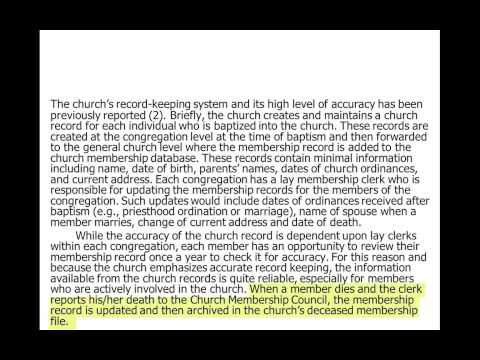
[5:37]So moving on to the second exercise, this one is actually two paragraphs long. But I'm going to encourage you to try to think of a way to bring it together into a single paragraph because I think it actually probably only lends itself to one paragraph. So this was from a study where they were looking at church records and this is from the method section. They're trying to tell you a little bit about those records with what where they came from and what information is in them. So again, it's two paragraphs long. Uh I just want to draw your attention to the very last line. I'm not going to read through the whole thing, you can read through it on your own, but the very last line of the second paragraph is kind of funny. So it says, when a member dies and the clerk reports his, her death to the church membership council, the membership record is updated and then archived in the church's deceased membership file. So notice that if, you know, you're reading that along, it sounds like it's the membership file, it's the file that's deceased, right? So it has this kind of funny things with adjectives, so you want to be careful with adjectives because you can come up with funny things like deceased files. Um so obviously you're going to want to edit that last line carefully. So why don't you go ahead and I'm going to put both of the um paragraphs up on a single slide so you can have them at your fingertips. Why don't you uh now go ahead and pause the video, edit both paragraphs, and then when you're done, restart the video and I'll kind of walk you through my edits.
[7:37]All right, so hopefully uh you were able to get it down to a single paragraph. Um, so when I was editing this, I asked myself, you know, what's the main idea, the main point of these paragraphs? And so what I think the main point was is that they were just trying to get across that the information that they used for their study, which was from the church records, that it was accurate and reliable. And notice in the original version, they used those terms accurate and uh reliable several times. Well, they use the term accuracy many times. So I was able to pair it down um by kind of taking away some of the repetition. So I want to scroll back and just kind of point this out to you. So in the original two paragraphs, they uh, you know, they say in the very first sentence, it's a high level of accuracy. They give you a reference for that, and then they're trying to give you some details about how this works to kind of verify that it is accurate. And then um, in the second paragraph, they go back to talking a lot about accuracy. Well, the accuracy is dependent, each member, uh can review its uh the record once a year to check it for accuracy. For this reason, and because the church emphasizes accurate record keeping, the information is quite reliable, right? So they're repeating those words accurate and uh reliable quite a bit. So um, what I did was just say, well, that's kind of the point of all of this information. The main point is just to say that, hey, these records are accurate and reliable. They have a citation for that. There's somebody who's done a study on that. They also want to back it up by just explaining how this whole thing works. The other point of this paragraph is to get across a little bit of information about exactly what's in those records. And that's important because that tells you what information they had available to them for this particular health study. So going back to my edited version, I just said, you know, I started with the church's record keeping system is accurate and reliable. And now I'm going to go through and tell you a little bit of details about how it works and what information is in there. When a new member is baptized, the church congregation creates a member record that includes, notice the semicolon, name, date of birth, parents' names, current address, and dates of church ordinances. Now, it's important that it's a lay clerk who does all this, but we don't need to keep repeating the term lay clerk. So we say, a lay clerk enters these records into the general church database and updates them to reflect dates of new ordinances, spouse name, changes of address and date of death. That can all be in one sentence. The spells, uh, you know, new ordinances, spouse name, changes of address and date of death. And then that whole second paragraph was about this idea that the members could review their membership records once a year and somehow that was going to improve accuracy. One thing, notice how I shortened that to a single sentence. Uh the reason I did that is if you go again back to the original, look at that second paragraph. It's all about this, you know, the members um being able to review their records once a year. Well, if you think about that carefully, it says, each member has an opportunity to review their membership record once a year to check it for accuracy. That's actually fairly ambiguous. It, so there's a lot of words here, but with a great amount of ambiguity about what's actually happening. So when you say they have an opportunity to review their membership, does that mean that um they have just one opportunity? They're limited, they can only review the records once, uh but they're allowed to review it once, or does it mean that they're encouraged to review their records every year, or is it more passive where they just could review it, should they feel the need to review it? So there's a lot of ambiguity here, and adding all of these extra details and words here doesn't help address any of that ambiguity. So I paired that down to a single sentence. And then that last sentence about when a member dies, we don't need to know that it's reported to the church membership council because what we care about here in the records, that's what we're using for the study. So we can get rid of a lot of extra details here. It's really not that important who's doing the reporting and who's archiving the records. We already know it's the lay clerk who's uh keeping track of these things. So I just paired that down to when a member dies, the membership record is archived. Um, so you can get this down quite a bit. Hopefully you were able to get something similarly short. Notice that the last sentence I allowed that to be in the passive voice, so when a member dies, the membership record is archived. Notice there's no subject. I didn't bother to say, well, it was the lay clerk who did the archiving or the council member, because I didn't think it was that important. So as I've alluded to before, in the method section where this was from, sometimes it's okay to have something in the passive voice when it doesn't really matter who did it and when it's more important to just get across what was done. So sometimes in the um, method section, it's actually okay to use the passive voice and I think it's probably a good use of the passive voice here.
[13:40]All right, so uh, for the last exercise in this in this uh practice module. I'm going to have you read a paragraph. This was from a study where they found a um an association between childhood misbehavior and subsequent drug use. So they actually, you know, saw some behavior, bad behavior in kids and they followed them over time and found later that they had a higher risk of drug use. So I want you to go ahead and uh now pause the video, read through this paragraph, edit it, and then when you're done, restart the video and I'll go over my thoughts on this paragraph with you.
[14:40]All right, so hopefully you got a good edit of this paragraph. And uh I want to point out one thing in particular about this uh paragraph. So, um, you might have noticed when you were reading it along, that that word however was a little bit funny. Did it, did that, I wonder if that struck some of you as you were reading it, right? So you get a bunch of sentences that are about studies that have also shown this link between childhood misbehavior and drug use and other studies in adults that have shown some kind of association between aggressive or bad behavior and drug use. You get this information about prior studies finding a similar link. But then you get a total shift in ideas and the authors kind of understood. They realized that they were making a shift, so they threw in the word, however, there. But that's actually not an appropriate use of however, it sounds funny because it's a little off, right? They're that however is supposed to tell you it's contrasting something in the previous sentence. Well, this is not. It's just their signal that they're changing ideas. So if you're changing ideas, instead of throwing in any random transition word, what you actually want to do, of course, is break this into two paragraphs. So I'm hoping that a lot of you caught this, that there's actually two ideas going on in this paragraph. The first is, here's all these other studies that confirm our results, that have found the same thing as us. And the second part of this paragraph, which should be its own separate paragraph, is what is the possible mechanism, the pathway that explains our finding. So you hopefully separated that into two paragraphs, that's one option. And actually the other option, I'll show you both uh I did both edits. Is actually to realize that maybe some of the material on previous studies is not even relevant and we could even delete that and make this into one paragraph. So I'm going to show you kind of both ways that I approached it. So here was my rewrite where I separated the ideas into two paragraphs. So I separated the previous studies from the pathways, the mechanisms. So, and I shortened things, I did some editing here, additional editing. Previous studies have linked early childhood conduct problems with subsequent drug use. Studies have also found that young adult and adult drug users exhibit more aggressive, unconventional, and impulsive behaviors than their peers. So I changed that around a little bit because I think the young adult and adult studies, it wasn't very clear in the original but I think what they were saying was that there was are studies that show that these things occur, the aggressive bad behavior could occur with drug use in adults. Um now those studies actually don't tell you whether or not the aggressive behavior causes the drug use or whether the drug use causes the aggressive or unconventional uh behavior. So we don't really know from those studies. They're also all about adults when the study that we're dealing with here is one about children. So, um maybe the fact that studies in adults find this association is relevant here. But I actually thought that perhaps it isn't even really that relevant. They did a study on childhood conduct problems and they linked it prospectively to subsequent drug use. Where the cause is clearly, you know, the aggressive behavior clearly comes before the drug use. Those other studies don't have, you know, we don't really know the direction of causality. They're also all about adults, which isn't really relevant here because we're talking about children. So one option, you'll see in my next uh way that I edited in my next one, is that you could actually delete all that information about the adult studies as I mentioned, and just have the whole paragraph of be about the childhood studies. Uh and then you're basically saying previous studies have linked childhood conduct problems with uh drug use, subsequent drug use, and here are all the pathways that may explain the link that they found as well, you know, that it, as well as what we found. They also found this same link in their study. So we can do it that way. So either of those edits is perfectly fine, but I'm hoping you recognize that there was this change of ideas in the middle of that uh paragraph. And I just want to give a quick acknowledgement here. Uh, I want to thank Gary Friedman of Stanford University. He's uh been a long time advocate of improving the quality of writing uh in scientific papers. And uh he's a fantastic editor himself and actually provided me with a whole treasure trove of examples, some of which have found their way into this course.
[20:44]The preceding program is copyrighted by the Board of Trustees of the Leland Stanford Junior University. Please visit us at med.stanford.edu.


