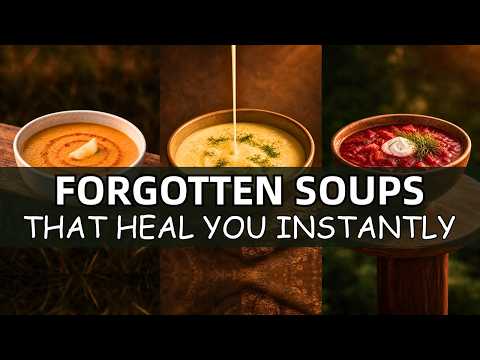
[0:00]What if I told you that some of the most powerful healing foods ever created, aren't in a pharmacy or a supplement store? They're in a pot on your grandmother's stove. Soups that have been feeding soldiers, healing the sick, and rebuilding broken bodies for thousands of years. Recipes that entire civilizations swore by. That got people through plagues, famines, and centuries of living without hospitals. Most people don't know this, but while we're all reaching for ibuprofen, the moment we feel run down, there are soups out there that have been genuinely healing humans for millennia. Soups with real nutritional science backing them up. And today, I'm going to show you 20 of them that will change the way you think about food as medicine forever. Stick around because number five on this list has been used for over 2,000 years and combines two of the most studied immune supporting ingredients on Earth. And number 20 is one of the most ancient fermented medicines ever discovered. And modern gut science is finally catching up with what Asian cultures have known for centuries. Make sure you hit that subscribe button because we post new videos every week that'll save you money and empower you to take charge of your own health. So let's get into it. Here are 20 forgotten healing soups, ranked from impressive to absolutely life-changing. Number one, Avgolemono, Greece, The Ancient Fever Broth. Let's start with Avgolemono, a Greek soup that's been on the table since antiquity and sounds almost too simple to be medicinal. Chicken broth, eggs, and lemon. That's essentially it. And yet Greek families have reached for this soup for everything from fevers to digestive recovery, from postpartum healing to flu season. Here's why it works. The combination of high-quality protein from eggs and the collagen-rich broth gives your body exactly what it needs to repair tissue when you're sick. The lemon contributes a real dose of vitamin C, which we now know plays a role in immune function and collagen synthesis. And the broth itself is easy on a damaged, inflamed digestive system, absorbed quickly without demanding much from a body that's already overwhelmed. Modern nutrition supports every element of this soup, protein, electrolytes, easy digestibility, and anti-inflammatory compounds, all in one bowl. Avgolemono got pushed out of our healing vocabulary simply because it requires a kitchen and a little time, while modern medicine trained us to think healing comes in a capsule. But Greeks never forgot. And now science is explaining exactly why they were right all along. Think of it as the IV drip your body actually wants, made from ingredients your great-grandmother would recognize. Number two, Canh Gà Lá Giang, Vietnam, The Digestion Awakener. If you've ever been so run down, you couldn't even think about eating. This soup was made for exactly that moment. Canh Gà Lá Giang is a Vietnamese sour chicken soup made with a wild leaf called La Giang, an intensely sour herb that grows along the edges of forests in Southeast Asia. Vietnamese families make this when someone in the house is sick, exhausted, or has completely lost their appetite. Here's the mechanism. The sour compounds in La Giang stimulate the production of digestive enzymes and stomach acid, which is exactly what a sluggish, sick digestive system needs to get moving again. When you're ill, digestion slows dramatically. Your body pulls resources away from the gut and toward immunity and repair. The sour hit from this soup signals the digestive system to wake back up, to start secreting, start processing, start absorbing the nutrients you desperately need. This is food as functional medicine. Not medicine dressed up as food, but actual food doing actual physiological work. Canh Gà Lá Giang disappeared from Western consciousness simply because La Giang doesn't grow in Europe or North America. But the principle, using sour, enzyme stimulating herbs in recovery broths is found in healing traditions all over the world. It's the soup that reminds your body it still knows how to heal. Number three, Caldo de Huesos, Latin America, The Gut Rebuilder. Bone broth has had a cultural moment in recent years, but Latin American families never stopped making it. Caldo de Huesos, bone broth, has been simmered in kitchens from Mexico to Argentina for centuries. And the traditional knowledge around it is remarkably consistent. Drink it when you're sick, when you're recovering, when your digestion is broken, when your joints ache, or when you simply need strength. And modern nutritional science has now confirmed most of it. Long simmered bones release collagen, gelatin, glycine, proline, and a range of minerals including calcium, magnesium, and phosphorus. Glycine, one of the most abundant amino acids in bone broth, has documented anti-inflammatory effects and supports the integrity of the gut lining. A damaged gut lining is at the root of a stunning number of chronic health problems, and glycine helps rebuild it. The key is long simmering, at least 8 to 12 hours for beef bones, 4 to 6 for chicken. That's what breaks down the collagen into gelatin, the compound that gives real bone broth its healing texture. This is one of the most nutritionally solid entries on this list. Not folk medicine, but food science with centuries of traditional wisdom behind it. Caldo de Huesos is the original gut healer, quietly doing what pharmaceutical gut treatments try to replicate. Number four, Borscht, Eastern Europe, The Blood and Liver Tonic. Borscht is bright red, startlingly earthy, and immediately recognizable. But most people don't realize they're looking at one of the most nutritionally dense soups ever developed. Eastern European families have eaten borscht through wars, winters, and famines, and there's a reason it sustained them. The centerpiece is beets, and beets are serious medicine. They're rich in betalaines, antioxidant pigments that give beets their color, which have documented anti-inflammatory and liver protective effects. Beets also contain nitrates that the body converts to nitric oxide, a compound that relaxes and dilates blood vessels, supporting cardiovascular health and blood flow. Traditional herbalists in Eastern Europe used beets specifically for liver complaints and sluggish blood. And modern research is explaining exactly why that worked. Combined with cabbage, carrots, onion, and often beans or meat, borscht delivers a genuinely impressive nutritional profile, fiber, folate, vitamin C, iron, and liver-supporting compounds all in one bowl.
[6:47]Borscht didn't disappear. It was just dismissed as peasant food by the same culture that eventually started selling beet juice as a performance supplement at $5 a bottle. It's the soup that's been a health tonic all along, hiding in plain sight behind its shocking color. Number five, Samgyetang (Korea) – The 2,000-Year Immune Weapon. And this is the one I teased at the beginning. Samgyetang is a Korean soup of a whole young chicken stuffed with glutinous rice, garlic, jujube dates, and ginseng. Then simmered for hours until the broth is rich, slightly sweet, and deeply fortifying. It's been eaten in Korea for over 2,000 years, traditionally served in the heat of summer. A concept called fighting fire with fire, or Yi Yeol Chi Yeol, using warming foods to make you sweat out the heat and recover your energy. Here's why modern science takes this soup seriously. Ginseng, specifically Panax ginseng, is one of the most studied botanical compounds on Earth. Clinical research has documented effects on immune modulation, fatigue reduction, and stress response. It contains ginsenosides, compounds that interact with immune cells in ways researchers are still mapping. Garlic brings allicin, with documented antimicrobial and immune supportive properties. Together, they form a combination that traditional Korean medicine specifically designed for immunity and energy restoration. Add in the collagen and protein from a slow-cooked whole chicken, the complex carbohydrates from glutinous rice, and the antioxidant compounds from jujube, and you have a soup that is genuinely, measurably nourishing from multiple angles simultaneously. Samgyetang is why the word superfood was invented. It just didn't need the marketing. It's the ancient immune weapon that modern immunology is finally starting to decode. Number six, Harira (Morocco) – The Recovery Engine. Harira is the soup Moroccans break their Ramadan fast with every evening, which tells you everything you need to know about its role as a recovery and restoration food. After a day without food or water, the human body needs protein, complex carbohydrates, fiber, and warming spices to gently restart. Harira delivers all of it in one pot. The base is tomatoes, lentils, chickpeas, and lamb or chicken, spiced with ginger, turmeric, cinnamon, and black pepper, finished with fresh herbs and a squeeze of lemon. Every one of those ingredients pulls its weight. Lentils and chickpeas together deliver a complete amino acid profile with substantial fiber, producing slow, steady energy release instead of a spike and crash. Turmeric and ginger bring anti-inflammatory compounds, curcumin and gingerols respectively, that have been studied extensively. Cinnamon supports blood sugar regulation. Black pepper contains piperine, which dramatically enhances curcumin absorption. Harira wasn't designed by nutritionists. It was refined over centuries by a culture that understood instinctively what a recovering body needed. The result is a soup that manages blood sugar, reduces inflammation, rebuilds protein stores, and feeds the gut microbiome all at once. It's the recovery engine that a culture built from necessity and perfected through generations. Number seven, Ash Reshteh (Iran) – The Micronutrient Bomb. Ash Reshteh is a Persian herb soup so ancient it's served at Nowruz, the Persian New Year, symbolizing good fortune and health for the year ahead. And after one look at the ingredient list, you understand why this soup has been associated with vitality for thousands of years. The base includes several varieties of beans and lentils, wheat noodles called reshteh, and then an extraordinary quantity of fresh herbs, spinach, parsley, cilantro, fenugreek leaves, dill, all wilted into the broth.
[10:43]On top goes kashk, a thick fermented whey product, plus fried onions, turmeric, and dried mint. This is not a soup with a few herbs scattered on top for garnish. The herbs are a primary ingredient by volume, creating a nutrient density that is genuinely remarkable. You're getting folate, iron, vitamins A, C, and K, magnesium, complete plant protein, prebiotic fiber from the legumes, and the probiotic benefits of fermented kashk all in one bowl. This is the soup that makes a multivitamin look lazy. Ash Reshteh got forgotten outside Iran simply because it requires fresh herbs in quantity, and that kind of cooking demands a relationship with food that modern convenience culture has systematically dismantled. But the Persians never stopped making it and eating it for very good reason. Number eight, Sopa de Ajo (Spain) – The Garlic Antimicrobial. Sopa de Ajo, Spanish garlic soup, is one of those recipes that looks almost insultingly simple. Garlic, stale bread, olive oil, eggs, paprika, chicken broth, a little cumin. That's it. And yet this soup has been the cold and flu remedy of the Iberian Peninsula for centuries. Spanish grandmothers made it at the first sign of a sniffle, and they were right to. The star is garlic, and not a polite amount of garlic. A proper Sopa de Ajo uses an entire head, sometimes more, roasted or sautéed until it softens and sweetens in olive oil. And when garlic is cooked and broken down in liquid, allicin and its derivative compounds are released into the broth, creating an antimicrobial medium that is genuinely measurable in laboratory settings. Studies have shown garlic extracts are effective against a range of bacteria and viruses, including some antibiotic resistant strains. The eggs poached directly in the broth add protein for tissue repair. The olive oil delivers anti-inflammatory mono-unsaturated fats. The bread, traditionally the stale heel of a loaf, provided energy in a form that was easy to digest. This was poor man's medicine, built from the cheapest ingredients in the Spanish kitchen, and it turns out those cheap ingredients were doing serious physiological work. Sopa de Ajo is the soup that proves genius doesn't need to be complicated. Number nine, Tinola (Philippines) – The Inflammation Quencher. Tinola is one of the most beloved soups in the Philippines and one of the most healing. It's a clear ginger-based chicken broth loaded with green papaya or chayote and Moringa leaves, called Malunggay in the Philippines, which are considered one of the most nutritionally dense leaves on Earth. The ginger is the hero here. Fresh ginger root, sliced and simmered directly in the broth, releases gingerols and shogaols, compounds with documented anti-inflammatory, anti-nausea, and digestive effects. Multiple clinical studies have confirmed ginger's effectiveness against nausea, including chemotherapy induced nausea and morning sickness. For general inflammation and gut discomfort, ginger broth is genuinely therapeutic, not just traditional. The Moringa leaves take the nutritional profile to another level. They're extraordinarily rich in vitamins A and C, calcium, iron, and complete protein relative to their size. Filipino families serve Tinola when anyone is sick, when a woman has just given birth, or when someone simply needs restoration. It's light enough for a sensitive stomach, warming enough to break a fever sweat, and nutritious enough to actually rebuild what illness has taken. Tinola got forgotten outside the Philippines simply because the world hasn't discovered Moringa yet. But it will. Number ten, Soto Ayam (Indonesia) – The Anti-Inflammatory Powerhouse. Now we're getting into the really powerful ones.
[14:38]Soto Ayam is Indonesian chicken soup, but calling it chicken soup the way most Westerners think of chicken soup would be a serious understatement. This is a heavily spiced broth made with lemongrass, galangal, kaffir lime leaves, and, most importantly, a generous quantity of fresh turmeric root. Turmeric is, arguably, the most studied anti-inflammatory compound in modern botanical medicine. Its active component, curcumin, has been the subject of thousands of studies, demonstrating anti-inflammatory effects, antioxidant properties, and potential benefits for conditions ranging from arthritis to metabolic syndrome. Soto Ayam doesn't use a pinch of turmeric powder. It uses fresh turmeric root, which contains the full spectrum of curcuminoids, along with essential oils that enhance bioavailability in ways isolated extracts can't replicate. Combined with lemongrass, which has antimicrobial and digestive properties, and galangal, a relative of ginger with its own anti-inflammatory compounds, Soto Ayam is essentially an anti-inflammatory delivery system wrapped in a deeply satisfying soup. Indonesian medicine never separated food and healing, and in Soto Ayam, the result is a soup that feeds you and repairs you at the same time. Hit that like button if you're starting to see how much healing knowledge has been hiding in other people's kitchens all this time. Number eleven, Kapusniak (Poland/Ukraine) – The Fermented Gut Medicine. Kapusniak is a sauerkraut soup that Eastern European peasants made through the harshest winters imaginable. And the fact that it survived those winters is itself evidence of how sustaining it is. The base is fermented cabbage, sauerkraut, simmered with pork or smoked meat, root vegetables, and a dark, hearty broth. Fermented cabbage is a probiotic food in the truest sense, a food that was alive with beneficial bacteria before the era of supplements and kombucha. The lactic acid fermentation process that creates sauerkraut produces populations of lactobacillus bacteria, organic acids that lower gut pH and protect against pathogens, and bioavailable vitamins, including a significant dose of vitamin C. Critical for Eastern Europeans, who had no citrus fruit through the winter months. Modern gut science has made the gut microbiome one of the most active areas of health research. And fermented foods like sauerkraut are now understood to be genuinely therapeutic for microbiome diversity and immune function. Kapusniak was gut medicine before anyone had the vocabulary for gut medicine. It was just called dinner, and it kept people alive through conditions that would break modern constitutions in a week. Number twelve, Mercimek Çorbası (Turkey) – The Rebuilder's Soup. Red lentil soup is served everywhere in Turkey, from roadside restaurants to five-star hotels to home kitchens, and eaten by everyone from young children to the elderly. Its universality is a clue to its fundamental nutritional role. This is the soup people eat when they need to eat, simple, accessible, deeply nourishing. Red lentils are one of the highest plant protein foods available, and unlike many legumes, they cook quickly and are remarkably easy to digest. They deliver iron, folate, magnesium, and a blend of soluble and insoluble fiber. The spicing, typically cumin, paprika, and a drizzle of butter with mint, adds both flavor and digestive support. Cumin stimulates digestive enzyme production. Butter provides fat soluble vitamins and makes the fat soluble compounds in the spices bioavailable. Mercimek Çorbası is the soup that gets dismissed as simple. And it is simple. But simplicity in food often means efficiency. This soup delivers high quality nutrition in a form the body can actually use, without the digestive load of complex heavy meals. In Turkey, it's often the first solid food given to someone recovering from illness. That's traditional knowledge as precision medicine. Number thirteen, Ukha (Russia) – The Mineral-Rich Recovery Broth. Ukha is Russian fish soup, one of the oldest recorded soups in Russian cuisine, going back at least to the 12th century. But traditional Ukha bears little resemblance to the fish soups most Westerners know. In its most authentic form, it's almost a clear broth, built from the bones and heads of freshwater fish, with minimal additions.
[19:17]A few root vegetables, black pepper, bay leaf, and fresh dill. The power of Ukha is in what fish bones release when simmered. Iodine, selenium, zinc, and omega-3 fatty acids, minerals and nutrients that are critically important for thyroid function, immune response, and inflammation control, and that are often chronically deficient in modern diets. The lightness of the broth makes it ideal for recovery. It's mineral rich without being heavy, easily absorbed, without taxing a weakened digestive system. Russian fishermen ate Ukha on the riverbank, made from whatever they'd just caught, because it restored them after hard physical work in cold conditions. It was food designed by circumstance and refined by necessity into something that turned out to be genuinely brilliant nutritionally. Ukha got forgotten outside Russia simply because the world moved to canned soup and lost the habit of using the whole fish. Number fourteen, Caldo Verde (Portugal) – The Antioxidant Powerhouse. Portugal's national soup is a simple, brilliant creation. Potato broth, olive oil, and extraordinary quantities of thinly sliced dark leafy greens, traditionally Galega kale, a variety more bitter and more nutritious than the curly kale most Americans are familiar with. Often finished with sliced chorizo for protein and depth. Kale is one of the most nutritionally dense vegetables on Earth, a fact that holds equally true whether it's in a trendy smoothie or in a bowl of Caldo Verde. The greens deliver vitamins A, C, and K in abundance, along with calcium, iron, and glucosinolates, sulfur compounds that support liver detoxification pathways and have documented anti-cancer properties in laboratory settings. The olive oil in the broth makes all the fat-soluble vitamins bioavailable in a way that eating raw kale doesn't. Portuguese families have eaten Caldo Verde through poverty and war, at celebrations and at sickbeds, because it sustains. It truly, physiologically sustains. It's the soup that reminds us that the world's greatest superfoods have been in grandmother's kitchens all along, long before they showed up in a $12 juice. And it's the reason Portuguese coastal communities have historically had some of the lowest rates of chronic disease in Europe. Number fifteen, Shorbat Adas (Arab World) – The Comfort Healer. Shorbat Adas, Arabic lentil soup, is one of the most widely eaten soups across the Middle East and North Africa, from Morocco to Iraq, from Lebanon to Saudi Arabia. Every family has a version. Every version is slightly different. And all of them are healing. The base is yellow or red lentils, cooked until completely smooth and silky, then spiced with cumin, turmeric, and often coriander, finished with lemon juice and olive oil. The lemon juice is not just flavor. It dramatically enhances iron absorption from the lentils, a nutritional pairing that traditional cooks discovered by palate thousands of years before anyone understood the chemistry of ascorbic acid and non-heme iron. That kind of accidental nutritional wisdom is everywhere in Shorbat Adas. The turmeric's curcumin, made more bioavailable by the fat in the olive oil. The lentils' soluble fiber feeding gut bacteria. The lemon's vitamin C supporting immune function. Shorbat Adas has been a recovery food, a sick day food, and a hunger banishing food across cultures and centuries, because it does exactly what a struggling body needs. It nourishes efficiently and heals quietly. Number sixteen, Canja de Galinha (Portugal/Brazil) – The Convalescent's Friend. In Portugal and Brazil, when someone is sick, truly sick, recovering from surgery, new mother, fever breaking, they are given Canja. This is not negotiable. Canja de Galinha is the soup that family brings when you can't take care of yourself, because it is the food that takes care of you. It's a whole chicken simmered for hours with rice, vegetables, and a few simple aromatics, lemon zest, parsley, sometimes mint. The result is a broth of extraordinary depth, and a rice so soft it nearly dissolves. Every element is designed for a body that can barely function. The protein is pre-broken down by long cooking. The collagen has become gelatin. The starch is softened and easily digestible. The aromatics are gentle and stomach soothing. Research on chicken broth specifically has confirmed what every Portuguese grandmother already knew. That the compounds released from chicken during long simmering have mild anti-inflammatory effects on the upper respiratory tract, explaining the centuries-old connection between chicken soup and recovery from colds.
[24:13]Canja de Galinha is that wisdom refined into its most essential, gentle, and effective form. Number seventeen, Sopa Tarasca (Mexico) – The Fiber and Antioxidant Engine. Named for the Purépecha people of Michoacán, Sopa Tarasca is a pre-Columbian Mexican soup that belongs on this list for one reason above all others. It was developed by a civilization that understood how to build maximum nutrition from the ingredients available to them. The base is dried black or pinto beans, cooked, puréed, and combined with roasted tomatoes, dried chilies, garlic, and chicken broth. Finished with crema, crispy tortilla strips, and cheese. This is a soup built on beans and tomatoes as primary healing ingredients. Beans are one of the most fiber-rich, protein complete, and micronutrient dense foods available, delivering folate, iron, magnesium, and resistant starch that feeds gut bacteria. Tomatoes, especially roasted or cooked, release lycopene, a carotenoid antioxidant with documented cardiovascular and anti-cancer associations. The Purépecha people built Sopa Tarasca from the three sisters agricultural tradition, beans, corn, squash, understanding instinctively that these foods work together to sustain a community. Modern nutritional science has validated that understanding completely. Sopa Tarasca is indigenous food intelligence encoded in a soup bowl, and it is as relevant today as it was 500 years ago. Number eighteen, Cock-a-Leekie Soup (Scotland) – The Surprisingly Powerful Gut Tonic. Cock-a-Leekie sounds like a punchline, but it is one of the most underrated healing soups on this list. Scotland's national soup is a simple broth of chicken, leeks, barley, and prunes. A combination that strikes most people as odd, until you understand what each element actually does. Leeks are members of the Allium family alongside garlic and onion, and they contain fructooligosaccharides, prebiotic fibers that specifically feed beneficial gut bacteria. They also contain significant amounts of kaempferol, a flavonoid with documented anti-inflammatory effects. Barley brings beta-glucan, one of the best-studied prebiotic fibers, known to support both gut microbiome diversity and immune regulation. The prunes, traditional in the original recipe, add soluble fiber and sorbitol, making this soup gently digestive regulating in the most polite Scottish way possible. Cock-a-Leekie was the soup that Highland families made when the old rooster was past his prime, but the winter cold was at the door. Necessity created something remarkably sophisticated, a prebiotic, anti-inflammatory, gut-supportive, immune-modulating soup that modern functional nutrition would have a very hard time improving upon. It's the soup that proves Scottish cooking has always been smarter than anyone gave it credit for. Number nineteen, Ogbono Soup (West Africa) – The Strength Rebuilder. Ogbono soup is made from ground wild mango seeds, called Ogbono or Bush mango, combined with palm oil, leafy vegetables, and meat or fish, creating a thick, viscous, deeply savory soup that is one of the most calorically and nutritionally dense traditional soups on Earth. The Ogbono seeds themselves are remarkable. They're high in fat, particularly oleic acid, the same monounsaturated fat found in olive oil, along with significant protein and dietary fiber. Research has documented appetite regulating effects from Ogbono extract, with studies suggesting it may help with weight management and blood sugar control. The palm oil delivers fat soluble vitamins A and E. The leafy vegetables, often bitter leaf or ugwu, contribute minerals and antioxidants. West African traditional medicine prescribed Ogbono soup specifically for recovery from illness, for nursing mothers needing to rebuild strength, and for anyone who had been significantly weakened. It's calorie dense by design, designed for bodies that have depleted their reserves and need serious rebuilding, not gentle nourishment. Ogbono soup is the kind of food that puts you back together when you've been broken down. The world outside West Africa simply hasn't discovered it yet. Number twenty, Miso Soup (Japan) – The Ancient Probiotic Medicine. And here we are at number 20, the one I saved for last because it represents something the modern world is only now beginning to fully understand. Meet Miso Soup, a soup so simple it barely seems to count. Dashi broth, Miso paste, tofu, seaweed, green onion. And yet this soup has been eaten daily by Japanese people for over a thousand years. Not occasionally, not as medicine, daily, at breakfast, as a baseline. Miso paste is a fermented food made from soybeans, salt, and a mold culture called koji. The fermentation process, which takes months to years for aged varieties, creates a food that is alive with beneficial bacteria, enzymes, and bioavailable compounds that raw soybeans simply don't contain. Modern gut science has established that the diversity of the gut microbiome is one of the most powerful determinants of overall health, immune function, mental health, inflammation levels, metabolic health. Fermented foods like Miso actively support microbiome diversity in ways that probiotic supplements are still trying to replicate. The seaweed in traditional Miso Soup adds iodine, fucoidans, and minerals that are nearly impossible to get from land-based foods. The tofu delivers complete plant protein. The dashi broth, made from kombu seaweed and bonito flakes, is itself mineral-rich and deeply nourishing. Epidemiological research on Japanese longevity has consistently identified Miso Soup as a likely contributor to the extraordinary health outcomes of traditional Japanese communities. It's the soup that shows what daily, consistent, intelligent nourishment can do across a lifetime. Not a cure, not a treatment, a practice. That's the lesson that all 20 of these soups are trying to teach us. Here's what connects every single soup on this list. None of them were invented by nutritionists. None of them were designed in a laboratory. Every one of them was developed by people paying very close attention to what happened when they fed their families. And refining that knowledge across generations until they had something that genuinely, consistently worked. We got trained to believe that real medicine is rare, expensive, and comes in packaging. That healing is something that happens to you at a hospital, not something you do at a stove. These soups from a Greek egg lemon broth to a Japanese fermented Miso, from a Korean ginseng chicken to a West African wild mango soup, they all push back against that idea. They say healing has always lived in the kitchen, in the pot, in the knowledge of how to combine ingredients that have been available to humans for thousands of years. If you enjoyed this deep dive into the world's forgotten healing soups and you learned something that might actually change how you cook, smash that like button. It genuinely helps this channel reach other people who are ready to reconnect with food as medicine. Drop a comment below and tell me which soup you're making first. Are you team fermented gut healers, team ancient immune soups, or team recovery broths? I read every single comment, and I love hearing from this community. And if you haven't subscribed to Homestead Roots yet, what are you waiting for? Hit that subscribe button and ring the notification bell so you never miss a video. We're building something here. A community of people who believe that empowerment starts in the kitchen, and we'd love to have you.


![Thumbnail for 2016 서울패션위크에서 YG모델 이호정을 만나다! [oh Hot] - KoonTV by 최군TV funny](/_next/image?url=https%3A%2F%2Fimg.youtube.com%2Fvi%2FSqHgAly3Ajc%2Fhqdefault.jpg&w=3840&q=75)