[0:02]Oh my God, it scared the shit out of me. Is this supposed to be happening?Is this supposed to be happening? Turn it off. I hate it. I really feel that maybe you should know this information.
[0:19]That was me, when I was fat and stupid. Now, I'm wiser, sexier, and more effervescent, much like my drinks. Hi, I'm Jazz and in this video, I'm going to teach you how to carbonate anything and everything without blowing yourself up like a dumbass. We'll find out what the best setup for you is, how I built my rig from the ground up, and all of the sciencey tips and tricks to have you floating to the ceiling like that piece of shit, Grandpa Joe from the 70s version of Willy Wonka and the Chocolate Factory. Let's take a drink, nobody's watching. Yeah.
[1:02]So there are quite a few different home carbonation systems out there now. You've probably seen a few like soda stream, ones that sit on your countertop. They all kind of do the same thing. They have tanks of compressed CO2, they force the gas into the liquid and makes you a bubbly drink. Countertop machines have their pros and cons. You can find them fairly cheap on the aftermarket or whatever, but the problem with them for me is that a lot of them use proprietary little CO2 tanks, and those can get expensive over time like constantly buying those little tanks and refilling them. They also only do a few liters, like maybe 20 liters or something, I don't know what it is actually. They don't hold as much CO2 so you have to swap them out all the time. Many of them will only carbonate water, not cocktails or juices or anything. Those can like ruin the whole machine. Depending on what you're up to, they could work, but they could also be kind of a nuisance and a pain in the ass. They also don't allow you to adjust your PSI, they don't allow you to use any bottle you want, any size bottle you want. A lot of them have their own special bottle, so you got to go buy those special bottles and have ten of them laying around or whatever.
[2:14]This setup solves a lot of those problems for me. It's got a large tank that lasts months, six months or more, depending on how much you're carbonating. And we carbonate a lot. It's meant to use regular soda bottles, really nice and convenient. You can have different sizes of soda bottles, relatively cheap to put together. It's about the same I would say as like buying a nice brand new Breville machine or something like that. But over time it's going to be way cheaper because filling up this tank is usually less than 20 bucks, at least where I'm at. Partly why I like this system the best. I think it's the most versatile, the most cost-effective, cock-effective. I think it's the most versatile, the most cost-effective, and it's kind of like a professional grade vibe over here. I'm kind of into that. So, I want to get into how to set this up, what all of these pieces are, how to put them together safely so you don't like fucking blow yourself up, which is traumatic. I can attest. Hey Siri, play Scars by Papa Roach.
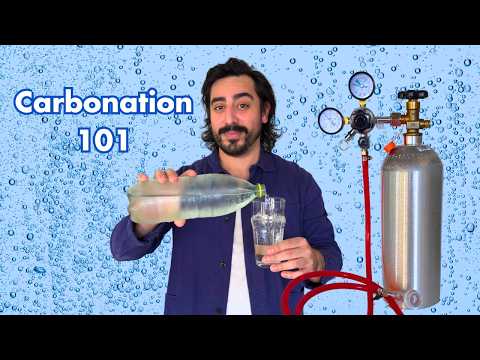
[3:22]Let's put this thing together. We'll start with the tank. The CO2 tank, this is a five-pound tank. You can get ten, 20 pounds if you're working at like a bar or something, maybe this is about as big as I could fit underneath my sink, so I went with the five-pound tank. You do need to make sure these are inspected. I think the inspections, at least for for my area, is a five-year inspection, so once it's inspected, it's good for five years, and that's just to make sure that the tank isn't going to like fail on you or, whatever. I got this one on Amazon, it came pre-certified, which is nice. So we had five years on that one. If you're going to buy a tank after market, you want to look for the markings on here that will have the date that the the tank was manufactured inspected or whatever. It'll be five years from that date, or you need to go get it inspected at your local gas man or whatever. We have a a a local spot that does CO2 gases and stuff for bars and and restaurants. And that's where I get mine filled up. It's about $17 US. It lasted about five to six months, depending. I mean, we use it a lot, like, I mean, obviously, we're like cocktail people, creators. So I think a normal person would probably get a little bit longer out of it. So just know that you're you want your shit certified. So once you have your tank, it's full of gas. This part is the most important part. Again, this part is the most important part. This is the regulator. You'll want to make a note here that there's a washer here, and that's going to allow this to get a tight snug seal, and that just screws right onto the tank. You can use a, you know, a little monkey wrench to get it on. I just kind of pull this number. What the regulator does is it regulates, obviously. The pressure coming out of the tank is 1,000 PSI. a lot. You'll see that the red dial here is bars, and that's barometric pressure. That's just another way of calculating how much pressure there is. You'll often see bars in like espresso machines use bars. But we're probably going to focus more on PSI here. Don't don't mix them up because they're very different. Trust me. I thought it was on 60, but I think it was on 1,000. Oh my God, Jazz. between 50 and 100. Oh my God, your hand's so fucked up. I know, it was between 50 and 100 bars of pressure, not PSI. It was like a bomb, like it felt like a fucking actual, right here. So if I were to open the tank here, we'll see that this line straight from the tank to this regulator is the regulator pressure, and this one, the vertical one, is the pressure that's going to be going out of the regulator into the hose or into the bottle. So the most important part of this regulator is how to how to set the PSI for your regulator. Some regulators are going to have up to 60 PSI. Ours goes up to 230 PSI. So you'll want to make note of that. But you'll use this knob here. Sometimes you have to have like a little flathead screwdriver or something to set the pressure. You'll pull it all the way out and then slowly push it in until it hits the pressure you want, and then you'll use the little lock ring to set it in place, and don't touch it after that unless you want to have variable pressures and you should be good to go after that. So this regulator, you'll notice, goes all the way up to 230 PSI. That's like way, way more than you'll ever need. Some regulators only go up to 60, and that's like basically plenty. I think that's about as much as you'd ever want to go. A normal bottle can only handle about 120 PSI. Technically, it's only rated for like 120 PSI before they can explode. In the grocery store, under pressure, at like high heat, a lot of these bottles are sitting at 80 PSI just on the shelf. So these bottles can handle quite a lot of pressure, but you don't want to be going like that hard. Like not 200 PSI hard. I would recommend 50. I think that's like more than enough for most applications. That seems to get us like a Topo Chico level, like it burns kind of bubble. If you wanted to go down to even as low as 15, you could kind of recreate a little bit of a much lighter effervescent bubble. That's up to you and that's like one of the greatest parts about this is you can kind of tweak how much, you know, how aggressive you want your carbonation to be. I like my shit like super, super carbonated. Once you have your pressure set, you're good to start carbonating, but do not start carbonating until you're sure that your regulator is set at the pressure that you want. And again, that pressure should probably be around 60 PSI or less. Once you close your tank, you can bleed that pressure and it'll go down to zero. The pressure coming out of the tank will probably stay the same until the tank gets really, really low, but it will happen pretty quickly like once the tank is really low. You'll also notice the tank is very light. This is pretty heavy right now, but once it's it's close to empty, it'll be like, you know, like an empty soda can. One last thing for the tank before I I forget, some tanks you'll find have like a black cage around this part. And that is something I would recommend if you're setting this up for a commercial situation, like if you're at a bar or if you're at a cafe or something like that, that's just going to prevent any of this from getting knocked around. Good to have like a safety cage here. Ours doesn't really see a lot of movement, so wasn't a big deal for me, but just keep. So the hose will just kind of slip onto this barbed uh connector and then there's a little uh fastener here, a little clamp, and you'll just clamp that down. Simple, easy. This hose is uh just the kind of one that I could find on Amazon that worked, was the right size, and about the right length. What I would prefer if I were investing in this would be to find a hose with a wire outer layer. Those are going to be a lot more sturdy. They're not going to pinch or crack or tear as easily. That's more if like you're in a bar or something. For home use, I don't really have much of an issue with this, especially if I'm I'm being careful with it. So, that hose will go down to this part. This is basically the same barb again with a little screw-on connector. It's clamped on, and then the last part here is your ball lock valve connector. This connector is meant to fit onto a ball lock valve that goes onto a normal bottle. The one that comes with it usually doesn't have this special back valve stopper. I opted for this one because I use this for cocktails as well as water. So this is very important if you plan on using this for cocktails or anything with juices, syrup, coffee, anything other than water. Honestly, even if you're just using water, it's probably a good idea because it's going to prevent anything from getting into your hose. And that could be a problem if you're carbonating stuff with sticky juices and stuff and it gets in your hose, it's going to start developing mold, it's going to be disgusting, and then you're pushing like moldy crap into your water, your cocktails, your bottle, whatever. Obviously, this hose can be cleaned, whatever, but just know that. The ball lock adapter for regular PET water bottle. They come in plastic or metal. The metal one's nice and heavy and it it works, but the plastic one works just as well. Far as I can tell, it's basically the same thing. They both have little rubber gaskets to help create a nice seal that may need to be replaced over time. Same with these top rubber that will help keep a nice seal. They may degrade over time. So the ones that I bought come with extra replacements, so if you ever notice that you're not getting a good seal or if there's hissing and stuff, that might be it. So the last part of this whole chain is the water bottle itself. These are Topo Chico water bottles, but what you're looking for is essentially anything that had carbonated beverage in it before, should be rated for whatever it is that you're trying to do. Usually, they're rated much, much higher than is necessary, so they avoid any like, you know, problems during shipment and and moving them around at the grocery store and shit like that. Any kind of Coke bottle, soda water bottle, I mean, we have multiple different kinds. Uh, these little bumpy parts on the bottom are specially designed to prevent blowouts. With these bottles, you can reuse them many, many times. We've had a lot of these since the the very beginning. What you want to look out for is when they start to deform. If you start to see any kind of stretching, uh if you've ever seen a bottle that has like white kind of stretching on it, that's a bad sign. If you see any scratching or gouges on the inside of the outside, that needs to be replaced after that. These can handle quite a number of like cycles before anything happens. If you see any kind of white stretching or anything like that, the bottle's got to go. Glass bottles are super dangerous in this scenario. If you really wanted to kind of be extra in a presentation or something like that, you could carb in the plastic, transfer it into a glass fermentation bottle like this that you know is rated for high PSI, and then you could cap it off and it will keep the carbonation in there. But I would not recommend carb in that at all. You could just create a fucking frag grenade, basically. The plastic that's the bottom of these is fairly thick and it creates really sharp like shards. So they're they're not like fully safe either if you don't know what you're doing. I'm not trying to scare anybody. As long as your regulator is set properly, you're you're fine. Learn from my mistakes.
[13:51]We've entered the tips and tricks section. First, we're going to start with water, how to carbonate the bubbliest water, how I do it step by step, and then we'll move on to cocktails. I turn on the tank first, all the way open. All the way. Not halfway, all the way open. This can cause problems with the valve inside. All the way open or all the way closed, always. Once this is open, you now have pressurization here, and then you open this part here and that will actually open up into the hose. So once both are all the way open, you're ready to start carbonating. So, let's carb some water. I like to use filtered water from the Brita. You can use tap, it's fine, it's just a taste thing. Go about 75 to 80% up the bottle is good. You want to leave a little bit of head room so that the carbon dioxide can sit in there and slowly dissolve into the liquid. Before we do that, we're going to press all the air out to the very top, and then I'm going to screw on my cap. As you can see, it's cold already, it's like fridge cold, but we want to throw it in the freezer for like 45 to an hour to get it like basically freezing cold. You basically want to look for some ice to start forming. You see this water is almost, it's beginning to freeze. It's slushy. There's like ice crystals all forming in here. Remember, cold. The colder your water is, the more CO2 can be dissolved in it. I'm shaking it to get as much CO2 in there as possible. This particular head or whatever makes that weird like choking a chicken sound, it's like a, you know, like a rubber chicken kind of sound. The other one, uh, doesn't really do that, but it's just the, the sound of the valve, basically. Not a big deal. I like to hold it like this, like almost like a gun kind of, and that's just to keep this from bending. Shake it.
[15:52]So this first shake is the longest one usually, and this is where the majority of the carbon dioxide is going to go into the water, and then the last two are just to kind of purge any uh oxygen that's left over and force carbon dioxide in where it used to be. I'll shake it until it starts to hiccup or like it starts sputtering. And you'll hear it like it's not really consistently coming in anymore. So you can stop, it's full of gas.
[16:26]Yeah, so we'll just do that. If you wait, you'll see that the head space is slowly growing, and that's actually CO2 leaving the water and creating a a head space of just CO2. And we'll go ahead and hit it three times is usually how much I do it. So I'll do it another time until it starts to sputter. I find that's like the sweet spot. I think it just gets it super, super bubbly. You don't have to do it three times. I've done it really well once, and that's still fine. If I do it three times, I can drink part of this, cap it, throw it back in the fridge, and it'll still be bubbly like the next day. Like it's very, very bubbly, so I like three times personally, but you don't have to.
[17:16]You know, hit this again and like let that chill in the fridge or whatever.
[17:23]So I have one done here. Okay, the last thing I wanted to demonstrate was nucleation sites. Here we have a glass with multiple pieces of ice. Lots of different edges for bubbles to form and escape, whereas this one has just like one piece of ice. Hopefully, we'll be able to see kind of the difference here. I guess the ideal situation would be a very clean glass that's chilled and has no ice. But, you know, for cocktails, ice is important, so. I hope this was fun or interesting or helpful in some way. If you have any questions, please drop them in the comments. If you would like to purchase stuff to build your own rig, I think we will have like links for all the parts. Thank you. If you want to become part of the staff here at Very Good Drinks, simply subscribe and like the video. We also have a Patreon you can join, a Discord you can join with monthly challenges, and some of the most brilliant bartenders in the world from all around the world in that Discord to answer your questions and help you along your journey to create the most fun, beautiful drinks that you your little heart desires.
[18:48]Thank you for being here.