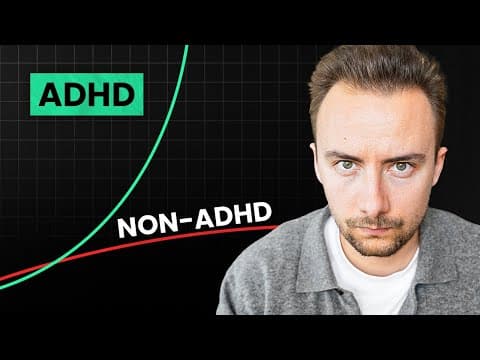
[0:00]If you have ADHD and feel like you're constantly starting things, getting obsessed, and then dropping them, this might be the most important video you'll watch this year.
[0:09]Because what if I told you, you've just been playing a game that was never designed for how your brain works.
[0:15]And right now, that game is changing because AI is changing what the world values.
[0:21]In this video, I'll show you why ADHD is becoming an advantage, what AI has to do with it, and how to actually use it, starting today.
[0:30]And if you've never heard ADHD explained like this before, make sure you're subscribed because this is exactly what we talk about here.
[0:41]If you have ADHD, there's a strange paradox about you that most people don't understand.
[0:47]You don't age in the way others do, not because time doesn't pass, but because your relationship with the world stays open.
[0:55]Most people, as they get older, start closing loops. They decide this is how things work. This is who I am. This is what I do.
[1:03]And slowly, curiosity gets replaced with certainty. They stop questioning things. They stop experimenting.
[1:10]They stop looking at the world with fresh eyes. But with your brain, that doesn't really happen.
[1:15]You don't like closed loops. Your brain keeps reopening them. You'll look at something everyone else accepts as normal and think, why is it done like that?
[1:24]And this is not an occasional curiosity event. It's constant. You go down rabbit holes that most people wouldn't even notice.
[1:32]You'll learn things that have absolutely nothing to do with your current life. And yet, something in your brain says, this matters.
[1:39]Even if you can't explain why, yet. And here's where most people misunderstand you.
[1:45]From the outside, it looks random, like you're jumping from thing to thing. Like you can't commit, like you're easily distracted.
[1:51]But internally, there's a very different process happening. Your brain is scanning for patterns.
[1:58]It's constantly asking, how does this connect? Where have I seen something like this before?
[2:03]This makes your focus more broad rather than narrow.
[2:06]And so, through calculated estimations and big picture connections, your brain is able to shortcut what other people usually have to think through for a long time.
[2:15]leading you to get to these aha moments that you usually can't explain, but just know are right.
[2:21]This is why, when you're around people, for example, you can usually tell who's bullshitting and who's being real almost instantly.
[2:28]Why you get bored with movies, because you predicted the ending 10 minutes into the intro. Or why you become obsessed with a new hobby, master it in two weeks,
[2:38]and then quit because the puzzle is already solved. You are a divergent thinker.
[2:44]Meaning, you have the ability to generate many original different ideas, perspectives, or solutions instead of just one correct answer.
[2:52]And so, where most people settle into certainty, you stay in exploration. And that's rare.
[2:59]Because exploration is uncomfortable. It means not having clear answers, not fitting into a single identity, not being able to explain your path to others.
[3:09]Most people avoid that. You live in it. In fact, you need it.
[3:14]Your brain needs the challenge and urgency of a real question or problem to generate dopamine, the neurotransmitter that gets you hyperfocused and motivated.
[3:23]And with this process, over time, something very interesting starts to happen.
[3:28]You don't just accumulate knowledge. You accumulate perspective that's hard to replicate.
[3:34]So, you are not behind because you haven't picked one thing and stuck to it. You've been doing something most people stop doing way too early.
[3:44]You've been staying open. Because you have sampled and are sampling more of life than most people ever will. That's what makes you a generalist.
[3:52]And there's a clear path for people like you. Books, the reason you can access knowledge today, shouldn't exist.
[3:59]At least not in the way they do now, because the people who were closest to solving that problem never did.
[4:05]They were specialists, copying text by hand, getting better and better at it. And then someone completely different solved it.
[4:13]Johannes Gutenberg. Not a scholar, not a writer, a guy who understood tools, metal, and machines.
[4:22]And instead of going deeper into writing, he connected ideas from completely different worlds.
[4:27]A wine press, metal casting and ink. And that one connection changed the world.
[4:35]Not through deeper knowledge, but through connected knowledge. And Gutenberg wasn't the only one.
[4:41]Steve Jobs didn't win because he was the best engineer. The Wright brothers didn't win because they had the most powerful engines.
[4:47]They won because they saw connections others didn't. That's the pattern. Generalists change the world.
[4:54]And whether you like it or not, if you have ADHD, that's how your brain works.
[4:59]But there's a problem. There's a voice in your head that's been trained into you since childhood.
[5:04]Stay in your lane, don't ruffle feathers, pick one thing and stick to it. That voice was built for a different world, a predictable one.
[5:11]One where doing the same thing for 40 years worked. We don't live in that world anymore.
[5:15]But you, you've been trained for this your whole life. You're sitting on a map of connections you just haven't decoded yet.
[5:23]And right now, for the first time, that actually matters. And I'm going to show you exactly how.
[5:29]Because we're entering into a new kind of world. One where AI handles the predictable work.
[5:35]And the advantage shifts to the people who can explore, adapt, and connect ideas fast.
[5:40]This is a new era of exploration. And the people who win in it won't be the ones who stay in their lane.
[5:49]Up until now, the system wasn't built for you. A person could be relatively successful based on how busy they were, willing to be inside the system.
[5:58]And our brains naturally resisted that. AI is collapsing that world. It's automating all the busy work.
[6:06]The rule following work is removed the thing that was always holding you back. The executive function tasks, the scheduling, the organizing, the thousands of tiny decisions
[6:13]between having an idea and doing something with it. AI can handle all that now.
[6:19]That's why 88% of neurodivergent employees report being more productive with AI assistance.
[6:24]The tool that is threatening everyone else's career is now your unfair advantage.
[6:30]Value is now your ability to frame problems worth solving, see what others ignore, create new approaches that didn't exist before, decide what matters before execution.
[6:40]That is where your ADHD brain thrives. And companies are recognizing this too.
[6:45]The CEO of Palantir said, there are basically two ways to know you have a future, vocational training, or you're neurodivergent.
[6:52]We're moving into a world where one person can build what used to take entire teams by working with AI.
[6:59]And in that world, your advantage isn't your resume. It's your brain. That's the leverage.
[7:05]And here is how you can actually use it, starting right now.
[7:11]Think of three things you've been obsessed with in your life, even if they seem completely random.
[7:16]Don't overthink it. Got them? Good. Now look at them and ask yourself, which of these do I actually love?
[7:21]Which of these could make money? And which of these am I naturally good at?
[7:25]Most people stop here. They think the goal is to pick one thing and stay in that lane forever. That's not how your brain works.
[7:32]The real opportunity isn't in choosing one. It's in the intersection.
[7:37]Because what looks random to you is actually a shortcut. And if you connect those dots, you don't just find a path. You create something no one else can compete with.
[7:46]I was always a huge fan of movies, video editing, and psychology, which has now translated into this completely crazy content creator,
[7:54]coach, entrepreneur career of mine that no path existed for back when I just started out.
[7:59]I paved my own way thanks to all the inputs and interests I chased naturally, and then connected them all.
[8:06]And the benefit of creating that path that is yours, is that you're often the first one there, which gives you a huge advantage in terms of potential upside.
[8:14]That's the path of the generalist. Now you might be thinking, this is great, Nick, but I still don't know what I should do.
[8:20]Perfect, because that's exactly what we're going to fix right now.
[8:23]There are two rules that will give you clarity and start moving you into the direction of the generalist immediately,
[8:30]even if your brain is subconsciously resisting it. First, stop asking, is this important?
[8:34]What should I do? Or what do I need to do? Start asking, does this actually spark my interest right now?
[8:41]Because for your brain, interest isn't a distraction, it's the activation switch.
[8:44]If something pulls you in, go deep. If it doesn't, don't force it. Offload it.
[8:50]Use AI, get help. Your job is to spend as much time as possible in the state where your brain actually works.
[8:58]In your zone of genius. And that means this, follow the side quest.
[9:02]Even when it makes no sense. Even when it feels uncomfortable because you've been told to stick to one thing ever since you were a kid.
[9:10]Because right now, you have access to something no one in history ever had. You can tap into almost any idea instantly.
[9:17]Any skill, any perspective, any knowledge. Any explorer, back in the day, Christopher Columbus, would have been insanely jealous of that.
[9:25]So the people who win now aren't the ones forcing a path. They're the ones who follow what pulls them and connect the dots later.
[9:32]Rule two, embracing the multi-lane path. Look, generic is over.
[9:36]The only thing that will cut through the noise today is the unexpected combination, the perspective no one else has.
[9:43]The person who can connect things that don't belong together. And your brain has been doing that your whole life.
[9:49]Most people with ADHD spend years trying to compress themselves, pick one thing, stay in their lane, stop jumping around.
[9:56]In other words, trying to sand down the thing that is going to make them irreplaceable.
[10:01]You're multi-dimensional, and in an AI-driven world, that's your superpower.
[10:06]And if you're unsure what direction that is, what direction you should take, there's an easy exercise for you.
[10:11]Every week, track what gave you energy and what drained you. Then, double down on energy and eliminate or redesign drains.
[10:20]ADHDers run on energy and not discipline. And then, don't just go down rabbit holes and consume, create something from it.
[10:26]Write a post, explain it to someone, build something small, share a video.
[10:30]This will turn your random interests into compounding assets and curiosity into career leverage.
[10:37]Specialists go deep in one lane. Generalists connect lanes. And that's where the future of you and the world will be decided.
[10:45]Now is the perfect time to start building a life around how your brain actually works.
[10:50]Follow your interest, track your energy, turn curiosity into output, and instead of asking what should I commit to forever, ask, where can all my interests come together?
[11:00]Because that's where your unfair advantage is. There's just one thing I need to be honest with you about before you go.
[11:06]A generalist without an execution system is just someone with a lot of ideas they can't finish.
[11:11]And if you have ADHD, you know exactly what that's like. The half started projects collecting dust in notes apps.
[11:17]The ideas you had two years ago that someone else launched.
[11:20]The version of yourself that keeps postponing until you get it together. Now, AI is going to remove a lot of the executive function tags we've been paying our whole lives.
[11:31]But it cannot manufacture the internal neurochemical signal that makes starting feel worthwhile.
[11:37]That's why I created another video for you, walking you through step-by-step how to build the execution system your generalist ADHD brain needs to take your ideas and turn them into reality.
[11:48]You'll stop being the person who has potential and start becoming the person who achieves.
[11:55]This is your time. What will your impact in a post AI economy be? I can't wait to find out.