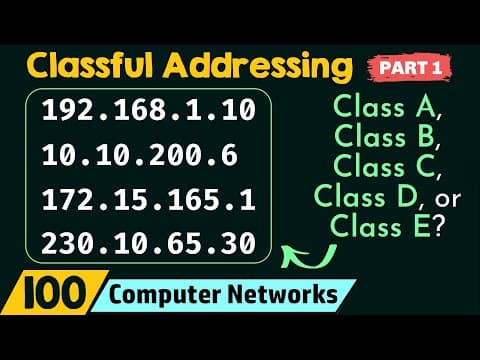
[0:06]Hello everyone. Welcome back. In today's lecture, we will see the part one of class full addressing. We will start the session with the outcomes. Upon the completion of this session, the learner will be able to Outcome number one, we will understand various classes of IPv4 address. Outcome number two, we will identify the class of IP address with the help of an activity. Let's dive into the topic directly. Basically, we have five classes of IPv4 addresses: Class A, Class B, Class C, Class D, and Class E. We know very well that IPv4 addresses can be represented in two ways. It can be represented either in binary notation or in dotted-decimal notation. We know IPv4 addresses are 32 bits long. These 32 bits are organized into four octets or four bytes. And each byte will be eight bits long. So we have four bytes in an IPv4 address. These four bytes can also be called as four octets, because every octet is going to contain eight bits. So 8 + 8 + 8 + 8 = 32 bits.
[1:16]And that's why IPv4 addresses are of 32 bits long. And Class A means out of these 32 bits, and the first byte, that is the first octet's first bit, the most significant bit. If it is 0, then it is Class A. If the first two bits in the first byte are 10, that is the starting of the IPv4 address in binary, if they are 10, then it does belong to Class B. If the first three bits are 110, then it does belong to Class C. If it is 1110, that is, if the IPv4 address starts with 1110, then it is Class D. The first four bits of the first byte or the first octet of an IPv4 address are four 1s, then it is Class E. So if it is represented in binary, we need to see what are the bit values, whether the IP address is belonging to Class A, B, C, D or E. In case if it is given in a dotted-decimal notation, say if the first byte or the first octet is between 0 and 127, it is belonging to Class A. In case if it is between 128 and 191, it belongs to Class B. If it is 192 to 223, it is Class C. If it is between 224 and 239, it is Class D. And if the first byte or the first octet is between 240 and 255, then it is Class E. How these values can be generated? In an IPv4 address, in a dotted-decimal notation, every octet will be between 0 and 255. Let's see the various classes of IPv4 address in a detailed manner. Say we know we have five classes of IPv4 addresses and we have seen in the previous slide that what is the range of each class. We are going to see things elaborately now. We have seen in the previous slide that the Class A's first octet's first bit is fixed, that is, it is 0. So when we say this 0 is fixed, and in the first octet, we have four octets in an IPv4 address, and we are concerned only about the first octet. In the first octet, the first bit is reserved, that is, it is 0, and we have remaining seven bits. The starting of this class will be all 0s in the seven bits, because the first bit is 0, and the ending of the IP address in Class A will be all seven 1s. That is, this 0 is fixed, and we have seven 0s in the remaining seven bits, and we have seven 1s in the remaining seven bits. And this is the starting of the Class A IP address, and this is the end of the Class A IP address. If this is the starting of the IP address, what will be the value? If all eight bits are 0, it is 0, and this bit is 0. That is, the position 128 is 0. And we have 1s in all other places. So when we sum these positions, we will be getting 127. And that is why this is 0, that is, the starting in the decimal, it is 0, and the ending is 127. So we will be getting 127 here. And let's move on to Class B. In Class B, the first two bits is 10, which is fixed. So when we have the first two bits that is fixed as 10, and we will be having the remaining six bits as 0 here. That is the starting of the IPv4 address in Class B, and the remaining six bits will be 1 in Class B. Please ponder one thing very clearly that we are concerned only on the first octet in order to find the class of the IP address. So what will be the decimal value? When we see the decimal value, this is 128 and there are no 1s in the remaining bits. So the starting will be 128, and the ending will be 191. So when we add the positions, we will be getting 191. To know the positions of these numbers, I request you to watch my previous lecture, where I have illustrated how to convert the decimal into binary and binary into decimal. Then coming to Class C, we know in Class C, the first three bits are fixed, which is 110. When we have 110 is fixed in the places, we will be having obviously five bits left. And these five bits, and the starting will be all 0s and the ending will be all 1s. And when we convert the binary into decimal, we will be getting 192 as the starting and 220 that is this binary equivalent will be 223 in decimal. And this is the Class C address. And coming to Class D, we know the IP address will start with 1110. So 1110 is fixed. When 1110 is fixed, we are left with only four bits. The starting of this will be 1110 and 0000. And the ending will be 11101111. When we convert this into decimal, we will be getting 224 as the starting of the IP address of Class D, and 239 as the ending of the IP address in Class D. Let's now move on to Class E. In Class E, we know the starting of the IP address will be all four 1s. When all four 1s are fixed, we have only four bits remaining. And these four bits, the starting will be all 0s, and the ending will be all 1s. And when it is all 0 in the last four places of the first octet, then the decimal equivalent will be 240, and the final value will be 255. So the starting of Class E is 240, and the ending of Class E is 255. And just recall, what is the starting value in an octet? It's 0, right? In decimal, it is 0. And what is the final value in an octet? It is obviously 255. Between 0 and 255 in the first octet, we have five classes. These Class A, B, C are for general purpose, and Class D is for multicasting purpose, and Class E is reserved for experimental and research purpose. I'm not going into the details of these things in this lecture. Anyway, we are going to deal about this elaborately in the next lecture. This lecture is intended to know how many classes and how each class is identified. Let's now move on to the activity. The activity is, find the class of the following dotted-decimal IPv4 addresses. So we are given with some IPv4 addresses, and we are required to identify or find the class of the IPv4 address. IPv4 addresses can be given either in the dotted-decimal format or in the binary format. In this activity, the IPv4 address is given in the dotted-decimal format. So these are the IP addresses given. How to identify the class of the IP address? We are required to focus on the first octet. If the first octet is between 0 and 127, it is Class A. If it is between 128 and 191, it is Class B. If the first octet is between 192 and 223, it is Class C. Between 224 and 239, it is Class D. And between 240 and 255, it is Class E. The first octet in this IP address is 192. So this is between 192 and 223. So obviously, it is Class C. Let's move on to the next value. This is starting with 10. If the first octet is between 0 and 127, it is Class A. And coming to the third one, and this octet is between 128 and 191. So obviously, it is Class B. And the class for the last IP address is Class D. This is a multicast address. Why? If it is between 224 and 239, obviously, it is Class D, which is mainly reserved for multicast purpose. If you want to solve these questions, so you should be very proficient with this table. Just refer the first octet values and identify the class. The question may be given either in the dotted-decimal notation or in the binary notation. Now, let's see the homework question. The question is, find the class of the following IPv4 addresses. And we are given with four IPv4 addresses. But this time the IPv4 addresses are given in the binary notation. Four questions are given. Just observe the bits in the first octet and find the class of this IPv4 addresses. Pause this video for a while. Take the help of this slide and try solving this problem. And post your answers in the comment section. I hope now you understood the various classes of IPv4 address. And we will be able to identify the class of IP address if it is given either in the binary form or in the dotted-decimal form. I hope you guys enjoyed the lecture and thank you for watching.