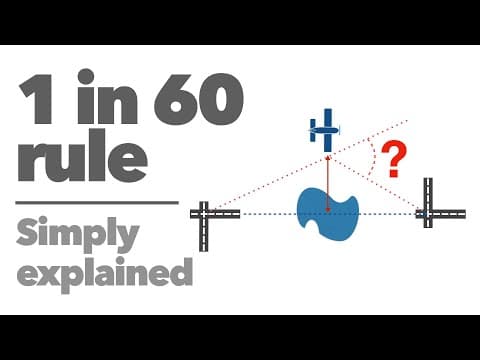
[0:00]The 1 in 60 rule is a handy navigation tool. Once you grasp this simple concept, it's easy to use.
[0:08]The best way to explain the 1 in 60 rule is by example. Assume that you planned a direct flight that is 120 miles long.
[0:19]There is a small lake halfway across and your planned track takes you overhead that lake.
[0:25]You take off and after having flown 60 miles, you find yourself one mile off track to the left of the lake.
[0:33]What the 1 in 60 rule states is that if you've flown 60 miles and you are one mile off track, your track error is one degree.
[0:43]This means that if you change your heading by one degree to the right, you'll be flying parallel to your planned track.
[0:50]But you still have 60 miles to go, and you need to arrive at your destination.
[0:56]Use the 1 in 60 rule again to obtain the correction angle. You are one mile off track with 60 miles to go.
[1:03]So your correction angle is a further one degree to the right. When you combine the track error with the correction angle,
[1:10]this gives you a two degree heading correction to your right for a direct track to your destination.
[1:18]Let's have a look at another example. Assume that you planned a direct flight that is 50 miles long.
[1:24]The lake is 20 miles out from home, and you find yourself three miles off track to the left of the lake.
[1:31]If the rule states that for a 60 mile flight, your track error is one degree for every mile off track.
[1:38]Then for a shorter 20 mile flight, your track error will be three times greater for every mile off track.
[1:46]Therefore, three multiplied by three miles off track gives you a nine degree track error.
[1:52]This means that if you change your heading by nine degrees to the right, you will be flying parallel to your plan track.
[2:00]You still have 30 miles to go. Use the 1 in 60 rule to obtain the correction angle.
[2:07]You are three miles off track with 30 miles to go.
[2:12]Therefore, two multiplied by three miles off track gives you a correction angle that is a further six degrees to the right.
[2:19]So, when you combine the track error with the correction angle, this gives you a 15 degree heading correction to the right for a direct track to your destination.
[2:30]In trickier situations, you may use these equations to obtain your track error and correction angle.
[2:39]In this final example, you planned a direct flight that is 88 miles long.
[2:45]The lake is 63 miles out from home, and you find yourself four miles off track to the right of the lake.
[2:53]By using the one in 60 equation, you determine that your track error is 3.8 degrees, which you round off to four degrees to the left.
[3:04]You still have 25 miles to go, and you determine your correction angle to be 10 degrees.
[3:11]So, when you combine the track error with the correction angle, this gives you a 14 degree heading correction to the left for a direct track to your destination.