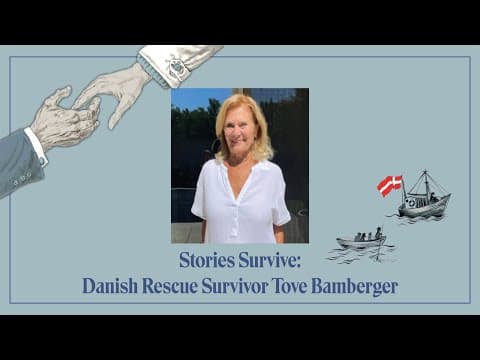
[0:14]All right. Um, hi everyone. Thank you so much for joining us today. We're so, I'm so excited to see so many of you here, especially in our uh recently uh renovated space, the Living History Center. My name is Sydney Ager. I'm the public program
[0:28]producer here at the Museum of Jewish Heritage, Living Memorial to the Holocaust. Thank you so much for joining us today. I hope that you have a chance to see our new exhibition Courage to Act,
[0:39]um, along with our other exhibitions, uh like you can see throughout the museum. So, if you have a chance afterwards, I, I really hope you will do so. Um, you're so thrilled to welcome to Bernberger and her daughter Ben with us today.
[0:58]Um, it's such a pleasure to have you. Um, so just a couple of housekeeping things that you can all turn off your cell phones, um, before we get started.
[1:07]Uh, and you each should have gotten a note card and a small little golf pencil. If you have questions throughout, we ask that you write those down on there, and then I'm going to collect them, uh, towards the end of our event today and we will ask those questions up here. So,
[1:21]uh, just keep a lookout when we've had a wave around for, uh, your note cards. Um, so, now I'm just going to give a quick introduction to Tova and then I'm going to hand it off to Tova and Annette. So, Tova was born in Copenhagen in 1934 and raised as a secular Jew.
[1:38]When the Germans invaded Denmark in April 1940, life in the country continued largely unchanged until September 1943, when Hitler issued a deportation order for all Danish Jews. Tova's family, along with 95% of Danish Jews fled to Sweden on a fishing boat.
[1:54]Tova attended a Danish school set up for the refugees in Sweden, and when the war ended, her family returned to their home in Copenhagen.
[2:02]There she married Niels Banger, who had experienced the same rescue and returned.
[2:06]In 1955, after Toba's high school graduation, Toba and Niels immigrated, settling in Washington Heights, New York, where they raised two daughters. Um, so now it is my pleasure to hand things over to Toba and Annette.
[2:29]I'm testing speaking or is it because of the microphone? Can you hear me now?
[2:35]Anyway, I'm happy to tell about my story. I first of all want to say I love Denmark,
[2:41]because Denmark saved us. You know, when the Germans came, we were actually told. We were told, what happened when the Germans came first to Denmark in 1940? When the Germans came to Denmark, what happened?
[3:00]Yes, when the Germans came, it was sort of, I remember I was playing outside and my grandmother opened the window and she said, Look up. And I looked up and the sky was dark. It was a German plane that had come to occupy Denmark.
[3:17]And Denmark is a small country, so they didn't fight. They couldn't fight. They had like a very small army. And in a way it was a friendly occupation, until Hitler found out that there was a country occupied by the Germans where they didn't have to use, so he sent a letter to a German, his name was still, his name was Mr. Duwitz.
[3:43]And he said that I will soon arrive but all the Jews are gone. So he rounded us up and sent us to, but the German that got the letter was a good German, he wasn't, he was a good German and he told me to warn them all.
[4:05]And he said, I'm not making a speech, okay? I'm not making a speech, okay? I just want to tell you all to go home, hide on among your friends, because the Germans are coming.
[4:16]And we, I went home and we, I know we took a train up to a Denmark's closest to Sweden, and a complete stranger comes up and he says, My name is Mr. Baker. I know why you're here. Come with me and I'll take care of you. And we went to his house, and he did take care of us, and he went with my father to try to get money for us. First to find a boat and find and get money to say they would take us to Sweden.
[4:48]How much money did you need? We needed like 2,000 crowns a person. It was a lot of money and he went to the bank, my father, and he got it. And I just remember when we got into a boat, we got first we took a train to a Denmark is closest to Sweden, and we did I said that, That's okay, what you were trying to get a boat. Remember and your father found a fishing boat and, he said, No, because my father stayed with a yellow color.
[6:16]He wasn't seem to Jewish and he wasn't afraid. And then one day he came home and said, we should be ready, and we were ready. And we went to the boat with my own family. And he told me that you have to wear two dresses. Oh yeah, that's right. Two dresses and a toothbrush in my pocket. And then when we stayed off, were you out in the open on the boat, were you, were you hidden on the boat?
[7:23]We were hiding in, and on the boat. And I just, I was just five years old, I think. And I was just proud that I wasn't afraid. And then when we came midway, we get midway in the water, a big boat came, and we saw it was a German who had captured us. It was really the Swedes. We said, No, you're neutral water, you don't have to be afraid.
[7:53]And we went from the fishing boat up into the big boat, and we sailed into Sweden. And there we got an apartment, and my father got a job in a bakery, and he would bring food home to us to the poor Danes, Danish refugees and bakery home, so we had something at night.
[8:15]And and I remember it as a very, very happy time. Because we knew we were safe, and we didn't realize what was really happening in the world. I don't think anybody knew what was happening.
[8:31]If there had been more people who had been like the Danes, I don't think that so many million Jews would have been killed. I said they would have been safe, but um, that's why I'm happy. I'm happy, I'm Danish. And I met my husband, and what did he, and first talk about um, when you left Sweden, did your family leave Sweden altogether? To go back to Denmark? No. Why?
[8:57]We went, you know, I think my father went first, because they said you're supposed to round up, help round up, get rid of the Germans, and they treated him like a hero. But the Germans were really captured already. But he, he helped get him out.
[9:16]And then I came later with my mother and my sister. What kind of welcome did you get when you got back to Denmark? We got back to Denmark, the Danes were standing with a Danish flag, because Denmark, it's red and white, and they were waving this, Welcome back.
[9:33]And I just wish other people had had the same experience. It was, it was wonderful to be welcome back. Talk about um, when you came back to Denmark, did you have a place to go? Was your house intact? Where did you live when you came back to Copenhagen?
[9:52]We went back to Copenhagen. My father, before he left, had owned a house. And that house was rented, I think to a German woman, or to a Danish woman who married a German. So, the house was full of pictures of Hitler. And I remember that, um, moving men kicked them all down the wall, because they didn't like to see pictures of Hitler. And, um, I just think that, I just don't understand why not more people knew about it.
[10:33]How were the Danes, um, while you were in Sweden? How did you have, what happened to your father's business? Was it destroyed? And what kind of business did your father have? My father had a business on the Main Street with twenty people working for him.
[10:46]And all he did was they took his salary, whatever, and whatever else money had come in, they put in a yellow envelope, I still remember. And when and when we came back, they just gave him everything back. They didn't take anything. Well, they didn't take anything. Nobody, nobody stole anything.
[11:27]Yeah. Had your husband's experience similar to yours? Yeah, my husband had the same experience, he also had a, uh, a business in Denmark, and he had people working for him. Is he, was he born in Denmark? No, he was born in Germany. And why did he come to Denmark? And then my, my mother, he was born in in Germany, and Germans started, uh, sending that nice in the Jews. So my mother-in-law said, I don't want to live in a country where my children are insulted.
[11:59]So she went back to Denmark. And, uh, he was born in Denmark. And moved to Germany to marry, and then in 1932 saw the writing on the wall. Realized what her son went to school and was wearing a keepa that people were saying, Dirty Jew, to him. So, she packed up her bags and said, We're out of here.
[12:19]Took her three children that she had at the time, and, uh, moved to Denmark where she was born. So there was no issue in terms of getting assimilated, she spoke the language. Then her husband, who would be my grandfather, came. He had a business going in Denmark and when things started getting really bad in Germany, he realized and left and went to Denmark also. And they had a similar experience as you in terms of getting on a boat, a fishing boat, exactly the same story.
[12:48]All the Danes, all the Danish Jews were saved more or less the same way. The Danes were wonderful, and they helped, helped us. Did all the Danes escape or were there some that went to concentration camp?
[13:01]There were some. I'm glad you remind me. Some didn't believe, they said, just it's not going to happen in Denmark, just stay home. And Germans came and took them. But the King of Denmark, his name was Christian the tenth, wrote to the Germans, we will be responsible for every Danish Jew. So they were not killed, they were kept together, and after the war they came back. They were sent to Theresienstadt, which was sort of a cross model camp where the Germans would take people to show that families were living together.
[13:30]It wasn't so terrible, we were treating people well. None of the Danes were killed because of my mom just said, the Danish Jews, they were, um, brought, they were looked after and the king said, If you touch anybody, um, it I will hold you responsible. So all the Jews that went to to concentration camp from Denmark were able to, um, return to Denmark after, which was also a very unusual story and shows you the power of people caring and speaking out and speaking up.
[14:03]I just don't know if everybody knows the story. I'm just telling what you all know. During the Second World War you were probably all born. And did you know what was happening?
[14:13]I think it took a while for for words to come out, but eventually the word was out. I mean it took a couple of years to know the atrocities and the extent of it, but it did come out. I mean, if people had been like the Danes, there wouldn't have been so many people killed. Um, Mr. Duquet, the one that we spoke about, who secured visas for so many people. He also was responsible, he had a background in shipping, and he had connections with a lot of Danes, a lot of friends in the Danish government.
[15:46]And he made sure that the German ships that were in the harbor to to take the Jews away were put in dry dock and the Germans were told that these ships are not functional right now, they have to be repaired.
[15:58]And then he paid off the harbor masters to look the other way so that, um, the Jews could escape during that Exodus. It was about 7,000 Jews that escaped over a very short period of time to to Sweden. Definitely paid off. Yeah.
[16:18]Otherwise, you wouldn't have been able to see me. And we went back to Copenhagen with, um, my husband and our kids, and went to that area, um, in Helsingør, where my parents were. My mother fled and we saw a fisherman there, and he said, Yes, his father was one of the people that rode Jews across. And I believe that the museum, is that correct, Sydney, has a fishing boat now that was taking
[18:44]Here, here. Uh, yes, the museum has a boat up in Mystic Connecticut that carried over 300 Jews. So, if you go into Courage to Act, that exhibition, if you have a chance afterwards, I highly recommend it.