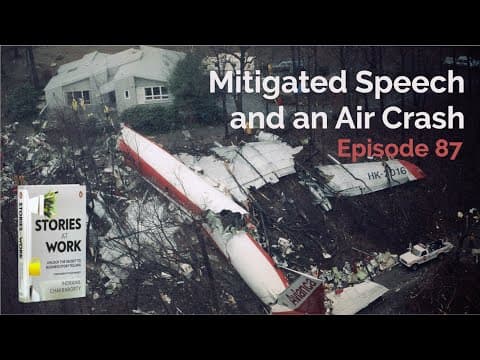
[0:00]It's 25th January 1990, Avianca 052, an aircraft belonging to the largest airline company in Colombia is about 16 miles away from the John F Kennedy Airport in New York. The plane is running out of fuel. The pilot says to the first officer, "Did you already advise ATC that we don't have fuel?" The first officer replies, "Yes, sir, I already advise him." A little over a minute passes. An aircraft traffic controller comes online and says, "Avianca zero-five-two, I'm going to bring you about 15 miles northeast and turn you back onto the approach. Is that okay with you and your fuel?" The first officer replies, "I guess so. Thank you very much." I guess so? Thank you very much? The plane's fuel gauge is showing empty and the first officer confirms that he guesses it's okay to wait? Is he out of his mind? 5 minutes later the flight engineer cries out, "Flameout on Engine number Four." Less than a minute later, the plane slams into the estate owned by the father of the tennis champion John McEnroe, in the posh Long Island town of Oyster Bay. 73 of the 158 passengers onboard, died. What really happened that day is the one thing that is responsible for a huge number of crashes in airline history. It had nothing to do with the plane. The plane was in perfect working order. It had nothing to do with the pilots. They weren't drunk or high or sick. It was nothing to do with the weather, although the weather was certainly bad that night, and it had nothing to do with air traffic control. They didn't make any catastrophic mistake. The cause of the crash was actually really simple. To know what it was, listen to this story from Malcolm Gladwell's book Outliers. Hi, welcome back to Stories at Work, a series where I share real stories from across the world that you can use when you want to drive home a business point. Our website, www.storyworks.in, already has over a 100 stories and we are adding one every week. Let's start today's story.
[2:25]It's 25th January 1990, Avianca 052, an aircraft belonging to the largest airline company in Colombia takes off from Medellin, Columbia. Its destination, the John F Kennedy Airport in New York. The weather that evening was poor. There was a storm, usually called Nor'easter blowing up and down the East Coast, bringing with it dense fog and high winds. There was huge backlog of planes trying to land at JFK. 91 planes were in queue. Avianca 052 was held up by air traffic control three times on its way to New York. The plane circled over Norfolk Virginia for about 19 minutes, above Atlantic City for 29 minutes, and 40 minutes out of Kennedy airport, it was again asked to circle for another 29 minutes. So after an hour and 15 mins of delay, Avianca was cleared for landing. As the plane came in on its final approach, the pilot encountered severe headwinds, forcing him to add extra power to maintain the momentum on the glide down. The next moment without warning, the headwinds dropped dramatically and now they were traveling much too fast to make the runway. At the last moment, the pilot pulled up and executed a “go-around". The flight crew in the cockpit that day consisted of 51-year-old Captain Laureano Caviedes, 28-year-old officer Mauricio Klotz, and 45-year-old flight engineer Matias Moyano. It was first officer Klotz's responsibility to conduct all communication with ATC, which meant that his role that night was absolutely critical. But his behaviour, was oddly passive. After the aborted, first attempt at landing, Klotz has been on the radio with ATC, trying to figure out when they can attempt to land again. Captain Caviedes turns to Klotz and says “what did he say? Klotz says “I already advise him that we are going to attempt again because, we now, we can't……” and his voice trails off. There is a four seconds silence and then Captain Caviedes says “Advise him we are in an emergency!” Four more seconds of silence. The captain tries again, “Did you tell him?” Klotz says, “Yes, sir. I already advise him. Klotz again starts talking to ATC and goes over routine details. He says “One-five-zero maintaining two thousand Avianca zero-five-two” The captain is clearly at the edge of panic. He shouts out, “Advise him we don't have fuel!” Klotz gets back on the radio with ATC and starts by repeating the last ATC command and says, “Climb and maintain three thousand and, uh, uh, we're running out of fuel, sir”. No mention of the magic word “Emergency”, which is what air traffic controllers are trained to listen for. Just, “we're running out of fuel, sir”. Now to begin with, the phrase running out of fuel has no meaning in air traffic control terminology. All planes as they approach their final destination are by definition running out of fuel, so when Klotz said that zero-five-two, no longer had enough fuel, the ATC ignored it as a nonchalant casual statement. Next, consider the structure of the critical sentence. Klotz begins with a routine acknowledgement of the instruction from ATC, and doesn't mention his concern about the fuel, which is the most important thing till the second half of the sentence. It is as if he would say in a restaurant to a waitress, “Yes, I'll have some more coffee and, uh, uh, I'm choking on a chicken bone”. How seriously do you think the waitress will take him? The air traffic controller with whom Klotz was speaking testified later that he just took this just as a passing comment. On a stormy night, air traffic controllers hear pilots talking about running out of fuel all the time. Even the “uh” that Klotz inserts between the two halves of the sentences serves to undercut the importance of what he is saying. So why did Klotz behave this way? Well, to understand this, we need to understand two concepts. One is called “mitigated speech” and the other is called “Power Distance Index”. Mitigated speech refers to any attempt to downplay or sugarcoat the meaning of what is being said. We mitigate when we are being polite, or when we are ashamed or embarrassed, or when we are being very deferential to authority. For example, if you want your boss to do you a favour, you don't say, “I need this by Monday”. You mitigate. You say, “Don't bother, but if it's too much trouble, and if you have a chance to look at it this over the weekend, that would be wonderful”. In a situation like that mitigation is entirely appropriate. However, in other situations, like in a cockpit on a stormy night with the fuel gauge reading zero, it's a big problem. Now for the 2nd concept. In 1960s and 1970s, a Dutch psychologist, Geert Hofstede, working for IBM, did a very consequential study on cross-cultural psychology. In his classical book Cultural Consequences, he writes about what is now called the “Hofstede’s Dimensions” - a framework used to understand the differences in culture across countries. The most interesting of the dimensions is what he called Power Distance Index or PDI. Power distance is concerned with attitude towards hierarchy specifically with how much a particular culture values and respects authority. In high-power distance index countries, employees are often afraid to express disagreements with managers. Power in organisations is not equally distributed, and people in power hold special privileges. In low-power distance index countries, people downplay their power, trying to look less powerful than they actually are. There are very few symbols of power, and power in such organisations is often equally distributed. A culture with high Power Distance Index is not inherently bad, but it is bad in situations in which you don't feel comfortable disagreeing with your superiors. When this happens in organisations, 2 things happen. One, good ideas never bubble up because the only ideas that are heard are the ones from the top, and two more importantly, mistakes are never pointed out, even when it is obvious to many people and that these things are not working, but these are bad for any organisation. But it is fatal in case of high-stake organisations like the one in the cockpit. Now Colombia has a high power distance index. In the cockpit the first officer Klotz, sees himself as a subordinate. It's not his job to solve the crisis, it's the Captain's job. Then of course there is the domineering Kennedy Airport air traffic controller ordering the planes around. Klotz is trying to tell them he's in trouble. But he's using his own cultural language, speaking as a subordinate would speak to a superior. The controllers, though, aren't Colombians. They are low power distance New Yorkers. Now they don't see any hierarchical gap between themselves and the pilots in the air, and to them, mitigated speech from a pilot doesn't think about this and that the speaker is being appropriately differential to a superior. It just means to them that the pilot doesn't have a problem. And that cost the lives of 73 people. What a story! Now where in business can you use this story? Many organisations are very hierarchical and India is a fairly high power distance index country. This story can be used to emphasise the importance of acknowledging and correcting the impact of this culture. As a leader, you need to ensure that everyone in the organisation is aware of the cultural nuances and the impact of high power distance index and do everything possible to reduce that in order to make it safe for people to point out mistakes or share new ideas. Sharing of new ideas by junior colleagues should be encouraged even when they're different from the ones the seniors have. There are a few things one can do to make sure that this happens, this culture is taken care of. There are still organisations where the senior person is never called by their first name. They are referred to as “Sir”. That usually reinforces the power distance. Many airlines across the world have changed the way pilots are addressed in order to take care of this deferential behaviour and mitigated speeches. One airline insists that all crew call their captain by the first name. It's easier for the first officer to say, “Rajeev, right about now, you should divert and avoid the thunderstorm the ATC is talking about,” rather than to say, “Sir, right about now, you should divert and avoid the thunderstorm ATC is talking about”. You would rather say, “Sir, what do you think about this thunderstorm ATC is talking about? What do you feel is the correct thing to do now?” Now there is another airline which refers to the two pilots not as pilot and first officer, but as a flying pilot and a non-flying pilot. So the question you need to ask yourself is what can you do in your organisation to make sure you are doing everything to reduce the impact of the high power difference index culture that India has and address the issue of mitigated speech. I hope you enjoyed that story and if you did there are many more on our website www.storyworks.in.