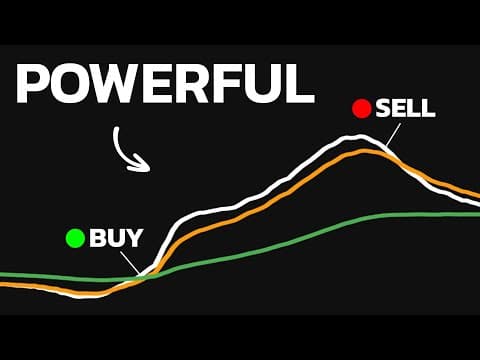
[0:00]You're gonna learn a secret settings and combination, it tells you exactly when to enter and exit. Just make sure you watch this video until the end and let's get started. But before we start, if you like my content, please support the channel by liking the video and subscribing to my channel if you haven't subscribed yet. All right, we need to add three exponential moving averages and one stochastic oscillator. First, let's add the stochastic oscillator. Here, we click on indicators and we search stochastic. This one, which is a built-in indicator on TradingView platform and we need to change its settings. So here we go to the settings of the stochastic oscillator and here for the K percent length we set it at seven and for K percent smoothing, we set it at three. So here we have seven for the K percent length, we have three for K percent smoothing and three for D percent smoothing. And then we go to the style tab and we increase the thickness of the lines, so they will be better visible on our price chart. All right, we're done with the settings of the stochastic oscillator and now we need to add the exponential moving averages. So here again, we click on indicators and we search ribbon. This one, Moving Average Ribbon, which is a built-in indicator on TradingView platform. All right, this indicator adds four moving averages to the chart, but we need three exponential moving averages with some special settings. So we go to the settings of the ribbon for adjusting the settings. First, here in the inputs tab, we remove one of them because we need three moving averages and the three of them should be exponential moving averages. So here we set EMA for them. Then here for the first EMA, we set the length at 21, for the second EMA, we set the length at 34, and for the third EMA, we set the length at 144. Then here for the first EMA, we set the color to white, for the second EMA, the color orange, and for the third EMA, we set the color to green. And finally, we go to the style tab and we increase the thickness of the lines, so they will be better visible on our price chart. All right, we're done with the settings of the exponential moving averages and now let me show how you find exact buy-sell signals based on this setup. But before that, I'm proud to announce that recently I published a book, The Art of Price Action Trading, which is a complete guide to price action analysis. The link is in the description and you can get it later if you want to master price action trading. All right, getting back to our trading strategy, now let me teach you how you can find buy-sell signals based on these exponential moving averages and the stochastic oscillator that we added here. If you remember, this green line here is an EMA with length of 144. The orange line is an EMA with length of 34 and the white line is an EMA with length of 21. We're gonna use these exponential moving averages for evaluating trends and momentum. And then we use the stochastic oscillator to identify pullbacks and end of the pullbacks, which are happening inside the identified trends. This is a reversal trading strategy, which means that we are trying to identify when a new trend is starting and then we're gonna find a low risk trading opportunity to enter a trade. Trading based on this trading strategy is very easy and you just need to pay attention to all the points that I'm gonna explain, so you can successfully and profitably execute this trading strategy in practice. Let me show how you can do it.
[3:46]First, I explain a short position setup and then I will explain a long position setup. This green line here, which is an EMA with length of 144, we use it for identifying major trend of the market. And then the orange line and the white line, which are EMA with length of 21 and 34, we use them for identifying minor trends of the market. In a short position setup, which is actually a reversal of the price from an uptrend to a downtrend, we want a situation exactly like this. Where the price from above the green line crosses the green line and goes below the green line. And after that, the white line and the orange line also go below the green line. When we have this situation that the price is below the green line and the white line is below the orange line and the orange line is below the green line, it tells us that the price probably turned to a downtrend and the minor trend is also down. But we don't enter a trade here because still too risky and we can encounter false signals. The price can just go to a trading range or again, it may advance again. We want to be more sure and safe with higher probability that a reversal is happening in the market. And for this purpose, we wait for a pullback. Because when a pullback happens and the price goes up, if there is still greater amount of upside momentum and the prior uptrend is still strong, the price will just cross the green line and advances the prior uptrend. But if the reversal is real and now we have greater downside momentum, this pullback and upside movement of the price will stop and then we will have decline of the price to lower levels than the previous low. This is the structure of a downtrend and we're gonna use this fact to enter a high probability trade. All right, so right now we are here. The price is below the green line and the white line and the orange line, both of them are also below the green line and the white line is below the orange line. Now we want to identify a pullback and end of the pullback and we're gonna use the stochastic oscillator for this purpose. We wait for the K percent line, the blue line to go above 80 and it shows overbought condition, which gives the possibility that a pullback has happened in the market and the price is ready to reverse. In the next step, we wait for the crossing of the K percent line below the D percent line, the orange line. When this happened and the blue line is already closed below the orange line, it tells us that probably the pullback ended and the price is gonna decline more. We enter a trade when the blue line is already closed below 80. You can see that it happened here when the scandal is closed. So the sell signal here is confirmed and in practice, we could enter a short position at this point. With the stop loss above the green line or above the pullback and profit target at risk to reward ratio of two. Or you can just stay longer in the trend and exit your position when there is a sign that the current trend is weakening. For example, when the white line crosses above the orange line. Please pay attention that this trading strategy is a reversal trading strategy, so we don't enter in the next pullbacks inside the trend. Here, in this trading strategy, we are trying to find starting of a trend and we only focus on the first pullback, which can provide an opportunity to enter a trade. Entering in the next pullbacks inside the trend would be a trend following strategy and that may need different measures for the settings, stop loss and profit target. So in this trading strategy, which is a reversal trading strategy, we only pay attention to the first pullback after having the other conditions that I explained. All right, this was a short position setup and now let me teach you a long position setup. All right, here we are trying to catch upside reversal of the price. We want a situation like this where the price from below the green line crosses the green line and goes above the green line. And after that, the orange line and the white line, both of them should also go above the green line and the white line above the orange line. This shows that minor trend is also up. Now we should wait for a pullback to enter a trade. Here in stochastic oscillator, we wait for the K percent line, the blue line to go below 20. This shows that probably a pullback has formed on the chart and the price is ready to reverse and start advancing. In the next step, we wait for the K percent line to cross above the D percent line. When the K percent line is already closed above the D percent line, it shows that probably the pullback ended and the price is gonna advance more. We enter a trade when the K percent line is already closed above 20, which happened here when the scandalous closed. So the buy signal here is confirmed and in practice, we could enter a long position at this point. With the stop loss below the green line or below the pullback and profit target at risk to reward ratio of two. As I explained earlier, this is a reversal trading strategy. So we only pay attention to the first pullback after having the other conditions that I explained. All right, now let me show more examples of buy-sell signals, so you completely understand.
[9:18]All right, as you can see, following the uptrend, here the price went below the green line and from here you can see that the white line and the orange line are also below the green line. Now we should wait for a pullback. We go to the stochastic oscillator and we wait for the K percent line to go above 80. And then we wait for the K percent line to close below the D percent line. When this happened, it shows that probably the pullback ended and the price is gonna decline more. We enter a trade when the K percent line is already closed below 80, which happened here when the scandalous closed. So the sell signal here is confirmed and we could enter a short position at this point. With the stop loss above the green line or above the pullback and profit target at risk to reward ratio of two. Moving on the chart following the downtrend, here you can see that the price went above the green line and after that from here you can see that the white line and the orange line are also above the green line and the white line is above the orange line. And now we should wait for a pullback, which here in stochastic oscillator, you can see that the K percent line reached to 20, that shows oversold and probable upside reversal of the price. So we can say that probably a pullback has formed on the chart and the price is ready to advance. In the next step, we wait for the K percent line to close above the D percent line. You can see that it happened here and the K percent line is already above 20. So the buy signal here is confirmed and in practice, we could enter a long position at this point. With the stop loss below the green line or below the pullback and profit target at risk to reward ratio of two. Please pay attention that although this trading strategy is very accurate, but it doesn't mean that this trading strategy gives you 100% guaranteed signals. No, this is not possible in reality and there is no trading strategy with 100% win rate. Losing positions are always part of the game and you need to manage your risk properly. There is a risk management strategy that is called 1% rule and it is one of the best risk management strategies that you can use. I have a complete guide on this, the link is also placed in the description and I highly recommend you to watch it. Because without a proper risk management strategy, you cannot become a consistently profitable trader. All right, that's it. Thank you for watching this video. If you have any questions, feel free to ask and leave a comment for me. I'll answer your questions as soon as possible. If you haven't subscribed to my channel, please subscribe and hit the bell so you get the notifications of my new videos. See you guys in next video and good luck with your trading.