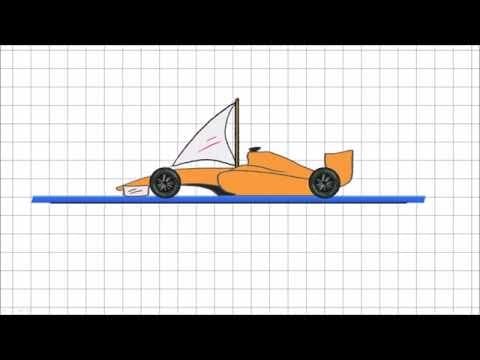
[0:02]Nothing spices up a race like rain. And unlike your typical road tire, Formula 1, and most track racing series, use different types of tires for wet and dry conditions. Why is this then? And how do wet tires work? Well, let's look at what makes driving in the wet different. Firstly, remember that dry F1 tires are slick. Now, weirdly outside of racing, the word slick means slippery, but this is F1, and F1 never tried to make sense. Slick tires are the grippiest tires you can get. They're slick because they've got no tread at all in the tire. The entire surface is smooth, flat rubber, noticeably different from your road tires which have to be ready for most typical weather conditions. The F1 tires are slick because you want as much of the surface touching the track as possible. The grip is generated by the friction between the rubber and the road. More area in contact with the road means more grip. When the track is wet, those slick tires start to do the complete opposite of what you wanted them to do, and that's aquaplane. If there's enough water on the track, the tires will start to ride on top of that water like a boat. A full aquaplane can lift the car completely off the track and give the driver no control at all over their speed or direction. Instead of maximizing the contact between the tire and the road, you've ended up completely minimizing it. In fact, the floor of an F1 car is so low to the ground that if the track is wet enough, the entire car can sail down the track in a manner even Ellen MacArthur would juggle to control. The other thing to remember is that tires grip best when they're warmed up. When cold, the rubber is hard and less grippy. Warming the tires up makes them more malleable and sticky, gripping and hugging the tarmac like an overly friendly ant, I guess. So, what do wet tires need to overcome these issues? Firstly, the diameter of the tires is larger. Not a lot larger, just 10 millimeters or a centimeter, but enough to lift the floor up and away from the water and reduce the risk of full body aquaplaning. And then we come to the grooves. The grooves being the defining characteristic of the wet tire. They cut channels into the surface of the tire leaving rubber islands between the grooves, known as tread. As the tire turns on the wet track surface, the grooves channel the water, giving it somewhere else to go, and allowing the tread to contact the road. The distinctive shaped grooves mostly aim to expel the water as quickly as possible away from the tire, straight out of the sides. Wet rainy conditions also cool the tires down below their ideal malleable gripping temperature, I mentioned a minute ago. Dividing the surface of the tire into tread blocks also allows the rubber to flex a little more, which helps it to build up heat more quickly. Actually, the rubber on wet tires is softer even than those on the softest dries, specifically to get them up to temperature much more quickly. You're probably aware there are two types of wet tire in F1. The intermediates which are suitable for most typical damp to wet conditions and the extremes, the strongest soccer wrappers for when it gets really wet. There are a few key differences between both of them. Let's have a look at the tread patterns on each of the tires. For a start, the tread on the inters is three millimeters deep, while the extremes are five millimeters deep. You'll notice the grooves on the inters don't actually completely divide the rubber into islands of tread. They displace the water in a much more passive way and have a lot more rubber on the tread, really maximizing how much of the tire still touches the road. Having more rubber surface will also stop overheating if the track dries up. The extremes on the other hand have a tread pattern that is heavily asymmetrical. That is the outside of the tire, the side facing away from the car, has a much more aggressive groove pattern than the inside. After all, when the track is drenched, you don't want to throw too much water at and under the car itself. The intermediate tire can displace an amazing 25 liters of water a second. The extremes displace a frankly ridiculous 65 liters of water every second. Every second, that's this many two liter bottles of your favorite brand of Diet Coke drink. No wonder it's basically impossible to see when following a car in the wet. So why don't we just use the wet and the dry and be ready for anything? Well, there's a number of really simple reasons for that. Firstly, in the dry, as I've said about six times already, we want to maximize how much rubber is in contact with the surface of the road for maximum grip. But this reason pales in comparison with just how quickly wet tires degrade in the dry. I mentioned that a lot of the design of the wet tires, the much softer rubber and the way the tread is cut, is to get the tire heated up. I also mentioned that a warm tire is much more malleable and sticky. Well, as with chocolate cake and the X-Men films, you can't have too much of a good thing. Once the tire gets too hot, it starts to degrade, crumbling to pieces instead of gripping on the track. This puts the lifespan of the tire into extreme decline. As the track begins to dry, and conditions are still marginal, you'll see drivers moving over onto the wet part of the track and away from the dry line to keep the tires cooled down to a temperature where they don't start falling apart. Having said all that, Formula E uses one type of tire for all weather conditions, so it's definitely possible. But Formula E aren't trying to maximize performance every stage, so they're comfortable to go with the economical solution of using one tire for all. So there it is, that's how wet tires work. Coming soon, I'll show you how drivers change their driving style and strategy in the wet, and what makes the difference between ending up drenched in dismal failure or soaked in success.
How do Wet Tyres work?
Chain Bear
5m 17s1,084 words~6 min read
Auto-Generated
Watch on YouTube
Share
MORE TRANSCRIPTS