[0:13]In the early morning hours, Gianni Crea is awake to open up the Vatican Museums for the thousands of tourists who visit daily. He is the Vatican Museum's key master. Beginning at 4:45 a.m., he coordinates the five people who open the museums in the morning and the five who close it around midnight. Yet, he not only oversees the work but walks one mile in the morning opening up each of the doors and gates. Each door and key is numbered, ensuring that among the 2,979 keys all are present.
[1:03]Here we are. Next, we will continue and go towards the Chiara Monte Gallery.
[1:14]However, after 21 years on this job, Johnny knows the keys like the back of his hand. One of the most spectacular parts of this job is being the first one to turn on the lights of the Sistine Chapel. He has the entire room all to himself before the tours begin.
[1:49]I have the opportunity to open the Sistine Chapel for all the tourists that visit from around the world. So it's unique, extraordinary, and beautiful. For me and also for my colleagues, we are also in the center of Christianity, so for a Catholic, it's more than you could ever want. Every day he's able to admire the frescoes Michelangelo himself painted for nine years in the early 16th century. It's not only this room which impacts him, but all the hallways and paintings remind him of history and the center of the Catholic Church. For example, this tapestry of the Resurrection of Christ, designed by Raphael has Jesus's eyes follow him each morning as he makes his rounds. It's an artistic illusion that always intrigues tourists. Immediately after, he turns on the lights for yet another well-known hallway. Here we are in the Gallery of Geographical Maps. It's one of the most beautiful galleries, hands down, that represents Italy through maps. These 40 maps showing each Italian region were requested by Pope Gregory the 12th in 1580. They were designed by Ignazio Danti to fill the 400-foot hall. Each aspect shows how art connects to faith. Going from hallways and the gallery of statues to Raphael's rooms. Here we are now in Raphael's rooms. At the end of the early morning tour, he concludes with a rare view, only reserved for the key holders looking out onto the Vatican. He can see all of Rome, but he says there's nothing like the museums. Everything is beautiful in the museums. Every door, every part has a story to tell, has its uniqueness. Yet the Sistine Chapel always wins for its history and art. I believe in the Sistine Chapel, but in the museums in general, art has the power to unite everyone in the world. This power is evident in how the number of tourists who come to the Vatican Museums has grown over the years. Crea asserts when he started more than 20 years ago, not even 2 million would come a year. Now that number has nearly quadrupled. It's a testimony to not only history and art, but to the Catholic faith that universally unites the global church.
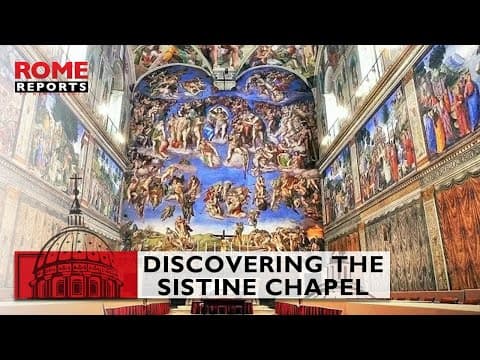
[4:33]If these walls could speak, they would not only tell the difficult story of how they were decorated, but also of the various conclaves that took place within the space. The Sistine Chapel is named after Pope Sixtus IV, who had it built in 1477. In 1505 his nephew, Giuliano di Medici, Pope Julius II, then asked Michelangelo to decorate this special room. The result is this, one of humanity's greatest treasures. Yet this beauty is not only the work of Michelangelo Buonarotti. Among others, Perugino, Botticelli, Signorelli, Ghirlandaio and Cosimo Rosselli are all very important names in Italian art history. Michelangelo was the main designer of these frescoes, although curiously, he did not consider himself a great painter. He instead wanted to be recognized for his expertise with marble. In fact, he was already very famous in Florence when he was called to Rome. Julius II wanted him to sculpt his grave, which includes the famous sculpture of Moses at the front. However, this project frustrated Michelangelo, so he received another assignment. One of the things that made Michelangelo reluctant to accept this commission from Pope Julius II was the challenge of painting a fresco on such a large surface, because he was a sculptor, not a painter. The biggest challenge for Michelangelo was to paint the Creation. This concave surface of 13,000 square feet required an enormous effort to appear like a flat surface for visitors below. Interestingly, Michelangelo did not follow a step-by-step process when painting the room. He instead began with the last story, Noah's Ark, and went back in time to the Creation. The last painting done was of the separation of the light from the darkness that happened before God created the universe. The artist faced another problem. He had to paint the image before it dried because otherwise, he couldn't modify it. Therefore, he had to destroy the fresco several times and restart them once again. After painting the famous creation, he left Rome to only be called back 30 years later to paint the Last Judgment.
[7:20]There was talk of a tense relationship between the pontiff and the artist. It is true that some literary and biographical testimonies from the time say Julius II was very impatient. He wanted to show the room to all of Rome who was waiting to see it. The problems didn't end there, since the work was painted amidst the Lutheran Reformation, many saw some elements that did not fit in with Catholicism. It was even considered vulgar for showing naked bodies. Michelangelo, however, had another theological meaning for the nudity. Being the Last Judgment, man's nudity is just as when he came into the world during creation. It thus ties together the beginning of man, represented with the famous meeting of the hands. It is a humanity outside the dimension of sin, a humanity represented by what exists when one is with God. Yet, not everyone could see it that way. Pope Pius IV proposed the so-called fig leaf campaign and commissioned Daniele da Volterra to cover each of the naked parts in Michelangelo's work. The painter who was responsible for covering all these parts was called the mutandino or braghetone because he put the underwear on the people. The citizens of Rome did not stop to think about the meaning of this censorship and only saw a man who was responsible for covering the bare parts. That's why they gave the painter this nickname. With all the difficulties, obstacles, and changes, Michelangelo managed to leave an everlasting testimony of his talent in one of the most fascinating places in the world still seen today.
[9:02]A conclave is a moment of change and anticipation to discover who will be the new successor of Saint Peter and leader of the universal Catholic Church. But imagine experiencing a conclave from inside the Vatican Museums in Sistine Chapel to the other secret passageways blocked off to the public. This is the experience of Gianni Crea, the Vatican's key master. During the conclave, we, the competent authorities, divide the keys and close all the doors from the museums to the Sistine Chapel's interior. Then the sole key we have to the Sistine Chapel is kept by the gendermaria to make sure the silence and nomination of the next Pope remain secret. The keys are designed so no one can have access to the interior of the Sistine Chapel from the side of the Vatican museums, but only cardinals entering from the Regal room. Each cardinal under age 80 is eligible to vote starting the first day inside the Sistine Chapel. Votes are cast each morning and afternoon until a two-thirds majority vote for the same person is achieved. After each round of voting, the famous black or white smoke can be seen from the Sistine Chapel, of which the Vatican's key master has an exclusive view. From here, you can see the Sistine Chapel and if the smoke emitted is black or white, white smoke means a new Pope has been elected. When my colleagues and I saw this in the last conclave with Pope Francis, who ran to St. Peter's Square to find out the name of the new Pope. Nobody can predict a conclave's length. In fact, the longest one was nearly three years, while the shortest was only three ballots. Yet, no matter the length, at least the view from the Vatican Museums is beautiful, as cardinals inside the Sistine Chapel or the key holders closely watching from outside.


