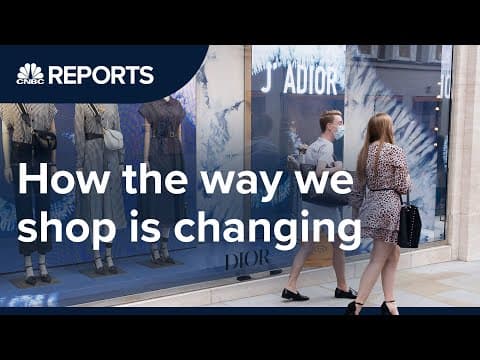
[0:00]The COVID-19 pandemic is just the latest challenge for retailers. The high street has been under pressure for some time as more people opt for the convenience of shopping online and retailers have also struggled in the face of increased competition.
[0:16]Lockdowns, social distancing regulations and falling consumer confidence have made the situation worse with many retailers closing stores. So, how is the retail sector facing these new challenges?
[0:35]Across the world, lockdowns and social distancing measures have forced many retailers, deemed non-essential to close their physical stores. The shock fall in revenue has pushed many firms into financial crisis.
[0:50]In the UK alone, fashion chains, Oasis, Warehouse, Debenhams, and Cath Kidston, just to name a few brands, went into administration.
[1:00]At the same time, consumers confined indoors were forced to use online shopping for most items.
[1:07]In April alone, Inditex, the biggest fashion group in the world, which owns Zara and Pull&Bear among others, reported a 95% increase in online sales.
[1:18]H&M reported a 40% jump in online sales from December till the end of May, and this is a trend that's likely to accelerate as more people come online.
[1:29]While the overall impact of the pandemic on e-commerce remains to be seen, the coronavirus crisis has already altered consumer behavior.
[1:40]Among 100,000 consumers surveyed in 50 different markets, 45% said that they are prepared to keep using products and online stores they found during the lockdown.
[1:53]This number rises to 50% for households with children.
[1:57]To answer this demand, retailers will have to keep investing in their online presence and delivery services.
[2:04]For example, Go Instore, a retail technology startup, works with different retailers to provide customer support through its advisors, who can offer tips on products and answer customers' questions.
[2:18]and once, but now on this device here, it's even more intuitive than before.
[2:22]It's all about giving consumers the comfort, uh, which they might not get, um, you know, without human-to-human interaction.
[2:28]We're still utilizing the stores and the store staff, it's just they're being utilized digitally.
[2:32]So, what is the future hold for brick-and-mortar shops? Will the high street or the mall be another casualty of coronavirus?
[2:40]There's a lot of uncertainty. We're bringing in all this social distancing, and that's creating for a lot of people quite a frustrating customer experience, right? You can't try on clothes in the changing room.
[2:54]You know, a lot of the stock has to be put elsewhere after you've touched it. Many brands are taking stock of how much physical presence they need. Inditex, for example, said it will close up to 1,200 shops worldwide.
[3:07]Department stores, John Lewis and Debenhams, have also announced store closures in the UK.
[3:13]Nonetheless, analysts are convinced the pandemic won't mean the end of the physical store.
[3:19]So, I'm actually quite bullish on this. People are coming back to stores. Our consumer research has told us time and time again that people like shopping in stores.
[3:28]Even millennials and Gen Z's that have all the apps on their phone, still like to shop in stores.
[3:33]As lockdowns lifted, consumers have been returning to the shops in droves.
[3:39]For instance, retail sales in the UK jumped 13.9% in June from the previous month, as non-food and fuel stores were allowed to reopen.
[3:50]In the eurozone, retailers also registered a higher number of purchases when lockdowns began to lift in the month of May.
[3:59]Retail sales were up 17.8% from April.
[4:03]But in most cases, shoppers return to a different retail experience. There are limits on how many people are allowed in store.
[4:12]Temperature checks are the norm in some places, and there are restrictions on trying on clothes. Even so, we might opt to shop in different locations.
[4:21]In the short term, I think malls and retail parks will do better because they're able to do social distancing, they're wide open spaces, they have big passageways, it doesn't feel unsafe.
[4:34]66% of people have said they will continue to avoid busy places, even as official restrictions are relaxed.
[4:42]Locations that used to command a premium on rents because of high footfall might now be a drag on tenants and landlords alike.
[4:51]How about our shopping carts? Have our shopping habits changed because of the pandemic?
[4:57]We'll see a lot more athletic wear, loungewear, casual clothing, fewer dress-up and occasion wear.
[5:06]And combined with the fact that people are going to be working from home more, there'll be obviously fewer office and informal clothes and more casual clothes. So it'll be a shift in the mix of what people buy.
[5:16]Recent data has also shown a surge in bicycle sales, DIY products and furniture items as people spend more time at home.
[5:26]Besides catering to these new consumer patterns, some retailers are looking to bridge the online and the physical store experience in this new landscape.
[5:36]demand for our technology from our existing customers increased dramatically. And then we've had a huge influx of of new retailers coming to us and and and trying to utilize the solution.
[5:45]What sort of retailers are looking at your product and seeing, well, this could really help us?
[5:52]Think about the products that typically you would research online but you'll be more comfortable to purchase in store. So things like consumer electronics, cosmetics,
[6:01]uh, believe it or not, fragrances is is working really well. And then of course, we've we've got things like sporting goods.
[6:06]And then like other leisure industries facing further disruption, retail still represents an opportunity for consumers to part with their cash.
[6:15]There's a real desperation in a lot of people to get back to doing normal things, and actually going to store and going shopping could be a part of bringing that normality back.
[6:27]Hi everyone. Thank you so much for watching. Where have you been shopping lately?
[6:31]Let us know in the comment section and don't forget to subscribe. I will see you soon.