[1:06]So let A, B, C be sets, let F be a function from A to B and G be a function from B to C.
[1:43]The composition of F and G is G of F from A to C.
[2:20]And G of F of A is equal to F of A. Sorry, G of F of A is equal to G of F of A.
[4:08]So in this course, we will study vector spaces which depend on a choice of field.
[5:15]Common example is R, real numbers.
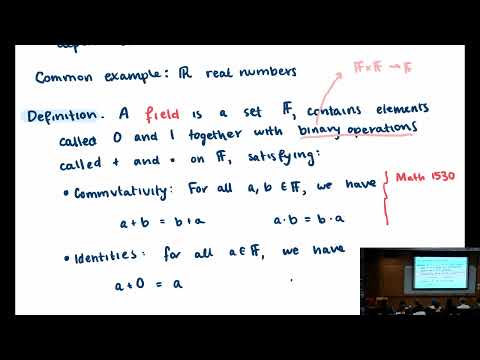
[7:28]A field is a set F, contains elements called 0 and 1 together with binary operations called plus and dot on F, satisfying commutativity.
[10:28]For all A and B in F, we have A plus B is equal to B plus A, A dot B is equal to B dot A.
[12:26]Identities: for all A in F, we have A plus 0 is equal to A and A dot 1 is equal to A. Additive identity and multiplicative identity.
[18:09]Associativity: for all A, B, C in F, we have A plus B plus C is equal to A plus B plus C, and A dot B dot C is equal to A dot B dot C.
[19:53]Inverses: for every A in F, there is a unique B in F such that A plus B is equal to 0, additive inverse of A.
[21:19]For every A in F with A not equal to 0, there exists a unique C in F such that A dot C is equal to 1, multiplicative inverse of A.
[25:15]And distributed property: for all A, B, C in F, C of A plus B is equal to C of A plus C of B.
[26:31]Question: what other examples of fields do you know? So R, Q. Z does not have multiplicative inverses. For example, the set {1, ., /} which is the multiplicative group of integers, if we assume a at F6, which is the multiplicative inverse of 3, 3*a = 1. If we multiply both sides by 2, (3*a)*2 = 1*2. So a*(3*2)=2, or a*0=2. This is a contradiction, which implies that 3 has no multiplicative inverse. So what if P = 1? F_0? checked. It is 0, +, -. It is not 0, -1, 1, it is 0, +, -.