[0:00]At 22:14 local time, 16 Israeli F-35 Adirs were crossing the Macros Mountains at 38,000 feet on what should have been the most straightforward mission of operation Rising Lion. 30 petroleum targets, nine days of air defenses already dismantled, and a straight line home. This would change in a matter of seconds. Unknown to the pilots, an Iranian S-300 missile system that should have been destroyed was already locked down on them because Iran had played a trick on Israel. The target that Israelis hit on March 3rd was a decoy. A convincing one, correct launch silhouette on satellite imagery, plausible thermal signature, enough to breathe to check the box. But the real S-300 had been driven 50 kilometers into the mountains and sat cold ever since. And now 16 aircraft with the radar profile of a delivery truck had just entered their roughly 150 km engagement envelope. On any other night, the Adirs would have ghosted past. The F-35 eyes radar cross section in stealth configuration, marble-sized, invisible at this range. But the F-35's each had four Spice 1000 precision guided bombs on external wing pylons and cramped two GBU-31 JDAM's in the internal base. Every pylon, rack and hard point multiplies the radar return. Israel calls this beast mode. The IAF had traded the jet's defining advantage, invisibility for raw carrying capacity. Betting there was nothing left to detect them. The S-300 crew was calling that bluff. The battery had 90 seconds to take the shot. The moment its radar transmitted an EA-18G Growler from the USS Abraham Lincoln's Air Wing orbiting Western Iran to catch exactly this kind of mission, triangulated the source and pushed coordinates via Link 16 to another Growler 60 miles south. AGM-88 HARM off the rail, seeker locked on the emission frequency, accelerating past Mach 2. Inside Ruby Lead, the pilot watched the threat diamond pulse on his display. The HARM was 70 seconds out. The S-300 was still in search mode, but a competent crew can transition to fire control in 40 seconds. If the antenna switched to continuous track before the HARM arrived, the next thing on the scope would be a missile with Ruby Flight's name on it. 60 seconds. The Growler pilot held the emission on his scope, watching the HARM's track converge on the source. 50, the S-300's pulse rate increased, the crew cycling faster, narrowing the beam. 40, still searching, not locked. The formation pressed east and waited for one of two flashes, the HARM hitting the antenna, or a SAM clearing the rail. The HARM smashed into the antenna array at Mach 2.1. $115 million air defense battery erased in a flash that lit the mountain ridge like a second sunrise. Nine days of patience, four seconds too early. The crew never transitioned to fire control. They never got the shot. But the flash faded and the lesson didn't. Degraded and destroyed, turned out to be very different words. If one S-300 had survived the weeks of coalition strikes by sitting cold in the mountains, the question wasn't whether Iran had hidden more, it was how many. And they wouldn't announce themselves until the next threat diamond lit up someone's display. But there was something bothering the pilots even more than Iranian missiles. 1800 kilometers separated Nevatim Air Base from Tehran, 1800 back. On any previous operation, that math demanded aerial refueling from KC-707 tankers orbiting Western Iraq. Aircraft so predictable, Iranian Intelligence had been tracking their orbit shifts for days. Every time those tankers moved, Irania knew a strike package was inbound. Tonight, the Adirs carried external drop tanks you see here to give them that extra mileage. Independence came with a price, though. Zero margin. Think of it like driving across the desert with exactly enough gas to reach the next station. No detours, no wrong turns, no speeding. Except every evasive maneuver was a wrong turn, and the S-300 evasion had already burned fuel from reserves that technically didn't exist. No tanker orbiting to bail anyone out, and they hadn't even reached Tehran yet. 12 kilometers from Shahran, the largest depot in Northwestern Tehran, 11 storage tanks, 260 million liters. Ruby Flight got the second threat diamond of the night, not from behind, but from inside the depot perimeter. A Pantsir S-1, Russian supplied, mobile, short-range point defense, 20 km missile envelope and inside 4 kilometers, twin 30 mm cannons firing 5,000 rounds per minute under radar direction. Parked between the storage tanks, hidden from satellite imagery by the tank farm's own geometry, tonight it was the only line of defense. And the pilots flying toward it were the high value targets. Worse, the Adir escort that would normally handle a pop-up contact was still 50 kilometers behind, transitioning from the S-300 engagement. No anti-radiation missiles on Ruby Flight, the ASQ-239 and a hard break. That was it. And a hard break during a bomb run means not dropping the bomb. Ruby Lead pressed 16,000 feet in a predictable dive. The Pantsir's tracking radar burning through the ASQ-239's jamming at 14 kilometers and closing. He passed through the auto cannons 4-kilometer engagement window for roughly 8 seconds. 8 seconds of radar-directed 30 millimeter against a fighter that couldn't jink because the bomb needed a stable release. The Spice 1000 released off the wing pylon when its scene-matched area correlation began comparing what it saw versus what should be there. Before the mission, imagery analysts loaded a three-dimensional reference image of each storage tank into the bomb's guidance computer. For release, the Spice extends folding wings and glides. No rocket motor, no thermal signature, GPS steers it to the neighborhood. Then in the final seconds, the bomb does something remarkable. Its electro-optical seeker photographs the ground and compares what it sees pixel by pixel to the reference image. Like facial recognition, but for buildings. It doesn't just fall toward coordinates, it recognizes its target, circular error, 3 meters, the length of a car. The Israeli pilot called it weapon away, then the break, hard right. Flares punching out of the dispensers in pairs. The G-suit crushing his legs as the jet wrenched off the bomb run heading. The Pantsir's missile warning tone screamed in his helmet. One round off the rail, tracking, closing. The ASQ-239, the F-35's built-in electronic warfare system, hammered the missile seeker frequency, essentially flooding the missile's ears with so much noise it couldn't hear where the jet actually was. 3 seconds of the loudest silence in the pilot's career. The tone warped, faded. The missile's track bent away from his jet as the jamming degraded the solution. Miss. The round corkscrewed into the dark somewhere behind the formation. But the Pantsir was still radiating, dangerous, and sitting between 11 fuel tanks that hadn't exploded yet. Tank number two went first. The Spice's warhead punched through the steel shell, detonated 2 feet above the fuel surface. 30 million liters of gasoline atomized into a vapor cloud that ignited before the fragments finished traveling. The fireball climbed 300 meters in 2 seconds, orange and black, rolling upward into the Tehran night. The Adir escort arrived 60 seconds later. The pilot had watched the Pantsir nearly SWAT Ruby Lead from 30 miles out on DAS. The distributed aperture system, six infrared cameras bolted around the F-35 that see what the pilot isn't looking at. Now the Pantsir's tracking radar was still sweeping, hunting for Ruby 2's egress. The escort rolled in, Spice off the pylon, and put the weapon through the chassis. The radar emission cut to black mid-sweep. $30 million of Russian air defense hidden for days between fuel tanks, undone by a glide bomb that cost less than the radar dish it landed on. Two SAM engagements in the first seven minutes. Zero margin on either one. Tank four, diesel, burns hotter, longer. The rupture split the sidewall. Tank 7 and 9 went within a second of each other. Four impacts merging into a single inferno that threw shadows across neighborhoods a kilometer away. And then came the problem nobody modeled. A smoke column punching through 5,000 feet, expanding east across the Tehran basin, directly into the approach corridors of every remaining target in the package. Sapphire Flight, four Adirs with GBU-31 JDAM's hit the wall 12 miles east of Agdasia. Not a SAM, not a MiG, a curtain, an anvil-shaped cloud of superheated petroleum smoke expanding east in the prevailing wind. Its base glowing orange, upper edges catching the city's ambient light, and Sapphire Flight was heading straight into it. Their own success, drifting across the target area at the worst possible moment. The depot Ruby Flight had just destroyed were now generating a smoke column that blocked the path for every aircraft behind them. The first bombs had built a wall that the next wave had to fly through. However, JDAM steered by GPS. Smoke wouldn't touch the weapon's guidance. What it touched was the human step. The moment where the weapons officer looks through the targeting pod, confirms the crosshairs sit on the oil tank and not the apartment complex down the street, and commits. Sapphire One repositioned 15 degrees south, 40 seconds of fuel he didn't have to get a clear EO look at Agdasia. The pod slued through the amber haze. Nothing. Nothing. Then the hard edge of a tank roof cutting through a gap in the smoke. Crosshairs settled, coordinates matched. He committed and released his JDAM. The JDAM's tail kit corrected 10 times per second, steering through clear air on the far side of the column. Clean hit. The roof peeled back like a can lid before the fuel caught. Then the second problem arrived on the same frequency as the first. A mobile GPS jammer activated somewhere in the Tehran basin. Truck-mounted, domestically built, Iran has been manufacturing these since they allegedly spoofed an American RQ-170 onto an Iranian runway in 2011. The fixed jammers went down on day one. Mobile units moved every few hours and the Israelis hadn't found this one yet. Noise flooded the L1 and L2 frequencies, the GPS bands every GBU-31 in the package depends on. The Spice bombs carry an electro-optical backup, but it, too, was already degraded because of petroleum smoke. Both guidance passed degraded simultaneously by two threats that didn't know the other existed. Think about what that means for a 2,000 pound bomb. A JDAM reporting nominal guidance all the way down, while tracking a phantom coordinate 200 meters from the programmed aim point, heading for whatever sits there. And the pilot can't see through the smoke to catch the drift until the satellite imagery tells him 12 hours later. 60 kilometers west, an F-15I Ra'am WSO was running his APG-82 AESA radar in ground mapping mode. Painting terrain through smoke the way sonar maps the ocean floor, even cross-referencing radar returns against his target coordinates when numbers that should have matched stopped matching. The depot's position on radar sat 5 meters west of where GPS said it should be. He ran it again. Same drift. 5 meters sounds academic until you remember every depot sits a few hundred meters from residential buildings and the weapons are already falling. His hands moved before the math finished. Updated aim points keyed into Link 16 and pushed to every aircraft in the package. AESA corrected coordinates compensating for whatever the jammer was introducing. Not sub-meter precision, not the 10 meter GPS spec, something in between, stitched together from a backseat through a data link running hot with 16 aircraft. Nobody planned for this. On the ground in Southern Tehran, the IRGC was fighting blind. The fiber optic nodes connecting air defense commanders to their batteries had been rubble since day three. What was left ran through civilian cell networks already buckling under 10 million people trying to call their families. A motorcycle courier carrying coordinates for the GPS jammer's next relocation point was stuck in traffic caused by the evacuation his own forces triggered. The war was outrunning the people trying to manage it. And while every sensor in the formation pointed at smoke columns and phantom coordinates, something launched out of the dark South of Tehran that nobody saw coming. A single MiG-29 had rolled off a dispersed runway during the Shahran explosions, when the sky was saturated with thermal noise and every eyeball in the formation was locked on burning fuel tanks. Radar off, running dark, no electronic emission of any kind. The MiG-29's first, infrared search and track, a passive sensor that detects engine heat without broadcasting anything detectable, swept the sky south of the depot fires and found what it was looking for. A thermal contact at roughly 15 kilometers, an F-16 Barakh descending through 18,000 feet toward the Southern targets. Engines at military power, pilot's attention on the ground. The Barakh's warning radar receiver, silent, because there was nothing to warn about. The MiG was closing the way carbon monoxide fills a room. No smell, no sound, nothing on any gauge until someone doesn't wake up. 12 kilometers, 10. The first return sharpening with every sweep. The Barakh exhaust plume growing on the scope. The Fulcrum pilot's thumb rested on the weapon selector. Inside the R-73's envelope now, tone building in his headset. 8 kilometers from release now. The Adir transitioning south from the Pantsir engagement saw it. His DAS flagged him a moving heat source against the city's thermal background that didn't match any friendly track. The Adir pilot locked it, fire control radar painted the MiG from 30 kilometers. The MiG pilot's radar warning receiver lit up and he understood exactly what an F-35 lock meant. It's the fighter pilot equivalent to hearing your wife say your full name from across the house. You don't ask questions, you start running. Hard descending break, diving into the thermal clutter of the burning depots, using the heat of a city on fire as a camouflage. The Adir held the track for 3 seconds before the thermal noise swallowed it. The MiG ran south at low altitude and recovered at a dispersed field. No shots fired, but 8 kilometers is inside the R-73 range. The Barakh pilot was seconds from a missile he'd never have seen coming. Iran's Air Force was supposed to be grounded. Nobody told the MiG-29 pilot, and the hardest target was next. Nothing on the target list looked like the Tehran Refinery in Shah-e Rey. A 225,000 barrels per day processing facility, cracking towers, distillation columns, pressurized vessels holding superheated hydrocarbon vapor at 400 degrees Celsius. The target was the fuel storage adjacent to the processing core. Miss short, empty ground, miss long, a catalytic cracking unit ruptures and triggers a cascading overpressure chain. Pressurized vapor finding escape routes through connected pipe junctions, each breach feeding the next. The kind of chain reaction that stops being a military strike and starts being like Chernobyl with extra steps. Emerald Lead, an F-15I Ra'am, lined up with the northern perimeter storage. His WSO had the best ground picture available. APG-82 terrain mapping overlaid with the corrected coordinates he calculated after catching the GPS drift. Through the accumulated smoke of three depot fires, the targeting pod showed thermal haze where refinery should have been. He wasn't seeing his target, he was trusting a radar picture from the nose of his aircraft, a GPS correction calculated by another WSO over a different quadrant of the city, and the map connecting the two through a data link running at capacity. The military equivalent of driving blindfolded because your GPS insists the road is there. Making matters worse, Emerald Lead's fuel gauge had crossed Bingo 4 minutes ago. The number where doctrine says stop what you're doing and go home. The extra fuel tanks that brought independence from the KC-707's were burning down since the Zagros and every smoke detour ate margin the mission planners never budgeted. One pass. Not because the mission demanded it, because the fuel said so. If the JDAM missed or a thermal plume kicked it sideways, there was nothing left to fix it with. And then there were the thermal plumes. Imagine throwing a football through a bonfire and expecting it to land on a dinner plate on the other side. Except the football weighs 2,000 pounds and missing the plate means hitting someone's apartment building. Burning petroleum throws superheated updrafts, columns of 600 to 800 degree air rising at velocities that dwarf normal turbulence. A JDAM's four fins correct 10 times per second for wind. They were certified for foul weather, not for superheated air punching upward at 30 meters per second through the weapon's flight path. The WSO stared at coordinates he couldn't visually verify on a target he couldn't see through a targeting pod showing nothing but thermal haze. The radar said the depot was there, the math said the correction was good. Every instrument in the backseat agreed. He committed. Pickle button down, JDAM away, 2,000 pounds dropping into a burning atmosphere on borrowed numbers. First weapon into the northern storage area. The secondary detonation, 60,000 barrels cooking off sympathetically, registered on the University of Tehran's seismographs. Not because the bomb was large, because that volume of petroleum igniting simultaneously shakes the ground hard enough to rattle instruments designed for earthquakes. Somewhere in the geology department, a graduate student's thesis data just got very interesting. Second weapon into the Southern perimeter. Two hits bracketing the refinery's processing core without touching it. 120 meters of clearance through smoke, GPS drift and thermal plumes that shoved the second bomb 3 meters off its programmed trajectory during terminal flight, 3 meters. The margin between hitting a fuel tank and hitting whatever's on the other side of the fence, achieved through smoke and GPS drift and a backseat the WSO couldn't see out of. The debrief would spend hours arguing whether that was engineering or divine intervention. If you enjoyed this video, watch our other video of B-2 bombers pounding Iran. Bye for now.
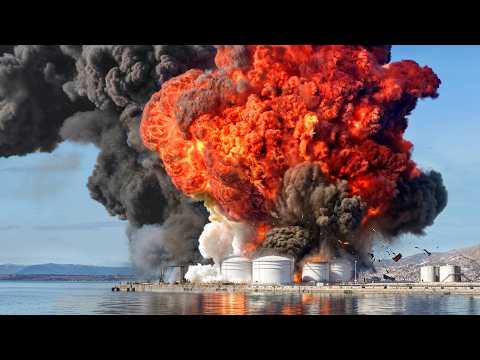
Something DANGEROUS Just Exploded in Iran... They’re Finished
Beyond Military
18m 45s3,015 words~16 min read
YouTube auto captions
Transcript source
YouTube auto captions
This transcript was extracted from YouTube's auto-generated caption track. The transcript below is server-rendered so it can be read, searched, cited, and shared without opening the original YouTube player.
Pull quotes
[0:00]At 22:14 local time, 16 Israeli F-35 Adirs were crossing the Macros Mountains at 38,000 feet on what should have been the most straightforward mission of operation Rising Lion.
[0:00]30 petroleum targets, nine days of air defenses already dismantled, and a straight line home.
[0:00]Unknown to the pilots, an Iranian S-300 missile system that should have been destroyed was already locked down on them because Iran had played a trick on Israel.
[0:00]A convincing one, correct launch silhouette on satellite imagery, plausible thermal signature, enough to breathe to check the box.
Use this transcript
Related transcript hubs
Watch on YouTube
Share
MORE TRANSCRIPTS


