[0:00]Last year I grabbed the Philips 2000 air fryer during Black Friday sale and honestly we were impressed with it. We used it a lot, but the size always felt a bit tight. Then this year I spotted the 3000 series with Rapid Plus technology on sale, and thought this might actually work out better for us. So today I'm testing it to see if it actually does. Hey, it's meem. If you love watching real results and no fluff, you've come to the right place. I do hands-on reviews like this all the time, so hit subscribe if you don't want to miss the next one. And if you're new to Phillips Air Friers, I already have a full review of the 2000 series, which you can check out after this video. And if you're still unsure, you can also watch my review of the 3000 series dual basket air fryer. I will link everything in the description box. First up, the 3000 6 and a half quart air fryer is bulky, but let's start with the basket. Right away you'll notice there's a plastic clip on the handle you slide over to reveal a button. It's actually a basket inside a basket. The other big downfall I noticed right away with this design was the waste of space this inner basket created. It leaves at least an inch on all sides. Slide the clip, press the button and the inner basket pops out. So even though the basket looks bigger, not all of that space is actually usable. The outer basket itself is pretty heavy and has that star-shaped design again, apparently to help with even air flow while cooking. And you do need to have the inner basket inserted at all times to cook. For this test, I'm comparing it to the 2000 series 4-quart basket that I have. There is also a 6-quart, but the 4-quart should also give a good sense of size and capacity difference. Compared to the 2000 series, the 3000 is wider in the middle and narrower at the top and bottom, almost like a pear shape. It's hard to measure accurately because of the shape, but I'm finding it measures roughly around 12 inches tall, from the handle all the way to the back around 17 inches in depth. And trying to measure the center width, it looks around 12 and a half to 13 inches at eye level. These are definitely give or take an inch, so it does take up quite a bit of counter space compared to the 2000, which uses roughly 14 inches compared to 17 inches of the 3000 model. Both models have a cord holder at the back with the 2000 being much smaller because the cord length is 33 inches versus 40 inches for the 3000. The 2000 basket is 8x8 inches and about 4 and a half inches deep, while the 3000 basket is 9x9 inches and 3 and a half inches deep. It's wider by an inch only, but it's not as deep. The non-stick coating on the outer basket is shiny black, and there is no indication of the type of coating, so we will assume that it is Teflon coated. This will also be the same for the inner basket coating. There's a silicon tab here on the bottom of the basket, and I'm assuming it's to prevent scratching the inner basket as you place it on top of it. And to give you an even better indication, if I place the 2000 crisper tray into the 3000, you can see that there really is only a total of about 2 inches extra gap. Stick around because later on I'll show you how all of this extra space performs when cooking wings and frozen food. The 3000 display is a top-down panel with 12 cooking presets, including dehydrate, a shake reminder, and a favorites button. You can still set the temperature manually like the 2000, which I like, but there is no dedicated preheat button on either model. The 2000 has nine presets and no shake reminder. So this is where it gets confusing, even for me. You may have seen 16 in one or 16 ways to cook listed in the materials and on the website, but you're only counting 12 on the machine. So here's the deal. Those 16 ways to cook aren't all separate buttons. Philips includes manual cooking options too. You can adjust the temperature and the time for anything, which adds a bunch more ways to cook. So while the display shows 12, the remaining ways to cook come from manual mode and other flexible cooking options, which is why they market it as 16 in one. These are just extra ways to cook, and it's very sneaky if you ask me. Another thing that does look a little deceiving is the window. It looks like it wraps around, but it doesn't. Only the front is viewable. It's placed next to the heating element and light. The little front window panel is the one that'll get dirty, and it's best to wipe it clean after every use to avoid both grease and cloud build up, which most people tend to experience. Always do a burn-off before cooking anything in a new air fryer. I've shown this a ton of times in all my videos, but if you don't know how to do that, I do have a separate video on why and how you should do it. And I'll leave a link in the description box and at the end of this video. Capacity is next. Like I said, I'm using the 2000 4-quart basket for comparison. Remember, the website photos can be a bit misleading. You want to spread food in a single layer, not cram it all in because that affects airflow and cooking results. I tested wings. I like to keep my drumettes and flats separate, but somehow too sneaked in the pack when separating them. Here I have 10 drumettes and two flats. The 2000 basket holds 12 wings perfectly in a single layer. When transferring those over to the 3000 basket, I can still add in another four wings. So this 6 and a half quart basket will let me cook up to 16 wings, cooking them in a single layer. So again, just to give you the size difference, it's really not a huge jump in usable space. After checking the capacity, I split the wings between both the baskets to do a cooking test, using the chicken preset at 380 degrees Fahrenheit for 20 minutes. And honestly, the 2000 series cooked better. They were more golden, crispier and juicier. The 3000 wings looked good, but not as good. They seemed a little bit more dry. I've laid them out next to each other, so you guys can decide which ones look better. Do drop a note in the comments. I also wanted to show you the amount of grease collected from both, more or less the same, just in case you're wondering. Next, I tested frozen food, fish sticks, and some lovely Cavendish fries. The 2000 basket fits seven fish sticks plus a handful of fries. The 3000, only one more fish stick and a few extra fries. I cooked these using the fish preset at 400 degrees Fahrenheit, setting the time for 15 minutes. But after 12 minutes, the 2000 series was already starting to brown much quicker. So both machines cooked for 12 minutes. The 2000 cooked more evenly and browned everything nicely. The 3000, however, dried out the fish slightly and didn't brown the fries as evenly. It seems the food towards the back of the basket browns more than the front end, leaving hot spots. So the bigger basket doesn't necessarily mean better results. If anything, its bulky design is pretty heavy to shake. The manual actually says to remove the inner basket and shake it over your sink. Yeah, that's not happening. I'm just shaking it over the outer basket instead. It works fine instead of walking across the kitchen with a hot basket in my hand. I mean, what do I do if I have greasy wings in there? It just doesn't make sense. And speaking of the sink, that double basket design also means double the washing, double the dishwasher space, and double the drying space. And finally, if you guys are wondering how to set that favorites button, because it is a little confusing, you are going to switch on the machine, press the star icon, press the temperature icon, set the temperature you want to set it to. I'll set it to 400 degrees Fahrenheit, then press time, set your time, and then you have to press the time button again to get back to the main menu. Then you will press and hold the star icon for about 2 seconds until it bleeps, and that should save the setting. And then do a quick check, select another setting, then press the star, and you should see your saved setting. So here's my take. The 3000 series has some nice upgrades, rapid plus, dehydrate preset, a favorite, and a shake reminder, and a slightly bigger basket by about 2 inches. But the 2000 still wins on even cooking, crispiness and overall results. For some reason, they've used a lot of tiny bits and pieces to construct this basket design. A metal piece here, a cover over the button, which I'm going to guess is a safety feature. Could it be so you don't accidentally press it while handling both baskets? I don't know, why don't you guys let me know what you think. There's a chunky piece over the edge here. I'm assuming it's to prevent scratches when sliding the basket in and out. And that silicone tab in the center of the basket, I can just foresee all the grease collecting under there. The 3000 is slightly louder, running on 1700 watts versus 1500 watts on the 2000. The 2000 weighs just under 5 kilos, and the 3000 weighs over 7 kilos. And with no built-in handles, it makes it a little difficult to grip and move around your counter. If you're tight on counter space or want reliable even cooking for wings and fries, the 2000 might still be your best bet. The 3000 looks fancier, but the improvements are more of a big letdown. I also found no difference in the rapid air flow technology to suggest it was a plus model because it didn't cook any faster than the 2000. All right, guys, thanks so much for watching. If you found it useful, please do give this video a like and give it a hype in the first 7 days of its release. If you are new here, please be sure to subscribe so you don't miss my next hands-on review.
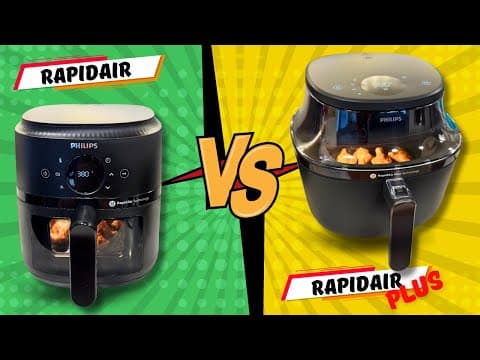
Philips Air Fryer Review: 2000 Series VS 3000 Series - Worth the Upgrade?
Meem Reviews
10m 0s1,826 words~10 min read
Auto-Generated
Watch on YouTube
Share
MORE TRANSCRIPTS