[0:00]Egoist, a person who is self-centered and focused primarily on their own needs and desires. While this is generally understood that having self-confidence is important in sports, the specific emphasis on being an egoist is a central theme in Blue Lock. It stands out when watching the show. But what does it really mean to be one and why does being an egoist specifically seem to matter so much? Let's set the stage. Blue Lock takes place in a post-World Cup Japan after the country's defeat in 2018. Ego Jinpachi, the coach and essential game master of Blue Lock, believes that the root of Japan's defeat in the World Cup was a lack of strong individual scoring ability, which he attributes to the country's strong cultural emphasis on filling one's assigned role and working as a cohesive unit. Jinpachi believes that in order to win the World Cup, Japan will need a revolutionary scorer who possesses a strong sense of individuality and the ability to go beyond their assigned role on the field. According to Jinpachi, soccer is a sport that requires more than just following orders or fulfilling your assigned role. This is why he says originally soccer was a sport with 11 strikers, because every individual player's goal should be to do what they can to score. And thus the player taking the shot should be the player most capable of it. As the show puts it, to turn zero into one, a single player has to define themselves as the striker. An ego is required to decide for yourself that you will be the striker, and the other players will naturally evolve around the striker taking up the other positions on the field to support the striker and score as many points as possible. Zero isn't drawn, it makes the bow come to it. In the world of soccer, goalies, defenders and midfielders can be trained, but first-class strikers appear where the game is most intense. That's because the ego required to be a top-notch striker also attracts players to the highest level of competition. It's a never-ending cycle of confidence, skill, and determination that propels the best players to the top while crushing the players below them. The main character of a story is often the vessel through which the messages and themes are conveyed, and Isagi, the protagonist in Blue Lock, is no exception. Despite at first hand coming across as someone soft and maybe unconfident, Isagi perfectly embodies the idea that ego is a key factor in driving one's abilities. Isagi's character, personality, and abilities are all crafted to highlight the idea that ego is what propels a player's success in soccer. At the start of the show, Isagi is a bubble ready to burst. We see his internal desire to reach a higher level of competition, despite his aspirations, he chooses to fulfill the team player stereotype by passing the ball instead of scoring himself, which in most sports anime would be rewarded. And while you'd assume this statistically is the better play, it is essentially shying away from the competition. Isagi distinctly says I'm going to Nationals, not we're going to Nationals when he rushes down the goal. However, when faced with the first selection of Blue Lock, Isagi makes a conscious choice to prioritize his ego over his insecurities. He attacks players who are stronger than him, showing that he has a true desire to compete. Ryosuke Kira is the opposite of him, being more talented and blasting through several defenders to score a goal in the same match Isagi decided to pass. However, those defenders simply weren't as good as he is. But when he's in the first selection, he ridicules the exercise rather than considering it an exciting challenge. And when faced with opposition, he gave up, despite having the physical and mental capabilities to succeed. Ryosuke's giving up has nothing to do with willpower, hard work, talent, or anything like that. It's simply a lack of a true ego, which would have propelled him to dominate the selection with his talents, which is the ego that Isagi did have and that made him challenge not just someone better than him, but the best player in the room. This dichotomy is most easily displayed even before the start of Blue Lock. Being informed of Jinpachi's ideology and told that his competition will put their future soccer careers at risk with the goal of simply becoming the best. Ryosuke is the first person to reject this notion, while Isagi is the first to accept it. Isagi's weapon on the field is a spatial awareness, which allows him to have a comprehensive view of the field. Unlike other characters who have easily defined weapons and talents, such as Bachira's dribbling, Chigiri's speed, or Kunigami's power shot, Isagi's vision of the field allows him to control the game rather than dominate it directly. When used modestly, Isagi's spatial awareness makes him a solid defender or a great assist. But when used egoistically, it allows him to control the game completely, circumvent his opponent's strengths and manipulate the game to score goals for himself. Put together, Isagi is a genius of adaptability. He doesn't just seek out the greatest competition, and he doesn't just have a great vision of the game. He's willing to use these traits to break himself down and repair himself over and over again, using not just his own strengths, but the things he's learned over the course of a game to see, adapt to, and overcome these challenges. I think another character that's a great vessel for the mentality of Blue Lock is Chigiri. While Chigiri had a great weapon of his own, being his speed, after an injury he becomes scared of losing what he has left. While this is honestly a perfectly normal way to feel, it does kneecap any chance of him developing a future in soccer, which he is painfully aware of. However, Chigiri's interaction with Isagi serves as a wake-up call and sparks the resurgence of his lost ego. Chigiri realizes that his fears have been holding him back and preventing him from reaching his full potential. Ego, in this case, is not just a sense of self-importance, but a driving force that fuels his ambitions and desires. It's not just a matter of bravery or willpower, but the burning desire of his ego that allows him to rip himself free of the shackles that tied him down. To explain why it's specifically ego and not willpower or bravery that allows Chigiri to do this, his desire isn't to help his team win or to enjoy the feeling of the wind flowing past him or something like that. It's the satisfaction he feels outspeeding others and leaving them biting his dust, which is more important to him than his knee, his reputation or even his entire soccer career. The ego that drives him to literally stake everything he has on a single moment is the same ego that proudly lets him proclaim his desire to be the world's greatest striker. All of this is good and well, however, in a competition specifically designed to grow players alongside their ego, egos will clash. While there are many noteworthy characters in the series, the most intriguing is Itoshi Rin, who holds the coveted number one ranking in the competition. While Rin is absent for the beginning of the story, the fact all characters are ranked numerically leaves the audience interested in finding out who number one is. We are introduced to a bunch of incredibly talented prodigies, each with their own unique ego and skill set. But from the start, we know that whoever carried the number one on their shoulder must be better than these players. Jinpachi's biased ranking, which is heavily influenced by ego, would place one of the most egoistical players at the top. And when Rin is finally revealed, the audience is left with a sense of subdued anticipation. We know that he is the best, but we don't know by how much. Isagi, who has an unwavering ego and a strong sense for competition, would obviously want to challenge Rin, knowing that the third selection will separate the players who stand at the peak from those who stand at the summit. During the match between Isagi and Rin's teams, we are introduced to three new mindsets from Rin and his teammates. Tokimitsu's self-image is so low that it forces a sense of desperation in his play that goes beyond anything we've seen up until now. Aoryu is almost a total opposite of Tokimitsu. He cares heavily about the spotlight and wants to stand out more than any other player. And then there's Rin, and we really get to see why he's considered the greatest player in the competition. For Rin, the stakes of losing are greater than for anyone else. He's not obsessed with winning, he's obsessed with not losing. While other players stake their dreams, reputations, and careers on these games, for Rin, losing is equivalent to death. His ego makes him play at a level of confidence and utmost authority, unmatched by anyone else in the competition. Unfortunately, this match doesn't go very well for Isagi. Despite him and his team's best efforts, they're unable to overcome the talent and ego of Rin and his team. Icarus flew too close to the sun too, which shows the importance of not only understanding your own abilities, but being able to perceive yourself in comparison to someone else. But in the world of competitive sports, it is an inevitability that even the greatest players will face defeat at some point in their careers. The true test of character lies in how one deals with that loss. This is where Blue Lock's philosophy stands out even more. While many other shown in storytelling genres focus on the recovery from defeat, Blue Lock emphasizes the value of despair and the possibilities it opens up. Jinpachi believes that individuals who suffer defeat but have an unyielding never-give-up mentality are blinded to a reality that is constantly moving away from them. Instead, it's the players who experience the strongest sense of despair and disillusionment after a loss, that are most likely to find new opportunities for growth and evolution. As we've seen already, a player's ego is a crucial part of their identity and their motivation. However, when that ego is shattered by defeat, it can be a deeply painful and destabilizing experience. Only the players with the strongest sense of self and the most resilient egos will be able to pick themselves up and move forward. The idea of embracing despair may seem counterintuitive, but it is an essential part of personal growth and development. In the world of Blue Lock, it is not enough to simply have a strong will and determination. One must have the courage to confront their weaknesses and embrace the despair that comes with it. Only then can they emerge as a better, stronger version of themselves. Isagi himself is no stranger to this kind of struggle. Throughout the series, he faces numerous setbacks and challenges, and each time he must claw his way out by relying on his ego. However, in order to overcome even greater challenges that could lie ahead of him, he may need to confront an even greater sense of despair and hopelessness. Anyways, Blue Lock is a story about ego, ambition, and the pursuit of greatness in the world of soccer. It challenges traditional shonen tropes by focusing on the importance of ego and how it drives the characters to push themselves to their limits. I think it's a pretty interesting take on the genre, which is why I wanted to delve through it like this. This video is very different from other things I've done, so if you enjoyed the video at all, showing it some love would be appreciated so I know to make more like this. Additionally, letting me know your own thoughts on the series or if you think I was off base or incorrect about anything, or if you think there are other great examples in the story of ego that I skipped over. But with all that being said, I hope you have a nice day.
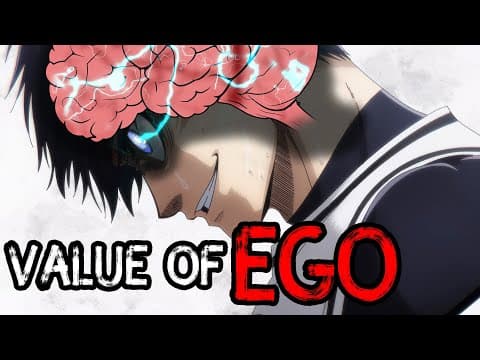
How Blue Lock Teaches You About The Ego You Lack.
ᚱising
10m 39s2,059 words~11 min read
Auto-Generated
Watch on YouTube
Share
MORE TRANSCRIPTS