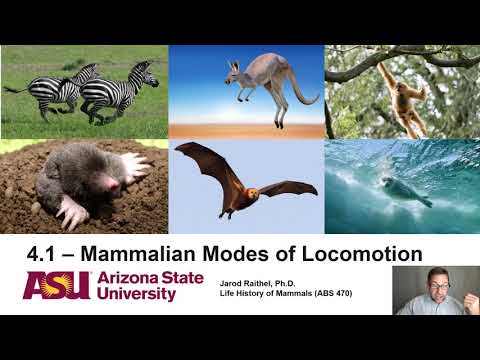
[0:00]Hello again, ladies and gentlemen, and welcome to module 4. The first lecture in module 4, lecture 4.1 is entitled the Malian Modes of Locomotion. So today I will be describing the myriad of different ways by which mammals have evolved to move from point A to point B. I will detail some of the anatomical adaptations that are characteristic of curial or running species like these zebras. Saltatorial locomotion, like this jumping red kangaroo. Brachiation like this Gibbon swinging from the tree limbs. Fascial species like this mole. Volant locomotion, like the true, uh, powered flight we see in the Chiroptera, like this fruit bat. And then I'll end with the fully aquatic marine mammals like this harp seal. Lecture 4.1 aligns with chapter 6 in your textbook, which is entitled Integument, Support, and Movement. That said, you are only responsible for the third section entitled Modes of Locomotion. That's what you'll be tested over. You can totally skim over Integument, basic skeletal patterns, and muscles. To begin with, many mammals use walking as their primary means of locomotion, and this appears to be the primitive pattern. Walking is probably the primitive pattern of locomotion, the first means by which mammals moved from one place to the next. Most mammals are quadrupedal, meaning they move on four limbs, although there are some notable exceptions, namely us. Mammals that are bipedal walking on two limbs. Species that move predominantly by walking are called ambulatory, like this polar bear. And then, uh, there are species, uh, who are exquisitely adapted for blazing fast speeds like this cheetah, and they're considered curial, the running species. The primitive walking gate is associated with a plantagrade foot posture in which all or most of the palms and soles are in contact with the substrate. In plantagrade foot posture, all or most of the palm on the forelimb or the sole on the hind limb is in contact with the substrate. So that's clearly evident here. The sole of the human's foot is totally in contact with the sand. So this is plantagrade foot posture. Also evident here in the bear, another plantagrade species. This is the bear hind foot here, uh, there you can see the bear hind foot, and that's the bear's forefoot, so that's the palm. In plantagrade foot posture, these metatarsals, as well as the phalanges, the toes, of the hind foot and then the metacarpals and the fingers, the phalanges of the front foot, they're oriented parallel to the ground. So examples of plantagrade species obviously include humans, bears, as well as rodents, skunks, raccoons, and hiraxes. In digitagrade species, uh, like this cat, we see that the metacarpals here in the forelimb, as well as the metatarsals in the hind limb, they've been elevated off the ground to an acute angle. Leaving only the phalanges in contact with the substrate. So this is the metatarsals here in gray, those are the phalanges, uh, shown in that kind of yellowish color, and then the brownish color, that represents the claws. Most digitagrade species have reduced one of their digits, leaving only four functional toes for locomotion. And then, in the ungulagrade mammals, we're going to take this curial foot posture even further. So, we're talking about the ungulates now, or the hooved mammals. And in the ungulates, we see now that even the phalanges, again, shown in yellow, as well as the metatarsals and metacarpals, shown in gray, are all elevated. So only the tips of the phalanges are in contact with the ground. That said, those tips are covered by these keratinized hooves as exhibited by this zebra. And we've got increased lengths now of metatarsals and phalanges. So you can see this evolution here in the plantagrade species. The metatarsals are parallel and in contact with the substrate. Uh, in the digitagrade species, those metatarsals are now elevated at that acute angle. And now, in the ungulagrade species, the metatarsals and the phalanges are both elevated. So, um, increasing specialization for curial locomotion. Along with their foot posture, ungulates have further reduced the number of toes, of digits, on, uh, their feet. So, for example, there are three digits in the tapirs. There are just two digits in the artiodactyls, like this deer, and then there's just the one digit, this one toe, uh, with this keratinized hoof in the horses and zebras. In his 1985 publication, which is cited at the end of this lecture, Hildebrand identifies four functional requirements for animals that walk or run:
[7:14]Number one, there needs to be support and stability, even though the feet make only intermittent contact with the substrate.
[7:27]So walking is obviously the most stable of gates because of the prolonged contact of the feet with the ground. However, when running, particularly when galloping, the animal must ensure that the front and the hind limbs do not interfere with one another, I.E. become all tangled up. Number two, the walking-running mammal must have forward propulsion.
[8:05]It's got to move its body forward. So, models of animal movement are based on the idea that the legs swing below the body like a pendulum. Jointed limbs and their associated muscles, tendons, and ligaments work like springs when the joints are flexed, storing energy that is released during the subsequent extension.
[8:44]Number three, walking and running mammals require maneuverability. That's the capacity to change direction during locomotion.
[9:03]It's required by both predators and prey. Most curial mammals, they can alter their gait momentarily such that both legs on the same side strike the ground simultaneously, resulting in an angular shift in the direction of the movement. Some mammals can even turn their bodies by flexing their spines while in the air, thereby altering their directions. And then lastly, number four, Hildebrand argues that walking and running mammals require endurance. Endurance is going to result from the integration of the animal's musculoskeletal systems as well as the physiological adaptations. So the appendicular muscles of curial mammals, they tend to be very rich in these fast-twitch muscle fibers that are capable of rapid and powerful contractions. But in order to fuel those contractions, those mammals need robust respiratory and cardiovascular systems to support, uh, those muscles that require that oxygen for respiration. With respect to number one, support and stability, large, heavy species such as elephants and hippopotamuses are gravital.
[10:44]Meaning that their legs are directly under the body. Further, their leg bones are columns, and their ankle and knee joints are nearly vertical.
[11:02]Collectively, this skeletal arrangement allows the skeleton to bear most of the large body weight, taking the burden off postural muscles that would otherwise require large amounts of energy to support and stabilize this massive hippopotamus. While lighter mammals such as deer can energetically afford to have their limbs positioned slightly outside of the trunk axis.
[11:45]They're going to rely more on muscles for postural support and stability during locomotion.
[11:57]It's more energetically expensive, but it's possible because they're lighter, and it's going to provide them with much greater maneuverability than the hippopotamus. With respect to forward propulsion, there are different strategies, different approaches to propelling your body forward. In other words, there are different gates that mammals are going to use for different situations. And by gates, I mean oscillation patterns of the limbs during forward movement. So, walking, pacing, and trotting are all considered symmetrical gates. As they all involve equal spacing of the feet making contact with the substrate, with the footfalls evenly spaced in time.
[13:00]However, in galloping, like this greyhound dog, as well as bounding, the footfalls are now unevenly spaced in time, and thus are considered asymmetrical. At moderate to high velocities, these gates can entail having all four feet off the ground simultaneously for a portion of the stride as shown here. So I think the best way to envision these different gates is to look at this really wonderful video which was created for animators. It's one minute and 47 seconds, but it's going to clearly demonstrate the different leg patterns as well as the footfalls used by curial or running mammals to walk, to amble, pace, trot, canter, gallop, and run. So please take a minute and check this out. I think you'll find it quite helpful. Speed is a crucial aspect of locomotion in curial mammals. An ability to move faster may increase success in hunting or escaping predators. Running speed is controlled by two components: the stride length, the distance traveled in a single step cycle, as well as the stride frequency, the rate at which one step follows another. Both stride length and stride frequency are related to body size, with larger animals tending to take fewer but longer strides than smaller species.
[15:04]These differences are going to compensate for one another to some extent because stride length increases with increasing body size, more rapidly than stride frequency decreases. Meaning, larger animals generally run faster than smaller ones, with some notable exceptions. Some of the swiftest animals that we see, the cheetah, the pronghorn antelope here in Arizona, as well as the red kangaroo, the saltatorial jumping kangaroo. They achieve stride lengths well beyond what might be expected by looking at their body size alone. So they're hurling themselves into this aerial phase of galloping, and greatly increasing the distance traveled in each step cycle. It's one thing to have me describe cheetah speeds of up to 80 miles per hour. It's another thing to see it. So please take the two minutes and check out this cheetah hunting. It shows great persistence in taking out this juvenile will to beast. Please check it out. Jumping and ricocheting are both forms of saltatorial locomotion.
[16:46]Jumping involves the use of all four feet, as exhibited by these rabbits, whereas ricocheting, also known as bipedal hopping, involves propulsion using only the hind limbs, such as in kangaroos, kangaroo rats, and jumping mice.
[17:13]Mammals that employ this ricochet motion spend much of their lives in a bipedal position. And they're going to use those four paws only occasionally for slow, short distance movements. If you remember way back, uh, to my lecture on marsupials, I showed you that diagram that broke down the different ways in which kangaroos move. So it might make sense to take a look at that. Um, the four limbs, uh, they are important, uh, they're employed for manipulating objects like food. Most mammals, uh, actually most vertebrates, uh, that use saltatorial locomotion, are jumping and ricocheting. They're actually small-bodied animals, the exception being these red kangaroos at right, which can top out at close to 200 pounds. Because saltatorial movement has evolved in several different groups, the anatomical similarities shared by jumping or ricocheting species are the result of convergent evolution.
[18:45]Recall, we discussed evolutionary convergence when we discussed fossorial species and lecture 2.4. At that time, we were focused on golden moles. Remember, convergent evolution. We're going to talk about it again and again throughout this course is when different lineages independently evolve morphologically similar adaptations in response to similar selection pressures. So species that show convergence on the same morphology, they may look similar superficially, but they may not be genetically very closely related at all. So the principal adaptation when we think about saltatorial species is the lengthening of one or more segments of the hind limbs, usually the tibia, and development of long, elastic tendons that stretch across the knee and ankle joints.
[20:07]Especially in large hoppers, energy stored in these tendons as the limbs recover from one jump, I.E. during landing is released during the next propulsive leap forward.
[20:30]Small bouncing species tend to store relatively less energy in these tendons and ligaments, but they have much reduced costs of propulsion. Uh, they have lower, uh, propulsion angles. In other words, they have a more vertical hop. So this is awesome. Some arboreal or tree-dwelling species that leap amongst the trees when they're on the ground. They're going to use ricocheting locomotion. So examples of ricochetal locomotion include lemurs, like this Crocoll's Sifaka, lemur here, almost looks like he's dancing. Uh, as well as Tarsiers and the white-faced Saki, which is a new world primate. So these ricocheting arboreal, uh, mammals will cling to a tree trunk with all four limbs, and then they'll drop down to the ground, land on their hind feet, and then bound back up to another tree. Primates that leap and ricochet have long femurs, uh, much longer than other primates, allowing them to make long leaps by increasing the lever action of their hip muscles. So please put me on pause and check out this unique form of locomotion for yourself. This is ricochetal locomotion on the ground. Um, it's going to begin at about 40 seconds into this video, but really cool to see. Climbing mammals use their limbs to move about in trees. That is, they employ arboreal locomotion and display a suite of corresponding adaptations.
[22:54]In species that also spend a substantial portion of their time on the ground, climbing is accomplished primarily by use of claws. These are keratinized claws here on this black bear. Small or arboreal mammals, such as squirrels, gain a steadfast hold on tree bark with those sharp claws.
[23:27]And they're able to maneuver on trunks and branches with considerable agility. Larger species, such as this black bear, they're going to use their claws in a similar manner, but they're much less agile than squirrels. All of these species possess footpads to provide friction in gripping tree limbs securely, as well as an increased number of sensory receptors on their palms and soles and the ventral surfaces of these digits. So, black bears may not be as agile of climbers as squirrels. I'll give you that. But they are much better climbers than us humans, who have to use climbing gear and climbing ropes like myself. Um, I may have mentioned it, uh, when I did my instructor introductory, uh, video. But back in spring of 2005, um, I was the, uh, field crew leader for a U.S. Fish and Wildlife Service team that was focused on capturing and translocating threatened Louisiana black bears. That's a subspecies of black bear with an elongated rostrum that's evolved to eat acorns. We were capturing these bears in bottomland hardwoods in, uh, Cyprus, bald Cyprus swamps, uh, in the Tensaw National Wildlife Refuge, and then we were moving them several hundred miles to the south and a bit to the west to the Atchafalaya River basin. These bears are incredible climbers. As you can see, they climbed straight up this vertical surface on this massive bald Cyprus tree, all the way up to there. That is the entrance to their den right there. It's about 100 feet off the ground. These pictures were shot with film, so the resolution is not great. And then here, this is me. I've made it up the climbing rope, and now I'm peering inside of that tree den with my headlamp. And there's a sow down here, a female black bear. She's curled up, and her cubs are suckling. Um, but you can look down inside this tree den and see that it's about 10 feet deep down inside the tree. So again, my point being, these bears are very good climbers. This is a very good and safe place to hibernate and have your cubs and, and nurse your cubs for several months. Here's, uh, one of those sows, uh, that we collared and translocated. You can tell, uh, she's obviously anesthetized. Uh, we used Ketamine, uh, to anesthetize the bears, uh, for transport, well, to get them out of the tree dens, and then move them down, uh, to Three Rivers in the Atchafalaya River basin. And then here is one of the translocated cubs, and you can tell even at, you know, six weeks old, uh, these cubs are already very well equipped, uh, with a sharp claws for climbing. As I'm sure many of you are aware, uh, many of the primates are amazing climbers. They're going to put those black bears to shame. So with the arboreal primates, uh, their digits are more flexible. They have mobile joints between the phalanges in the hand, uh, which is going to allow them to grasp branches. Old world monkeys and apes have also evolved an opposable thumb, which can be rotated towards the tips of the other digits, again, for grasping, uh, while climbing. Uh, there's a specialized form of swinging, uh, through the branches called brachiation. This is particularly well developed in the Gibbons. Um, so Gibbons have very large clavicles, collarbones, that are actually anchored to their sternum. They have really long forelimbs, obviously grasping hands, they have great big opposable toes. They have a really stout pectoral girdle, which is going to stabilize that shoulder joint, allowing the forelimb to bear the weight of the animal as it brachiates, as it swings in the trees. We actually have, uh, the same structure, uh, in our pectoral girdle. Um, and this is a reflection of our arboreal ancestry. This is some beautiful footage of a brachiating gibbon. It's truly impressive. Um, so I was thinking when making this slideshow, this Gibbon would absolutely kill it at the Spartan race. Many arboreal species like primates have long tails that they're going to primarily use for balance, uh, when maneuvering about on tree branches. However, in a few species of South American monkeys, like this aptly named spider monkey, the tail has become a prehensile appendage used to grasp branches. In the spider monkey tail, the distal portion of the tail, the end, the tip of the tail, has developed these friction pads and an increased number of tactile receptors like the gripping hands and feet of other climbing mammals. Mammals that dig in the soil to find food or create shelters for themselves are called fossorial. So it's useful at this point to distinguish between the terms fossorial and fully subterranean. Fossorial refers to animals with adaptations for digging, uh, like this wombat pictured at bottom left. Whereas a subterranean species refers to species that live virtually their entire lives underground, like this African naked mole rat. Among mammals, there are far more fossorial than subterranean species. Regardless, the limbs of digging species tend to be short, and they're powered by strong appendicular muscles to power that digging. So digging is usually accomplished by scratching at the soil with the four paws to excavate a hole or a tunnel large enough to accommodate the animal's body. However, many fossorial rodents are going to use their teeth, their incisors as digging tools, as shown at right. So fossorial species that use their incisors to dig include root rats, bamboo rats, blind mole rats, the pocket gofers, and the African mole rats as pictured here. They have these large incisors that are external to the lips that are going to allow them to dig with their teeth while their mouths remain closed. Because as we're digging, we don't want to get a big mouthful of dirt. Further, the eyes of subterranean species are very small. Oftentimes they're non-functional, they're vestigial, meaning they're evolutionary leftovers. They have tactile receptors in the snout that are very well developed, and they're going to have vibrissa, these whiskers that often will occur, um, all over their bodies, including their the tail, the body wall, the legs, and then lastly, they have subterranean mammals have very acute senses of hearing and smell. Gliding has evolved independently in several groups of mammals, gliding possums, colugos, and members of Rodentia such as flying squirrels.
[33:20]Which is what is pictured here. Colugos are in the order Dermaptera, the skin wings, and we're going to talk about Dermaptera next in lecture 4.2. And there are also gliding members in the order Rodentia, the rodents, such as the flying squirrels, flying in quotation marks. In each of these groups, the gliding species are arboreal, and they use their gliding ability as a means of moving from tree to tree.
[34:04]The principal morphological adaptation for gliding species is the patagium. This is an extension of skin that stretches from the lateral neck and body wall to the wrists and ankles, as well as to the tips of the fingers, toes, and tail in the colugos.
[34:41]So the animal leaps from a perch, it extends its limbs and tail such that this patagium is going to act as an airfoil. Aerodynamic control during gliding and landing is accomplished by adjusting the position of the limbs. You can never have too much David Attenborough, can you? So this species is incredible. This is the Sunda colugo, or also called the Kabong. And this guy is capable of gliding for over 100 meters. Uh, please check out this footage. Among mammals, only bats, the order Chiroptera, have evolved true powered flight or volant locomotion. Interestingly, with the exception of swimming, flying is actually the most energetically efficient means of moving a body from point A to point B. In other words, you're going to cover more ground calorie per calorie burned when flying compared with running or jumping or certainly burrowing, which is energetically expensive. A bat's wing is also a patagium, but its skeletal support, principally the autopodial bones, is more highly modified than in gliding mammals. It's got this thin membrane of skin, like in the gliders, um, but now it's going to have skeletal support from these really impressive metacarpals and phalanges. So the bats are highly modified, uh, for flight, um, in comparison to the gliders. Further, the bats have this broad and slightly keeled sternum, much like a bird, which is going to serve as the point of attachment for, uh, the flight muscles, the pectoralis muscles. The shoulder includes a very stout clavicle, a collarbone, uh, with a locking mechanism to keep the joint at an appropriate angle, keeping those wings locked as airfoils. The radius of the bat's right here is thin and elongated, comparatively. But the ulna, now, it is reduced distal to the elbow, meaning out here, far, distal from the elbow. So you can see the ulna is only from here, uh, to here. At the wrist, the number of carpal bones in the wrist is reduced, and those remaining carpals have all fused into a single bone, which is going to provide a lot more stability for the rigors of flight.
[38:18]The first digit here is relatively unmodified, and it bears a claw. But digits two, three, four, and five have greatly elongated metacarpals, as shown here, as well as two or three phalanges that are oval in cross section. The radius and bones of digit two, right here, those are going to support the leading edge of the bat's wing, while digits three, four, and five form struts for the trailing edge of the wing. So this is a fascinating 39 seconds. It really shows the bat's wing thrusts in slow motion. So really check this out so you can see the mechanics of powered flight in the Chiroptera. So all mammals that spend a significant portion of time in water, like whales, dolphins, manatees, they evolved from terrestrial ancestors. Because water is generally cooler than average mammalian body temperatures, and it's also more thermally conductive than air. Aquatic and marine mammals must conserve heat when they are in the water. So most species of aquatic mammals have thick coats of fur and or thick layers of body fat that serve not only for insulation, but also for buoyancy in the water. And fibius species, uh, that are semi-aquatic, so the polar bear, uh, think platypuses, uh, the monotremes, uh, beavers and muskrats, uh, the water shrew, which I showed you a video of. Otters, uh, even moose are considered semi-aquatic. They spend a lot of time in lakes and ponds. Most of these animals, uh, these semi-aquatic mammals, are equally at home in the water as they are on land. Webbing between the toes of many of these species, like in this polar bear, the webbing is going to increase the surface area in contact with the water, which is going to aid in propulsion. The pinnipeds, like seals, sea lions, and walruses are fully aquatic. They're only going to move onto terra firma, dry land, in order to breed and to give birth to their pups. The limbs of the pinnipeds have evolved into flippers where all five of the digits are encased in a single sheath of integument of skin. In the pinnipeds, their tails are absent or rudimentary. Anatomical specializations for a fully aquatic life reach their pinnacle among marine mammals.
[42:24]Those mammals that never come on land, not to breed or to give birth, they're going to do all of their life cycle in the water. And those include two groups, the Cetacea, which we'll cover later in the semester, and the Sirenia, the manatees and dugong, which we've already covered. In the marine mammals, like the Cetacea, this baleen whale, we see that the axial skeleton has become simplified. The cervical vertebrae, those in the neck, have become partially fused for stability, and then the interlocking facets between the trunk and the tail vertebrae have been lost, allowing for more flexibility in that tail. The sacrum, as well as the hind limbs, the femur, the tibia, they're gone. And the pelvic girdle, uh, that's all that's left, this tiny little vestigial pelvis. So I always use slides of whale skeletons in my evidence for evolution lab in my general biology 2 class. Um, because of course, uh, whales evolved from terrestrial vertebrates, and this is the evolutionary leftovers of their terrestrial past. This little vestigial pelvis. The whale tails are modified into horizontal flukes that provide propulsion by dorsoventral undulation. So they're going to propel themselves like this. Uh, that type of propulsion is called dorsoventral undulation. Their forelimbs are modified into flippers and frequently show an increase in the number of phalanges. Uh, much like the pinnipeds, they're going to show an increase in the number of phalanges. Um, but these flippers, they're not used for propulsion. The tail is doing all of the propulsion. Um, the flippers are merely stabilizers, and they're going to allow that whale to bank and turn. So that finishes marine mammal anatomy for now. We're coming back to the whales and the dolphins, I promise. They're just too much fun. Only a couple of references cited in 4.1. Hildebrand, remember, um, the four requirements for walking and running. Next up, we have lecture 4.2, which are the orders Scandentia and Dermaptera. So we're going to come back to those Colugos. I hope you enjoyed it. Thank you so much for your time.


