[0:20]Um, okay, so, uh, this is part two of, um, the missing lectures for this last week of class. So, in this lecture, we're going to look at the, um, complex spectral theorem. So, we will, um, prove the theorem and then I'll do kind of an involved example that, um, illustrates the theorem and also goes over a lot of the topics that we've done in this last part of the course. So, this is a pretty deep theorem about diagonalizability, normal operators, and orthonormal bases. So, our favorite, um, operators on a vector space V are going to be those where there's an orthonormal basis of V such that, um, T is a diagonal matrix with respect to that basis. And we'll see that, um, this situation happens when the operator is normal. So let's state the complex spectral theorem.
[2:01]Okay, so, um, let V be a vector space over C. And I'm going to let T be a linear operator on V. Then, the following are equivalent. So, we have, um, one, T is normal. Um, then we talked about what that was in the last lecture. And third, um, we have that T is a diagonal matrix with respect to some orthonormal basis of V.
[4:23]Okay, so, um, these two, we'll say briefly why they're equivalent, but this is more or less by results that we have already shown. And then, um, the second part is that we're going to show that three implies one. And this will be pretty easy, and then we'll also show that one implies three, and that will be the last part of the proof, and that's sort of the more complicated step. Okay, so let's start the proof.
[5:06]So, um, let's argue why, um, two and three are equivalent, briefly.
[5:18]So, um, we had a result before that, um, basically said V has a basis consisting of eigen vectors of T if and only if T has a diagonal with respect to some basis. So, it was basically this same statement, um, without the, um, condition that the basis was orthonormal. And, um, so, how do we now upgrade this to, um, the to add the condition that the basis is orthonormal? Well, it was the same basis in both cases, right?
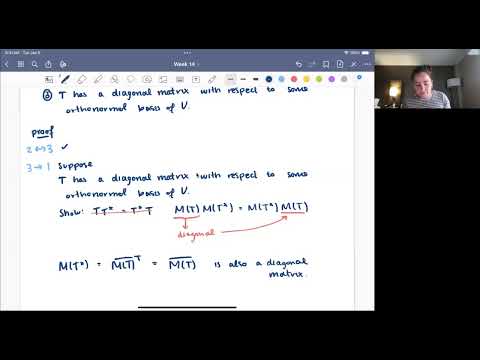
[6:05]So if we start off with an orthonormal basis consisting of eigen vectors of T, then, um, with respect to that basis, T is a diagonal matrix, and so, um, this, this statement will hold. And vice versa. So, this is, um, sort of already done by, um, things that we've discussed and now we're just adding in the condition that the basis is orthonormal. Okay, so let's then prove that three implies one. Okay, so here's how this goes. So let's suppose, um, that three holds. So, suppose that T has a diagonal matrix with respect to some orthonormal basis of V.
[7:05]Okay, so, then we need to show that T is normal.
[7:22]And by an argument from last time that we, we said that it was enough to show, um, in fact, that M of T, M of T star is equal to M of T star, M of T.
[7:44]And we also talked about how M of T star is, um, given by the conjugate transpose of T. So, um, we know that with respect to some orthonormal basis of V, M of T is a diagonal matrix.
[8:16]And so, what is M of T star? This is M of T conjugate transpose.
[8:29]Um, the transpose of a diagonal matrix is the same as the matrix.
[8:38]So we just have the, the conjugate of the matrix of T. And since this is a diagonal, since M of T is diagonal and, um, the conjugate just takes the conjugate of every entry, this is also a diagonal matrix.
[9:00]And, um, okay, I don't think we've proved this fact, but it's true that if you have diagonal matrices and you multiply them, um, that multiplication is commutative.
[10:39]So, um, let's call this equation one.
[27:41]So, this means that zero is equal to the squares of all the entries, except the first one, which means that all of these things must be equal to zero.
[27:55]So this implies that A1J is equal to zero for J is greater than or equal to two.
[28:13]So, now I know that actually all of these entries are zero.
[29:33]And that proves, um, the theorem, up to this fact that, um, uh, sorry, not that one. The, that up to this claim that T has an upper triangular matrix with respect to some basis, and that is something, um, you can read why that is in the textbook. Okay. So, let's do, um, an involved example. This is going to pull together like everything that we've done in probably like the last month of the course.
[3:09]So I would encourage you to throughout this example, um, pause and work out pieces of the computation for yourself and then compare to what I get. So here's what the example is going to be.
[3:36]I'm going to let T of XY be equal to X plus Y, comma minus X plus Y. And this is from the complex numbers squared to the complex numbers squared. And what we're going to do is we're going to find an orthonormal basis of eigen vectors of T, and we're going to write down M of T with respect to that basis.
[4:46]Okay, so, um, yeah, and first of all, like, okay, so in order for this to even, for us to even know that this exists, we first need to show, um, that T is normal. So we have to check that first. So I'm going to write down M of T. This is, so plugging in, um, X equal to one, Y equal to zero. I get that the first column should be one minus one. And then plugging in, um, Y equals to one, I get one one. Okay, so then M of T star is going to be the transpose of that. So, one, one, minus one, one. And to check that the that T is normal, I need to compute both products and see that they're equal. So, um, here's the products.
[6:19]And to compute the other order, then I get, two, zero, zero, two. So, T is normal.
[6:48]Okay, so now I'm going to compute, um, the eigen values. So, I'm going to do, um, that of M of T minus lambda I, and set that equal to zero. So, we get one minus lambda, one, minus one, one minus lambda, and we want this to equal zero. So, this is one minus lambda squared plus one is equal to zero. So, what does this come out to? We have one minus two lambda plus lambda squared plus one is equal to zero. So rearranging, I have lambda squared minus two lambda plus two is equal to zero. Um, okay, so I'm going to do, um, det of M of T minus lambda I and set that equal to zero.
[7:43]So, um, usually that enables me, as long as one of X or Y is not equal to zero, um, I can set that equal to one, and then just solve for what the other one should be.
[8:04]So looking at this equation, if Y was equal to zero, so then we would not have any of this, that would force X to also be zero. So, since and we can't have that.
[8:18]So, since Y is not equal to zero, I can set Y to be equal to one.
[8:29]So then looking at this second equation, I would have one minus X is equal to one plus I. So then I get that X is equal to minus I. Okay, so then that tells me that, um, one eigen vector, which I'll call V one, is equal to minus I, comma one.
[8:58]Okay, and then let's solve for lambda two. So, there, I'm going to get the equations, so I'll just jump straight to the second line. I'll have X plus Y, comma Y minus X, our lambda two was one minus I. Okay, so then I get the equations, X plus Y is equal to X minus I X, and Y minus X is equal to Y minus I Y.
[9:33]Again, from this equation, I can tell that Y is not equal to zero, so I'm going to set Y to be equal to one. And then that tells me that one minus X is equal to one minus I. So then X is equal to I. So then I'll let V two be equal to I, comma one.
[10:10]Okay, so then V one, V two is a basis of eigen vector.
[10:24]Okay, so now, um, step three, I'm going to apply Gram-Schmidt to V one, V two. Okay, so just applying the formula, so E one is going to be V one over the norm of V one.
[10:52]Okay, the norm of V one is going to be the square root of the inner product of V one with itself. So, this is minus I, one, comma minus I, one, which is minus I, times I, plus one times one. Okay, and this is the square root of two.
[11:30]Okay, so E one is equal to V one, which was minus I, comma one, over the square root of two.
[11:46]Um, okay, great. And then let's compute E two.
[11:53]So, by Gram-Schmidt, what is this going to be? This will be V two minus, we need to subtract off the part of V two that's parallel to E one, and then divide that by the norm of the same numerator.
[12:18]Okay, so let's calculate, um, this coefficient. V two, E one.
[12:26]Um, okay, so this is, what was V two? I, comma one, and we're dotting that with E one, which is minus I, comma one, over the square root of two.
[12:47]Okay, so then what do we get? Um, we have I times the conjugate of minus I over root two, which is I over root two, plus one times the conjugate of one over root two, which is still one over root two.
[13:18]And so I get, um, zero. Okay, great. So that means that we have nothing here, since this coefficient, this coefficient came out to zero, so we get nothing. So we just have to then divide by the norm of V two.
[13:36]So, let's compute the norm of V two.
[13:42]This is the square root of the inner product of V two with itself.
[13:48]V two is I, comma one, inner product of I, comma one, I, comma one, which is the square root of I times minus I plus one times one, which is the square root of two again.
[14:10]Okay, so that means that E two is equal to I, comma one, divided by the square root of two.
[14:24]Okay, so then E one, E two is an orthonormal basis of eigen vectors of T. Okay, so then what step are we on? Four. Let's compute M of T. Well, since this is a basis of eigen vectors, that means that M of T is going to be a diagonal matrix with the corresponding eigen value, um, along the diagonal. So, what is the eigen value corresponding to E one?
[15:05]Sorry, the, the eigen value corresponding to E one was lambda one, which is one plus I.
[15:16]Then we need lambda two in the other entry, and that's one minus I.
[15:26]Okay, so that's the matrix M of T.
[15:31]So that was, um, the complex spectral theorem together with, um, an example.
[15:43]And on Wednesday, we'll do, like, a crash course on solving systems of linear, um, equations.