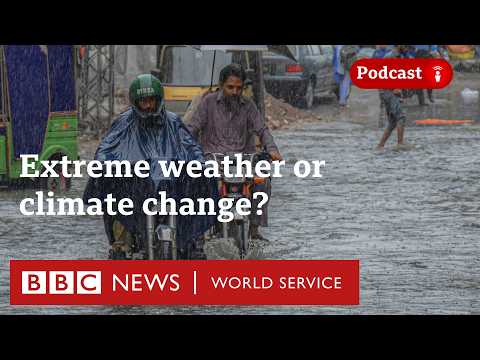
[0:00]The psychology of it is very complicated. People switch off. And I think you have to pick your moments of discussing climate change where it really, really does matter.
[0:10]Try making a weekly program that way. I'm Jordan Dunbar, and a few weeks ago, Greia Jackson and I got to find out.
[0:18]What's the difference between weather and the climate? From the BBC World Service, I'm Jordan Dunbar, and a few weeks ago, Gra Jackson and I got to find out.
[0:32]Our guest today is Matt Taylor, lead weather forecaster at the BBC, and I'd say one of the UK's most recognizable forecasters. Welcome, Matt. Thanks so much.
[0:42]Thank you very much for having me. Pleasure to be here. Matt, my question is, you've been doing this for 20 years. Weather presenters are quite famous for getting themselves into sticky situations.
[0:52]because you broadcast from farms and beside the sea. What's your favorite story from the last 20 years of presenting the weather?
[1:00]Oh, I think I've broadcast from just about everywhere now. Uh, one of my favorites, which is not one of the sticky stories, was actually broadcasting in a meeting David Attenborough.
[1:12]I was doing an extra broadcast at a London Wetland Centre. He was there to promote the big butterfly count, who was there to be interviewed as well.
[1:19]I did my forecast, he was sitting and I was really conscious while I was doing my forecast on air because we do work without scripts.
[1:25]Uh, I have to remember so much many facts just straight into the camera, but I was very conscious all of a sudden, he'd swiveled around, and his eyes were on me.
[1:35]And the second I finished, he stood up and applauded and said, well done. That was amazing. And so it was like,
[1:39]Oh, that's so nice. Such a renowned broadcaster such as David Attenborough saying that was just my moment made. My career made.
[1:49]I bet. What is the difference between weather and climate?
[1:53]They're intrinsically linked. Your weather is essentially what is happening to you day in, day out. So, is it raining, snowy, is it sunny?
[2:04]Is it warm? Is it cold? Is it windy? That is your day-to-day weather. So, it's what's impacting you on a day-to-day basis. What you plan around, what you plan your day around.
[2:14]What you're wearing, where you're going to go. Climate takes the sort of broader look and not just in day-to-day details. You have to average what is happening with your weather over decades.
[2:27]Generally, we think about 30 years, 30 years and then instead of saying, is it rain, is it snowy, is it sunny?
[2:35]You then look at, is it, uh, warming, a warm climate, a cold climate, is it a wet climate or a dry climate? Those basically, four essentials.
[2:46]Uh, and then by coming it together into those decades, you can then compare how things change. Is this a trend to see in the future, what are the chances are we're going to see more of this in the future?
[2:59]And all the global climate models are showing that we are on this warming trend, but in different parts of the world, it is different levels of it.
[3:08]Climate change is almost a little victim of its own success from a public perception point of view. When I was growing up, when I went to school, and there's a whole generation, we were taught about global warming.
[3:21]And I think it the global warming has got into some people's brains in that it will warm all the time.
[3:29]But we are talking about global warming, the globe is warming, but on a more local level, what we're seeing is the climate change. Some getting hotter quicker than others. Some are getting wetter quicker than others. Some are actually getting drier than others.
[3:43]And so, that's why climate change is a bit more of a more encompassing term, a bit more of an understandable one than say perhaps global warming is kind of gives us a slight misconception that wherever you are, you'll be seeing the temperature rise day on, day off.
[3:57]And why is the climate getting wetter in some places and drier in others because of climate change?
[4:04]It's down to how weather patterns are changing around the world.
[4:10]Uh, when we look at a planet that's warming, an atmosphere that's warming, the warmer the atmosphere is, the more moisture it holds.
[4:19]And so, some areas where you saw rainfall previously, actually that rainfall's getting more intense. The best way I can sort of describe it, if you think of a bathroom,
[4:26]same bathroom, running the tap, same temperature comes out. If it is running in a sort of cold bathroom in the winter, you see the condensation form very quickly.
[4:36]And so the moisture starts to drip down the walls. If that bathroom is much warmer, there is more moisture going into the bathroom.
[4:44]And so it's longer before you start to see condensation, and then when it does come down the walls, there's a lot more water coming out.
[4:51]So it's the same sort of thing when we're talking about rain clouds. The warmer the atmosphere, the more moisture there is, the bigger those rain clouds will be and the heavier the rain will be that comes from it.
[5:01]I think the other confusing thing about this is that climate change influences the weather that people experience day to day. So can we just talk a little bit about how that happens and why?
[5:12]Uh, it does. As I said, they're both intrinsically linked. There'll be parts of the world where it will influence on a day-to-day basis, whether when you see extremes in temperature, when it gets hot, actually your hot days could be hotter and more likely hotter than they were before.
[5:27]Your wet days could actually be much wetter than they were before. So, your day-to-day still has the same variability, and we'll always still have that same variability, but you could be seeing some a bit more extremes in what you see from day-to-day.
[5:43]And it could also mean, and what a lot of places are seeing is, the colder days are less, fewer frosts, less snowfall.
[5:52]And this is the complicated thing about trying to convey it in that there will be parts of the world where before they were quite cold, and so you get snow, but if you warm them up a little bit,
[6:05]you've got you think the atmosphere is going to hold a bit more moisture, the clouds are going to have that little bit more in the way of moisture too. Snowfall could actually get heavier at times.
[6:14]So I think this is what causes a lot of confusion, but yeah, as the climate changes, it will influence your day-to-day weather.
[6:20]Yeah, and you see in the intergovernmental panel reports on climate change that, you know, lots of extreme weather is going to become either more extreme or more common as well.
[6:32]Yes, if you had a little graph, sort of a normal graph where you have your cold and warm extremes, your average in the middle, basically what it's doing is moving everything a little bit up.
[6:44]And so, your hotter extremes a little bit hotter. Your colder extremes a little bit warmer, not as cold as it was, and your average increases as well.
[6:52]Okay, so then it's better to think of it as the climate changing than simply warming.
[6:59]Yes, warming globally, but actually on your local level, your climate is changing, and that doesn't mean it warms every single day. It just means actually where it does warm, it warms more, or where it's wet, it gets wetter.
[7:15]So it's a changing climate that can still have its cold spells, can still have its dry spells, but it doesn't mean you warm every single month after each other.
[7:25]Do you ever make the link between climate change and weather in your reporting?
[7:30]We do. We do more so than ever before, and that we will try if there's some big world event,
[7:39]uh, even local, we can say this is unusual. This is not what we'd normally seen. Climate change has had a footprint on that.
[7:46]It's very difficult always has been in the past to intrinsically link climate change to a specific event, because the studies weren't there. You weren't able to do it.
[7:57]And we have to remember that even though we will still, we'll get extremes, we've always had extremes.
[8:04]So making sure one saying that one is particularly linked to climate change is always very difficult. But what we're finding now is that when you get more of these, it's easier to say on air that actually this isn't normal for the time of year.
[8:17]We still only have a fixed duration as weather presenters. We still got to get the forecast across, but it's very important to us now just to give a bit of wider context that people understand actually, is this normal for where we live?
[8:31]Is this extreme, are we going to see more of this? So, 10 years ago, you could be waiting several months before you saw whether climate change had a fingerprint on a specific event,
[8:42]which already had gone out of people's mind, but these days, you're talking, you can some attribution studies can be done within days or a week or so of an event taking place.
[8:52]And it's done by almost running two models next to each other, one in which we've had that influence, and you take out the human influence of climate change, and the other model and you run them to work out actually what is the probability of that happening.
[9:09]Is was it more likely, less likely, uh, has a weather event been more intense because of human influence?
[9:20]So, these modeling techniques, attribution studies have come on leaps and bounds, much, much quicker and help us to convey to the audience of what is normal and what is not and why something has happened. Everybody wants to know why something has happened. The curiosity of people.
[9:35]I was going to say, do people appreciate the fact that you're linking climate change, or do they take an opposite or opposing view?
[9:41]You get both views. Uh, like everything. I think social media's been a big driver.
[9:48]You get very polarized views. Uh, there are some who will still go out of their way to deny anything has happened and he's changed.
[9:59]This is despite the fact that the overwhelming majority of climate of scientists agree, our world is warming and it's because of the influence we've had.
[10:08]But also, I would say I get messages of people who want me to mention every single weather event, saying, well, you haven't mentioned that it's a warm day.
[10:15]This is this is wrong. This is wrong. But actually, you have to find that middle ground of what is backed up by science, and also trying to remind people that we still we've always had extremes,
[10:30]but also just trying to guide people to what extremes a sort of normal extremes and what aren't.
[10:36]Do you find that personally quite hard? Because sometimes it's not just it's not happening. It can be quite a personal attack, I find.
[10:44]Oh, it's usually personal, quite often. Uh, I suppose the, the biggest one was when we hit 40 degrees in the UK.
[10:51]The amount of personal attacks you got off that were quite phenomenal.
[10:58]It is Britain's hottest day ever. The UK record temperature was broken today. And the Met Office has just said that 40 degrees Celsius has now been broken at Heathrow.
[11:10]Indeed. And an historical and fairly sobering day, I think for UK climates today. The daytime one has certainly gone. At 1:00 p.m. As you've already heard, the first 40 Celsius day here in the UK at Heathrow.
[11:21]Why are they attacking you? Because this is this was record breaking weather affected everyone. Where I was, there was no electricity because the substation caught fire.
[11:29]It was clearly out of the norm.
[11:32]Well, it had a big impact, and it wasn't just an isolated station. hundreds of stations across the UK broke records.
[11:41]So it's not once some claim it's fiddling with data.
[11:47]I'm just here to report what has happened. That was my job, and it was there playing out in real time, what was happening.
[11:57]But some felt it was, uh, some sort of manipulation of data to try and persuade people that climate change was happening, rather than, well, no, no, no.
[12:11]This is playing out on your front doorstep now. We've never seen this in the UK before. It was highly unlikely. We never thought we'd see this for even though climate scientists had warned about it,
[12:22]it seemed to occur much earlier than we were prepared for, certainly as presenters. And straight away, it was seen as you're lying to us. You're lying to us.
[12:34]I think I saw people relating it to the 1970s. There had been a heat wave where there'd been very, very hot. And people were saying, this isn't new.
[12:44]We had this in the 1970s. Yes, and that was what was confusing.
[12:49]It is. 1976 is the one that everybody sort of heart back to, and that was an incredible summer for terms of heat and duration of heat.
[13:02]Reservoirs in the Authority's area have been steadily drying up for months. It's worst in Northamptonshire, where several important reservoirs are now only a third full.
[13:11]At Pitsford, a road which was flooded when the reservoir was created 20 years ago, can be seen and driven on for the first time ever.
[13:19]Boreholes used to supply local farms have dried up, and farmers had to improvise to get supplies for their homes and livestock.
[13:28]Several reservoirs have had to be closed down, increasing the strain on the remaining ones.
[13:33]The wonderful heat wave soon caused problems as drought set in. For the first time in British history, water had to be rationed.
[13:43]Water has been turned off tonight to tens of thousands of homes, and supplies will not be turned on again until 8:00 tomorrow morning.
[13:52]By driving around the town in a somewhat ostentatious van, the patrolmen hoped to discourage the use of sprinklers and hose pipes without having to bring a prosecution.
[14:01]We never got to the levels we did, though, in 2022. And it this comes back to almost your local view rather than taking a global view of things.
[14:12]If you looked at how temperatures varied compared to normal across the globe, we were in a small little dot where temperatures were unusually high.
[14:25]This time round, this dot of heat expanded much, much bigger, a huge wide area.
[14:34]So, even though 76, it was very hot here, globally, it was insignificant compared to what other things were going around the globe.
[14:41]But this time, you look back at 2022, huge portions of the globe are heated up, and that is the signature of a changing climate.
[14:48]And I think, the problem with climate change and people get very weary very quickly.
[14:56]It's the psychology of it is very complicated. People switch off. And I think you have to pick your moments of discussing climate change where it really, really does matter.
[15:09]Try making a weekly program that way. It's very difficult, and there is a whole psychology around climate change in that people don't just want to hear doom and gloom. They want to hear what can be done. How they can help. Are there positives to it in that people are doing stuff that makes a difference?
[15:28]Some people say we over-warn, but actually, warning people has saved thousands of lives across the world.
[15:35]You look at just the, uh, the Philippines, uh, we saw Haiyan, the impact that had to human life when that was a cyclone typhoon, uh, Haiyan, which had a huge, huge impact across the Philippines.
[15:48]One of the strongest storms ever recorded has torn through the central islands of the Philippines, causing landslides and flash floods.
[15:55]When Super Typhoon Haiyan hit land, it triggered a storm surge that inundated coastal villages, roofs were ripped off houses, and power lines were brought down.
[16:05]The Filipino authorities say more than 12 million people are at risk.
[16:09]Off the back of that, improved modeling, computer modeling, and warning systems meant that the ones we saw last year,
[16:17]the loss of life was minimal compared to that, because we've got better at warning people. We've got better at understanding the impacts that weather can have in various places.
[16:26]We should say, although you're here in London, the BBC, you do the world's weather as well.
[16:32]Oh, we do. Yes. So, my, uh, job can be anything from forecasting for, uh, small county level in somewhere in the United Kingdom, and the next minute I could be broadcasting to somewhere Vietnam, Australia.
[16:45]I'll say something, though, my world knowledge is brilliant. If you ever want me for a pub quiz, that's right. Yes. So, uh, but no, you have to have a a good knowledge of what's going on, and also have to have an idea of what is normal in certain parts of the world and trying to convey that in what's quite often a short bulletin is something going to be warmer than normal, colder than normal.
[17:09]This is not right for this time of year, or this is as you'd expect in say April.
[17:14]Is it getting harder for you to forecast the extreme weather as the climate changes? Is that getting more difficult?
[17:24]I wouldn't say it's getting more difficult as such, all because the computer power has changed, computer modeling has changed as well.
[17:34]I think it's just the fact that there's some of the extremes are so extreme, it makes it sometimes difficult to realize, oh, wait a minute.
[17:48]This is even more than even we were expecting. I think the extremes are modeled fairly, fairly well, but I think as we go forward in the future, as computers get quicker,
[17:59]uh, influence of other things that we might be able to pinpoint areas better than we could do in the past.
[18:04]Yeah, because I remember for one of the hurricanes in the last couple of years that was in the Atlantic and it hit the US.
[18:10]Um, one of the meteorologist forecasting it actually choked up and cried because he was so shocked at how quickly that hurricane had intensified in 24 hours.
[18:21]I think it was The have been a few occasions of that, and I think that, maybe it is that the the speed of which things can intensify, which sometimes computer models don't quite get.
[18:30]I still think they're doing a fantastic job, and they did a great job in forecasting track, direction, but the speed at which some of the hurricanes, uh, accelerated, intensified last year, were off the scale.
[18:45]And even here in the UK, from this is just me talking about my own experience, we now, I think, see peaks in heat quicker than we used to.
[18:56]When we see warm days, it used to build up over several days. It seems to happen in a much shorter space of time, which could be again part of this warming climate.
[19:06]And what about the forecast of a few days out? I think you mentioned sort of five days that we're working on. Is that going to get more difficult?
[19:15]You know, is the accuracy going to go down as climate change continues to have an effect?
[19:20]I think they're always adapting computer models and they're looking at the dynamics, the equations which go into it.
[19:27]So I actually think we will probably increase the accuracy. This is something really for the computer modelers themselves, but you look even now, the accuracy of a, uh, four day forecast is what a one day forecast was 30 years ago. Wow.
[19:44]So, the accuracy is increasing. A perception might change because we've all got these apps on our phones, but actually, when you grind down into the details, the accuracy has increased hugely from what we had just decades ago and I can't see us really taking a step back from that.
[20:02]Do you not think even in 20, 30 years time when our climate might be, you know, two and a half degrees Celsius warmer than pre-industrial times that we'll still be able to get that level of accuracy that we do today?
[20:13]I think we will. I think the computer models will adapt with time. We've already seen it. The the forecasts for the exceptional heat which we said to talk about in Canada, which would have been virtually impossible without climate change,
[20:25]the computer models were in the rough sort of rough ballpark of what we were going to expect, the same too in the UK, even a week in advance. They were showing up temperatures of over 40 degrees.
[20:40]Maybe one or two forecasts were a little bit more extreme, but still, to forecast a temperature over 40 degrees. I'd never seen it for the UK in the near 30 years that I've been involved in weather.
[20:50]We've talked a lot about how computer models and taking data from the past is so important as well as all the data you're getting in right now to talk about the weather.
[20:59]Is artificial intelligence going to play a big part then in keeping it accurate?
[21:06]Artificial intelligence is very good in short-term modeling, and I think AI will have a big part in forecasting those severe events, localized events, in the future, and it already is starting to do so.
[21:20]Because it uses less computing power, it can also do it quicker. Uh, you can run the computer model more times a day.
[21:26]At the moment, because of the amount of computing power needed in traditional weather models, you only run them four, five, maybe six times a day.
[21:37]But you could run these many, many, many times over. So in short-term events, they could perhaps pinpoint severe weather much, much quicker and help warning systems than we'd normally see from traditional weather models.
[21:50]When it comes to climate modeling, though, because AI basically learns from the past.
[22:00]I climate changed from the past. So, it would have to have a certain bit of learning from the scientists to help it along.
[22:10]So the physical computer weather models that we have now will still be there doing it. AI probably will be a part of it, though.
[22:17]Now, Matt, I know weather forecasting was like a dream job of yours as a child.
[22:21]Oh, it was, completely. Has it turned out to be everything you wanted it to be?
[22:24]Oh, everything and more. I've been incredibly lucky.
[22:27]I, uh, got obsessed with weather from the age of four, five years old.
[22:30]I grew up in Scotland, the weather changed every five minutes there. And I, even from that age, I just wanted to be a weather forecaster. It was a bit of a rocky road to get there, but I got there and I get paid on a daily basis to wax lyrical about my passion. Something I love, something I'm, let's be honest, very geeky about most of the time that even my wife and kids will roll the eyes and most of my pictures when I come home from a holiday of various clouds I've seen.
[23:11]Honestly, it's a joke. They say we've got more picture of clouds than you have for the kids, Dad. Hilarious. Well, Matt Taylor, thank you so much for joining us today.
[23:20]Thanks, Matt. And thank you for watching. If you've got a climate question, you can drop it in the comments below. And don't forget to like this video so that we know to make more and subscribe to the BBC World Service YouTube channel so you don't miss out. I'm Grey Jackson. I'm Jordan Dunbar. See you next time.