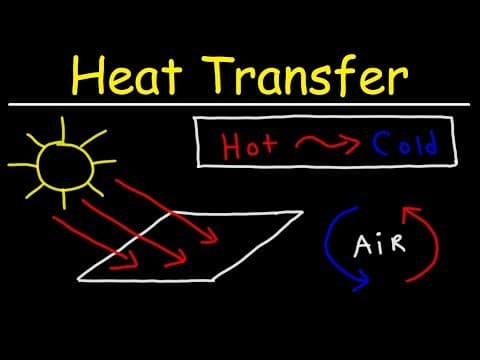
[0:01]In this lesson, we're going to talk about three methods of heat transfer: Conduction, convection, radiation. So let's start with conduction. What do you think conduction is? Heat conduction occurs through contact. So let's say if I have a very hot metal bar. Let's say this temperature is 100°C. and a cold metal bar at 10°C. What's going to happen if I put these two together? Once they're in contact, heat is going to flow from the hot region to the cold region. There's going to be a net flow of heat. And this is going to continue until the temperatures are the same. So let's say if the temperature drops to 55. At this point, when the temperature is the same, we have thermal equilibrium. Now, heat is still flowing from both sides. However, the net flow of heat is going to be zero. There's not going to be any net change. But every object emits thermal energy. So make sure you understand that heat flows from an object at high temperature to an object at low temperature. It always flows from hot to cold. Now, some materials conduct heat better than others. Metals are known as conductors. They can conduct thermal energy very well. Diamond can also conduct heat energy. Materials that resist the flow of heat are known as insulators. So two good examples of insulators are wood. Another one is fiberglass. These materials do not conduct heat very well. So let's say if you're holding a hot pan. And typically, the pan is made up of a metal, so you don't want to touch it here because it's very hot. However, the handle will usually have an insulator. Most likely, it could be wood. And so you can hold the wooden part of the handle, but you don't want to touch the metal because heat will transfer from the metal to your hand and it could burn you. But if you hold it from the wood due to the thermal resistance of the wood, there's not going to be much heat that's going to transfer to your hand, which it's safe for you to hold it there. So it's important to understand the difference between insulators and conductors. Now, there's a term known as thermal conductivity. Metals, because they're good conductors, have a very high thermal conductivity value. So, for example, copper has a thermal conductivity of 380 Joules per second per meter per Celsius. Water doesn't conduct heat as well as copper. The conductivity of water is 0.56, so as you can see, it's much less. Wood, which is a known insulator, is around 0.10. So it's very low. Fiberglass has a thermal conductivity of 0.048. So fiberglass is a very good insulator. And even better is air. Air is an extremely good insulator: 0.023. Now, this is true for still air, or air that is not moving. If the air is moving, heat transfer can take place. So, for instance, imagine if it's winter time and you're outside playing and you feel a breeze. If that breeze hits you, you're going to feel very, very cold. The breeze is going to carry away heat from you, and so your body temperature is going to drop. However, if you don't feel the breeze, you're not going to feel very cold compared to if you do feel the breeze. And so, whenever you have a fluid in motion, and if it takes away heat energy from you, it's doing so through convection. So air is only a good insulator if the air is not moving, if it's still air. But if it is moving, it can carry away heat from your body. That's why on a hot day, if you feel just a small amount of wind, just a little breeze can make you feel cooler. Another example that illustrates the fact that air is such a good insulator is the amount of clothing that you wear during the winter time. Now, if you want to dress warmly, you want to wear layers of clothing. So if you have a shirt, you want to add another shirt to it, and maybe another one. So in between the shirts, you're going to have trapped air molecules. And because the air is not moving, because it's still air, it serves as a good insulator. In fact, as a better insulator than the clothes itself, notice that air is a better insulator than fiberglass, and even wood. So if you can trap air between the shirts that you're wearing, it can help you to stay warm in the winter time. Now let's talk about our second method of heat transfer, which is convection. So what exactly is convection? What would you say? Convection occurs when heat is transferred by the movement of a fluid. And that fluid could be a liquid or a gas. It could be liquid water or the movement of air, like a wind. So let's say if we have a beaker that contains water. And we're going to add some heat. So the water molecules at the bottom will be heated. And as a result, they will rise to the top. And as they rise, they cool down. And so what you have is that cold water molecules will descend, and the hot water molecules will rise. And the same is true in air. So let's say it's a hot day and the ground is very hot due to the sun. Warm air is going to rise from the ground to the top. As the warm air rises, it cools, and the cold air molecules will descend. Now, the reason why warm air rises is because it's less dense than cold air. Whenever you heat up a gas or even air, the molecules expand, and as a result, there's less mass per unit volume. And so the density decreases. And so because hot air is lighter than cold air, hot air rises, cold air sinks. A good way to illustrate this is, let's say if this is the ocean. If you drop a metal, because the metal is more dense than liquid water, it's going to sink. But let's say if you put wood, wood is less dense than water, so it's going to float. And so heavy objects sink, but objects with a low density, they tend to float. And water is a fluid, the same way air is a fluid.
[7:16]So that's why hot air rises because it's less dense than cold air, and cold air sinks because it's heavy. A third method of heat transfer is radiation. Radiation occurs whenever heat is transferred through empty space by electromagnetic waves. A good example to illustrate this is the sun.
[7:46]Thermal energy from the sun travels through empty space. And as it reaches the Earth, it causes the temperature of the Earth to rise. So it heats up the Earth. And at night time, the Earth emits infrared waves, thus cooling itself down, decreasing its temperature. In fact, the sun is not the only object that emits radiation. Every object with a temperature above 0° Kelvin emits some form of radiation. Even us, we emit radiation. However, we emit it in the form of infrared rays. And as you increase the temperature of an object, the radiation level increases. For example, let's say if you have iron metal. If you heat up iron metal, so maybe let's say 900° or 1000°C, it's going to appear red hot. And so you're going to emit infrared waves and even red light. Now, as you increase the temperature, let's say to about 3000°C, this object will begin to emit visible light, even white light. So it's going to appear white hot. And so as the temperature of an object increases, the amount of radiation that the object emits increases. The surface of the sun is about 10,000° Kelvin, and so it's very, very hot. And in the sun of the sun, it's over a million degrees Kelvin. I don't know the exact temperature, but it's in the millions. It's very, very hot at the center. And so whenever you raise the temperature of an object, it's going to emit more radiation. Now, there's one more thing that we need to talk about. And that is how certain materials react to electromagnetic radiation. So, for example, let's say if you have a white object placed in front of the sun. The white object will reflect a lot of the electromagnetic radiation emitted by the sun. And so it's going to stay cool. On the other hand, a black object, exposed to the sun, will absorb most of the sun's radiation, and so it's going to get hot. So that's why in the summer, it's a good idea to wear light-colored clothing. So if you put on a white shirt, you're going to stay cool in the sun. However, if you put on a black shirt, you're going to feel the black shirt get hot very quickly when it's exposed to the sun. And so it's important to understand that black objects absorb radiation efficiently, and light-colored objects tend to reflect radiation efficiently.