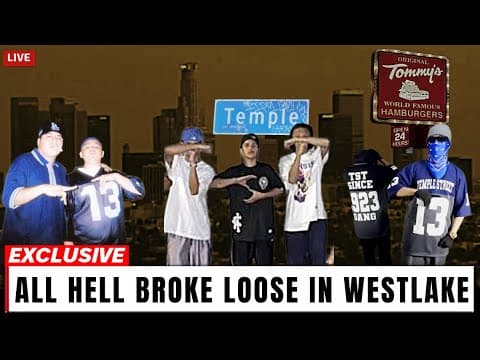
[0:08]Temple Street is one of those names you hear and instantly know it carries history. We're talking about a gang whose roots stretch all the way back to the 1920s, almost a century of movement, conflict, expansion, and evolution in Los Angeles. They're widely recognized as one of the oldest standing street gangs in the entire city. Unlike most sets that remain tied to one ethnic identity, Temple Street became something different early on. Through the decades, the neighborhood pulled in Latino members, Filipino members, and a mix of others who lived around that stretch of Rampart, Beverly, and Temple. Filipinos especially played a major role. They weren't just associates, they built their own clicks under the Temple Street umbrella, and eventually expanded the identity into other cities, other states, and even overseas. By the 2000s, Temple Street wasn't just a local LA gang. It was a name recognized far beyond city limits. But the bigger a gang gets, the more enemies it attracts. With different clicks spread across different pockets of the city, Temple Street eventually found itself beefing with multiple sets. Rockwood 13, 18th Street, BMS, MS 13, F13, and more. And those rivalries produced a long list of cases, retaliation cycles, and street incidents that shaped the gang's reputation. Let's get into them. One of the earlier high-profile cases involves a man named Ishmael, who was working at J&L Video, a small shop sitting near Temple Street and Rampart Boulevard. On the night of October 9th, 1994, inside was the manager, Ismail Magallanes, was doing what he always did, holding down the counter, watching movies, and keeping an eye on the door. Hanging out with him that night was 17-year-old Eugene "Temper" Afable,
[2:02]a known Temple Street member. Temper was comfortable there. The store sat right in Temple Street territory, and he'd stop by to watch videos and chill. That night he was wearing a black football-style jersey with the letters TST across the front repping the neighborhood without saying a word. Around 9:00 p.m., as a movie played in the background, Ismail sat behind the counter. Temper stood a few feet away. Nothing seemed out of place, no big argument, no buildup. Then Ismail heard a single gunshot. Temper collapsed. Out of instinct, Ismail looked up just in time to catch a glimpse of the shooter running out of the store. Later, he'd tell detectives the shooter was a young Latino male, mid-teens to early 20s, light-skinned, clean-shaven, about 5'4" to 5'6", bald with a short ponytail in the back. No mask, no words, just in, shot, and gone. Next door, inside a laundromat, another witness heard the same shot and looked toward the video store. He saw a man quickly walking away, same description, light-skin, young, shaved head with a little ponytail. Nobody heard a robbery demand. Nobody saw an argument. It looked like a targeted hit. LAPD Rampart Division responded. When detectives arrived around 12:50 a.m., they found Temper on his back inside the store, still wearing the TST jersey. A single shell casing from a .38 caliber pistol lay nearby. The scene looked clean. Nothing to suggest a random robbery. This was about gang politics. The area around Temple and Rampart was well known to officers. According to gang expert Detective Vincent Valderama, Temple Street controlled the blocks around the video store. Their rivals, Rockwood 13, claimed an area roughly a mile away. The two sets had a long running conflict, and to hit someone that visible in that location, wearing that jersey, it sent a message. The next day, detectives showed Ismail a six-pack photo lineup. He pointed to one face, the Rockwood suspect as "close to the shooter, only heavier." In court, he said he was about 90% sure that was the same man he saw running out of the store. The laundromat witness backed it up, identifying the same Rockwood member as the person he saw walking away from JNL Video right after the shot. But that night wasn't over. Around midnight, about three hours later, Jose Aguilar, Francisco Picheno, Gabriel Halu Cruz, Joaquin Halu Cruz, and Ronaldo Halu were hanging out in a driveway on North Bonnie Bra Street, still inside Temple Street territory. Out of nowhere, two men approached. One wearing a Halloween mask, the other in white pants, a dark shirt, and a Dodger's hat. Before anyone could react, shots were fired. Several men were wounded, and at least one died at the scene, while another later passed at the hospital. Nothing was stolen, no argument, just a second targeted hit in the same neighborhood, only hours after Temper was killed. To detectives, the pattern was clear. A Rockwood gunman hits a Temple Street member inside their turf, then later that same night a masked pair hits a group tied by family and territory to Temple. When the Rockwood suspect was arrested, his tattoos, RWST, LCS, and RW, left no mystery about his affiliation. In court, investigators tied him to several other shootings involving rival sets. He even ended up involved in attacks inside the jail. By the time everything stacked up, Gerardo from Rockwood 13 was ultimately sentenced to death. In late 2007, the tension inside Temple Street wasn't about turf or rivals. It was about a breakup. Irvin, a Temple Street member, had recently ended a brief two-month relationship with Diana. But instead of walking away like a normal person, he spiraled. Friends in the neighborhood later told investigators he was obsessing, showing signs of jealousy, and openly telling people he couldn't accept Diana moving on. And Diana had moved on. She started seeing a new boyfriend named Oso. For Irvin, that was fuel on the fire. According to witness statements, he began roaming the neighborhood telling anyone who would listen that he planned to deal with Diana and Oso. At first, nobody took him seriously. People assumed it was breakup talk, nothing more. But on December 2nd, 2007, Irvin proved them wrong. That evening, he found out Diana was hanging out at a friend's apartment. He showed up acting calm, asking if she wanted to take a walk to talk things out. Diana agreed. She wasn't afraid of him, and nobody expected anything violent to happen. Minutes later, she was found collapsed in a walkway off Temple Street, clinging to life. A single head injury told investigators exactly what happened, but Diana didn't survive long enough to speak. The neighborhood went into shock. This wasn't a gang dispute or a robbery. This was personal. Hours after the attack, Diana's friends saw Irvin again. His clothes were freshly changed, and when they asked where she was, he reportedly smirked and told them she wasn't coming back. He even got a teardrop tattoo the same day, something detectives would later highlight during trial as a sign of pride rather than regret. Police narrowed in on Irvin quickly. He was the last person seen with Diana. He had threatened her publicly, and the walkway where she was found was on the same route he'd taken her toward. Irvin denied everything, but the timeline, witness accounts, and his sudden tattoo made the case air tight. In the end, Irvin was convicted and sentenced to 50 years to life, not for a street conflict or rivalry, but for one of the most senseless acts connected to Temple Street, a tragedy driven entirely by jealousy. In December 2008, the corner of Beverly Boulevard was a familiar hangout spot. Tommy's Burgers always had people drifting through, families grabbing food, locals cooling off, and crews from different blocks crossing paths. That's where Lester, a security guard, was working his usual shift when everything went sideways. Earlier that evening, witnesses say a small argument broke out between a young Latino man and someone from a group standing near the parking lot. It wasn't a major clash, more like heated words, a shove, and the young man leaving with his girlfriend. Security assumed it was over. It wasn't. Minutes later, a silver car pulled back up to the lot. The same young man jumped out, now holding a gun, and walked toward the group with a smile on his face. According to surveillance footage and witness testimony, he raised the weapon and opened fire without hesitation. One man, Xavier, was struck multiple times and collapsed on the pavement. He didn't survive. Lester ducked behind a column as the shooter calmly got back into the car and sped away. Detectives pulled every angle from Tommy's security cameras. The footage showed the shooter and his girlfriend clearly enough for officers to ID him. Juan, a known Temple Street member. His girlfriend, Nadia, appeared by his side on camera before and after the shooting. Police surveiled Nadia's home for several days. When Juan finally returned, officers moved in and arrested him. Investigators later testified that the entire attack started because someone had stepped on Juan's shoe during the earlier argument. A tiny moment of disrespect that spiraled into a fatal retaliation. Both Juan and Nadia were charged. But the evidence against Juan was overwhelming. Surveillance video, eyewitness accounts, and his own documented gang ties. He was ultimately convicted and sentenced to life in prison, all over a confrontation that lasted less than a minute. On December 27th, 2008, Joseph, a tow truck driver working along Beverly Boulevard, was stopped behind a dark Volvo. As he waited at the light, he saw the Volvo's window slide down. In the next lane, a Nissan Ultima rolled forward. Then, without warning, bursts of flashes erupted from the Volvo. Multiple rounds tore into the Altima, and the car drifted as its driver slumped over the wheel. The Volvo instantly sped off. Joseph, shaken, but composed, grabbed his radio and called 911, giving one of the clearest suspect vehicle descriptions LAPD had received that month. Within minutes, officers in the Rampart Division spotted the Volvo and initiated a pursuit. What followed was nearly an hour-long chase through West Lake and surrounding neighborhoods, running lights, swerving through traffic, and refusing to stop. The chaos ended when the Volvo crashed and three men bailed out on foot. LAPD set a wide perimeter and brought in K9 units. All three suspects were caught hiding in nearby yards. Their names were Hurston, Ronald, and Richard, all identified as Temple Street members. Back at the scene, detectives recovered casings that matched the weapon used on the Altima. Witness statements, Joseph's call, and the abandoned Volvo tied everything together. The victim in the Altima did not survive, turning the case into a homicide investigation. Prosecutors argued the shooting was a targeted gang retaliation, carried out in broad daylight with total disregard for civilians on one of LA's busiest corridors. The jury agreed. All three suspects were convicted and sentenced to 50 years to life, marking one of the most reckless and publicized Temple Street incidents of the late 2000s. New Year's Eve 2008 was supposed to be nothing more than a small celebration. Wendy and Amy were heading to a party hosted by a friend named David, a member of MS 13. They also invited Amy's ex-boyfriend Chris, who showed up with Rafael and two other Temple Street members riding along with him. From the moment everyone met at Wendy and Amy's place, the tension was obvious. Amy told the Temple Street group and David the same thing: "Don't start anything, keep it cool." But it didn't matter. Old issues and neighborhood politics were already simmering. Minutes after arriving near the party, the Temple Street car pulled up again, this time rolling slow. Before anyone could react, shots were fired toward David. He collapsed almost immediately as the car sped off into the night. The entire hit took seconds. Detectives worked fast. Surveillance and witness statements confirmed Rafael was the shooter, and the same vehicle was found just two days later. Chris denied all involvement and was eventually cleared. But Rafael wasn't so lucky. The evidence, witnesses, and timeline locked him in as the primary suspect. Rafael was later convicted and received a 60-year to life sentence for the attack. A New Year's Eve tragedy that started as a simple gathering and ended with a life lost and multiple lives destroyed. Ivan and Juan were Temple Street members, but neither lived near Temple Street anymore. In late 2008, Ivan had moved to South Los Angeles, staying on West 55th Street, and Juan would regularly pick him up for delivery truck work they ran together. On that morning, they were driving eastbound on 55th, cutting through a neighborhood claimed by BMS. As they rolled toward Broadway, a white compact car suddenly appeared behind them, trailing closely. At first, Juan assumed it was just impatient traffic until the car sped up, swerved toward the truck, and someone inside yelled a gang slur out the window. Juan hit the gas, trying to shake them, but the white car pulled alongside the truck and opened fire. Several rounds punched through the metal paneling, and Ivan was struck as Juan kept driving, trying to get them out of the line of fire. The white car sped off, and Juan immediately grabbed the truck radio and called for help, giving dispatch the make, color, and direction the attackers fled. Surveillance cameras from nearby businesses later showed the white car stalking the truck minutes before the shooting. Months later, police arrested Jose, a BMS member, after finding a weapon in his home that matched the shell casings recovered from the truck. Juan identified him in a photo lineup and ballistic tests locked the case in. Jose was convicted and sentenced to 75 years to life. In the late 2000s, tension inside Temple Street wasn't always about rival gangs. Sometimes the danger came from inside the neighborhood itself. That was the case when Flacco, a Temple Street member, reached out to his homie Ruben one evening, asking him to come hang out. Ruben trusted him. There was no reason not to. They'd known each other for years. What Ruben didn't know was that Flacco had already put a plan in motion. He had called another Temple Street member, Fly, and told him to meet up at the spot. Fly believed Ruben had disrespected him and owed him money, and instead of settling it the normal way, he came prepared to make an example. When Ruben showed up, Flacco distracted him, keeping him talking. Out of nowhere, Fly stepped out from behind a parked car with a handgun. Ruben barely had time to react before Fly fired, striking him in the leg and sending him to the ground. Fly then hit him in the head with the barrel, demanding money. Ruben handed over what he had, about $200, and the two men ran off, leaving him injured in the street. Ruben managed to call his friend Juan, who drove him to the hospital. While being treated, Ruben told investigators exactly what happened and identified both men by name. Detectives quickly secured a warrant and raided Fly's residence. Inside, they found not only the weapon used in the attack, but scales, packaged narcotics, and other evidence tying him to ongoing criminal activity. With Ruben's statement, the recovered firearm, and the additional charges stacked against him, Fly received 120 years in state prison. Flacco, who set up the ambush, was also taken into custody and charged for his role in the attack. It was supposed to be a quiet Sunday morning. Lito, Andreas, and Santos were at their small neighborhood church getting ready to serve the congregation, when they suddenly heard the sound of shattering glass outside. At first, they thought it was an accident until they stepped out and saw the real problem. A young woman named Janette was spray painting graffiti across the church wall, marking up a place the community considered sacred. Lito called out for her to stop, but instead of backing down, she charged at him, knocking him to the ground. When Andreas and Santos tried to break it up, things escalated fast. A man named Pedro, later identified as a Rockwood 13 member, jumped out of a nearby car. Without hesitation, he pulled out a handgun and opened fire toward the group. Both Santos and Andreas were struck. Despite being rushed to help, Andreas didn't survive his injuries. The attack stunned the neighborhood. This wasn't a gang clash on the street. This was a shooting on church grounds in broad daylight, witnessed by people who had only shown up to volunteer. Detectives didn't need long. Pedro had left behind a drink bottle with his DNA on it, and Janette left behind her spray paint can with her prints. Once arrested, both were tied directly to Rockwood 13 and charged accordingly. In court, the shooting was described as a reckless act meant to send a message inside Temple territory. Both suspects were ultimately sentenced to life, a senseless loss sparked by vandalism, fueled by gang pride, ending in tragedy. In early December 2015, tensions between Temple Street and Florencia 13 ignited a violent confrontation that started as a simple argument outside an apartment complex. Hector, a young Temple Street member, had gone to visit the mother of his child. When he stepped outside, he ran into a group of F13 members standing near the parking area. Words were exchanged. Things escalated, and Hector found himself surrounded. Outnumbered, he backed off and left the scene, angry, embarrassed, and convinced the situation wasn't over. Witnesses later told investigators that Hector made comments about returning to "handle it." But nobody thought he meant immediately. Roughly 15 minutes later, he reappeared. This time emerging quietly from a nearby alleyway. Without warning, Hector opened fire toward the group of men he argued with earlier. Most scattered instantly. One man, Andrew, wasn't fast enough and was struck in the foot as shots hit the pavement around him. Hector fled in a car before officers arrived, but several residents had already seen his face clearly. Detectives secured surveillance footage showing a man matching Hector's movements returning to the exact spot of the argument. Within days, police searched Hector's home and found the same handgun used in the shooting, along with additional weapons. During questioning, Hector claimed he acted out of fear, and was only trying to protect himself after being surrounded earlier. But prosecutors argued that leaving and returning with a gun eliminated any self-defense claim. With eyewitness IDs and the recovered weapon, the case was airtight. Hector was convicted and sentenced to 26 years in state prison. By the late 2000s, the city tried to shut Temple Street down with one of LA's toughest gang injunctions. Curfews, no hang zones, and association bans. On paper it looked like a choke hold, but on the street, it barely slowed anything. In the end, the injunction became another chapter, not a solution. The neighborhoods changed, but the history, the cases, and the impact never disappeared. That's the full breakdown.
[20:41]I would ask you guys to please like, comment and subscribe. More videos coming soon. So until then, watch your step and respect the streets.


