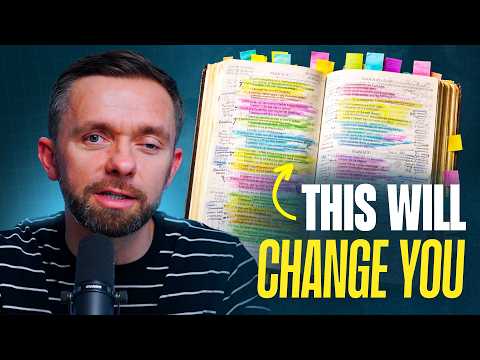
[0:00]Have you ever finished a Bible reading and realized you cannot remember a single thing you just read? You close the cover, you check the box on your plan, but nothing really sticks. If that's been you, you're not alone. For many of us, the Bible feels like this huge holy book we should read. We're just not really sure how to get anything out of it. In this video, I'm going to help you to move from skimming the Bible to actually feeding on the scripture. And so that the Bible will become more like a breakfast than a homework. Jesus said that we don't live by bread alone, but by every word that proceeds from the mouth of God. That's what it means when the scripture becomes your daily food. I'm going to show you a simple and a practical way to study your Bible, like any believer can do. You don't need a seminary degree, no Greek or Hebrew required. Just a few tools, a simple method, and I believe, an open heart. Let's start with the first thing, and that is the heart. Not the Bible translation, but it's about the heart. So, the key number one is you got to come hungry and invite the Holy Spirit. Reading the Bible does not start with your highlighter, it actually starts with your spiritual hunger. Scripture describes God's word as food, bread from heaven that sustains your spiritual life. Just like you will not try to live on one big meal on Sunday and then starve all week, you were never meant to live on just a sermon on Sunday. You need a daily bread, a fresh word from God. But you also cannot truly understand and enjoy the scripture without the Holy Spirit, because the Holy Spirit is the author of the Bible. So before you read anything, pause and invite the Holy Spirit. You can pray a simple prayer like this, Holy Spirit, I am here. I am hungry, open my eyes to see what you are saying. Help me to understand and help me to obey. So, the first key is simple. Don't just open your Bible, open up your heart. Come hungry, come expectant, and come with the Holy Spirit's help. Key number two, is create a simple, yet sustainable setup. Most people don't struggle as much with understanding the Bible as actually they struggle with showing up. So let's make this showing up part as easy as possible. You need three things: time, place, and tools. Time is this: pick a specific time that you meet with God in his word. It could be in the morning, it could be during your lunch break, it could be during the evening. Treat it like an appointment, like a doctor's appointment that you can't cancel. Many teachers will suggest actually putting it on your schedule, because we rarely would grow in the areas we do not plan for. The second thing is the place, choose your regular spot, a corner of the couch, a desk, a table at the coffee shop. When you sit there, your brain starts to associate that place with, this is where I meet with God. Try to keep it as a distraction free place as possible. Keep your phone on silent or in another room if you can. And now let's talk about the third thing, which is tools. You don't need a huge library. But there are a few tools that can help you, a Bible translation that's both readable and accurate. For devotional reading, a thought for thought or contemporary translation will be fine. For deeper study, you can also have more of word for word translation nearby. A notebook or a journal, because Bible study means you're writing things down. A pen or a highlighter. Also another thing is a Bible study app or a Bible study so you can quickly see cross references and other translations. Once you've picked the time and place and tools, you've built a simple Bible study habit system that will remove a lot of friction. In my personal life, for me that time is very early in the morning. It's one of the first things that I do when I wake up, make my cup of coffee. I have a chair where I sit, it's away from everybody, I don't bring my phone there. I have my iPad for the Bible study tools and my physical Bible with a pen and a highlighter. And it's like a system, it's it's like a an appointment that I have with God. And I first have an appointment with God in his word, and then I pray out of that word. Now, key number three, is use the soap method. So the soap method works like this, soap stands for scripture, observation, application, and prayer. Let's walk through this. Scripture, start by choosing a short passage. For a daily study, you can think of a paragraph, maybe not an entire book, five to ten verses. In your journal or your notebook, you can actually write S and then copy the main verse or verses by hand or write them down for reference and some key few lines. Now, something happens when you're actually writing down the verses, is you will notice things in those verses, typically you don't notice. There's a power of writing verses down. Now some of you may prefer to type them out, that's fine as well. I would avoid trying to copy and paste. Why? Something happens as you type those words. So, the scripture is powerful. Now, this could also include your daily reading plan, you know, most of us have a reading plan where we read through the three chapters. The problem with the three chapters is is a lot more harder to actually study those three chapters. So, what I like to do is I have my reading plan, and as I read through, I look for that portion that kind of sticks out. And I want to hone down, I want to like zone in into those portions. Today it was from Mark chapter one, and it was about Jesus getting up early in the morning and going to spending time with his father. And then the crowds were looking for him, and then he told them, he says, I must go to other towns. And that was like a download. I hone down on that whole portion of three, four verses and really started to kind of press in more um like milking those verses and that that scripture for me. Then I took that into prayer. So the second thing, as you read the scriptures, you wrote few scriptures down is observation. Observation is, what do you see? This is where the good Bible study really starts. This is where you begin to ask questions like a detective. Who is talking, who is being addressed, what is happening? Are there repeated words, contrasts, commands, or promises? Here are a few tips. Pay attention to the context, the verses before and the verses after. The chapter or the whole theme of the book. The meaning is determined by the original author. Your job is to discover this meaning, not to invent this meaning. Also, try to look at the same verse in two or three different translations. A more literal translation might show you the structure. A thought for thought translation might give you another sense in a very plain language. So, in your notebook, you can write O for observation and put some bulletin points of the things that you notice. Don't worry about trying to be deep. You just simply write what you see. The third thing is A for application. This is the part where most people skip, because they love to dive deep into the Greek, into the Hebrew, the original language, the patterns, and the contrasts and everything. But as one pastor puts it like this, the best translation of the Bible is when you translate God's word into your daily life. The goal isn't just to fill your head with information, it's to see real transformation. So under A in your journal, you can write something like this: What is this teach me about God? What does this teach me about myself? Is there a sin I need to confess, a promise I need to believe, a command I need to obey, or an example I need to follow? If I actually believed this today, would my life look different? What would be different in my life? So those are some of the questions you can put under application. What does it teach me about God? What does it teach me about myself? Is this portion challenges me about a sin that I need to confess, a promise I need to believe, a command I need to obey, and an example I need to follow? And if I actually believed this, what would be different in my life? So, make this very specific and very doable. Instead of I should love people more, focus more on today I'm going to encourage this friend. I'm going to forgive that co-worker and stop replaying what happened. And the last thing is prayer. So, you read the scripture, you had the observation, you put some application. Now take it to prayer. God doesn't just want you to study about him, he wants you to talk to him. So, under P, you can write down a conversation of what you learned today from the scripture. Lord, thank you for showing me this today. I confess that I have been, and fill in the blank. Today, help me to fill in the blank. Give me the strength to obey your voice. So, when you're practicing soap, think of like soap when you're taking a shower, okay? You're not just reading, you're hearing, you're thinking, you're responding, you're talking with God. And over time, this is how the truth will move from the pages of the Bible into your heart. Key number four, is read things in context and let the scripture interpret scripture. Have you ever heard somebody that will quote a verse or a thought that just sounds off? And very often, it's because the verse have been skipped or ripped out of the context. It's like misquoting a famous line from a speech while skipping everything around. So, here are two guard rails. Guard rail number one is read things in context.
[10:14]Before you decide what the verse means, read the paragraph, read that chapter, and if you can, read the whole book. Ask, how would the first readers have understood this? The ones who were reading these portions of the scripture, that means you're doing exegesis, drawing meaning out of the text, instead of eisegesis, where you are pushing your own ideas into the text. Remember, the Bible has one interpretation, but many applications. We want to discover what it meant then, so that we can apply it now. That's where you must start. The second guard rail, when it comes to letting the Bible interpret the Bible, and that is let scripture interpret scripture. The Bible is its own commentary. If a verse is confusing, look for other passages on the same topic. One part may tell a story, another part may explain the principle and expound that story. To help you with this, you can use cross references in your study Bible. You can use concordance to look up key words or verses. A good Bible dictionary or a basic commentary when you're really stuck, would really do the job. Those tools can help to bridge the language, the culture, history, and geography gaps between the world of the Bible and your world today. So, you can see what's going on and what it means for you right now. Key number five, is you have to study in a community and obey what you know. Here is the key, you can study alone, and you don't only study. So, let's talk about the first one. Don't study alone. Yes, you need a personal relationship with God, but God never designed you to grow in isolation. One of the things you need to keep in mind is that God wants you to be involved in a local church. Learning with and from other Christians. We're told to teach and admonish one another with God's word, to listen to pastors and teachers, and to benefit from wise believers who have walked with Jesus a bit longer than we have. This may look like this, joining a small group or a Bible study. Sharing your soap notes with a friend. Asking a mature believers or a pastor, when you hit passages you do not understand. The second part about this is you don't just study, you have to obey. Our biggest problem is actually not that we don't know enough, is that we don't live out of what we already know. We are warned in the Bible not to just merely listen to the Bible, because then we will deceive ourselves, but to do what it says. So, every time you open the scripture, you have to come with this mindset. I'm not just here to get more verses in my head. I'm here to let God's word shape my heart, my choices, my lifestyle, and my worldview. So, I want to challenge you for the next seven days from the time you watch this video. Pick a place and a time. Decide when and where you're going to meet with God every day and put that on a calendar. Secondly, pick a book of the Bible. James, Philippians, Gospel of Mark, any will work great. Thirdly, use the soap method you just learned today on a short passage that you read. So, write the scripture, observation, application, and prayer in your journal. And the fourthly, is share at least one insight you've learned with someone, whether it's in your small group, whether it's with your spouse, or your family member. Text a friend or tell somebody what God has been sharing. Why? Because teaching others is one of the best ways you can actually cement God's truth in your own heart. If you'll do this for one week, you'll be amazed at how different the Bible begins to feel. It won't be just a book you're reading, it will start to become your daily food. You know, I'm a preacher of God's word, but I'm an eater of God's word. And a lot of times actually things that I do preach are the things that feed me. And so, while that's not the only thing I preach, yet God's word has been a consistent diet of my personal life. I don't know what I would be today as a Christian, even as a pastor, had it not been for the power of God's word. It's unlike any other book. So, our game plan is this, we come hungry and we invite the Holy Spirit. We have a simple yet sustainable system or a process. We use soap method to move from reading to really digesting, meditating and putting it into our heart. We guard ourselves with context and cross references, we don't take things out of context. And we stay within the community. But most importantly, we obey what we learn. If this helped you, consider sharing this with somebody who's struggling to connect with Bible right now. And as you go, remember, you don't live by bread alone, you live by every word that comes out from the mouth of God. He loves to speak to you through his word. I do have an e-course, it's free, called Bible Basics that you can take with your small group or by yourself. It's about, I think 10 lessons, each lesson is about 10, 11 minutes long, where you can learn really more how to study the word of God. Check it out, go to vlad's cool.com, and check out that e-course, and I believe it will bless you. Thank you, until next time.
[17:03]I hope that this video helped you to grow in your walk with God. Imagine multiplying that impact through the world. Through this ministry, we've discipled over 160,000 students through our online school. Created over 60 reading plans that over 2 million people have completed already. And published resources in 18 languages. But our heart is bigger than content. We're feeding orphans, building homes, and partnering with missionaries on the front lines of the Gospel. Would you consider becoming a monthly partner? Every dollar helps to reach, teach, and care for more people. Click on the link below to become a part of this movement.


