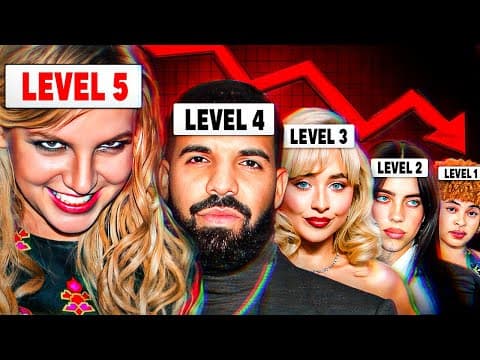
[0:00]Every time an artist blows up overnight, the internet does what the internet does best. The term industry plant gets thrown around so much now that
[0:08]I mean, it's hard to even know what it means anymore. See, this levels to this. And let's start with the ones who hide it best. The organic.
[0:17]Step on the glass, staple your tongue.
[0:20]These are the artists who still need you to believe that they started from nothing. The story has to feel real, the struggle, the discovery, the breakthrough,
[0:29]the indie darlings who got lucky with a viral moment. But if you look closer, their bedroom is in a million dollar house that their parents own, or
[0:37]that viral moment was coordinated by PR agents and label executives. They keep the aesthetics to DIY, but behind the scenes, there was professional management going on the whole time.
[0:48]Even before you knew their name. Artists like Billy Eilish.
[0:51]I've wanted to do this like my whole life, so I'm a little shaky.
[0:56]Now, she's talented, but the whole, we recorded Ocean eyes in my brother's bedroom thing. That's not the whole story. What they don't mention is Phineus was already working in the music industry.
[1:05]Their mom was an actress, their dad was in bands. They grew up in LA, already around the entertainment industry.
[1:11]Billy was even homeschooled specifically so she could pursue music.
[1:15]You grew up homeschooled? Yeah. Did that shape who you are and who you will be? Because
[1:21]And by the time Ocean eyes dropped, Phineus had already written and produced for other artists. He had a manager, he understood how the machine worked.
[1:30]Interscope didn't just stumble on him on SoundCloud. The setup was already there. See, there was this guy named Danny Rukussin, who became her manager.
[1:38]And Danny was business partners with Brandon Goodman. And Brandon managed Fallout Boy. So Billy already had deep industry connections from the start.
[1:46]The organic plant, they're the smartest plays because they keep the indie credibility while having major label resources. They played it cool.
[1:53]That's not the case with level two. The obvious. These are the artists who don't exist one day and then the next day they're on every playlist.
[2:02]The push is so aggressive that even casual listeners noticed that something's a little off.
[2:08]You see them on festival lineups before they have a fan base, getting late night TV slots before they have a catalog,
[2:13]collaborating with A-listers on their second single. The machine gives them all the signs of success before they've even earned it.
[2:20]They'll have 50 million streams, but you never heard anybody play their music in real life.
[2:25]They're trending on expert, nobody's actually talking about them. They're everywhere and nowhere at the same time.
[2:31]They're betting that if they push hard enough and fast enough, eventually fans will follow. Most of the time it doesn't work or it only works temporarily.
[2:40]But when it does work, it works fast. Now, she's cliché to talk about at this point, but the artist most people talk about in this category has to be Ice Spice.
[2:48]Once again, Ice Spice.
[2:53]She went from unknown to featuring with major artists in a few months.
[2:58]Munch dropped in August of 2022, and by October, she was already being called the Princess of Rap.
[3:04]And then she was at the Met Gala by May. Also, her music video blew up on Worldstar Hip Hop.
[3:09]And I can tell you being in the music industry myself, Worldstar charges big money to feature you.
[3:14]But if you look even closer than that, her label 10K projects is run by Elliot Grange. And Elliot is the son of Lucian Grange, who runs Universal Music Group.
[3:23]So, it's not just the money, it's also the access and every door being open for you at the same time.
[3:29]Another one is Kid Laroy. Now, he's a controversial one because there's signs of him being an industry plant, but his upbringing and his start in the music industry is pretty highly debated.
[3:39]It's hard to really know for sure. First off, his dad was a music producer and sound engineer, and his mom was a talent manager.
[3:46]And after some digging, I found out that she started a management company called Mama Capone Management to help Kid Leroy and the people he was working with get on the map.
[3:55]And it goes a little bit deeper because the claim is that he grew up in poverty in the ghettos of Australia, but some of these early photos I found would say otherwise.
[4:04]Now, of course, I wasn't there, so we still can't say for sure, but between the Juice World features and the Justin Bieber collabs, it felt like he was being marketed as the next global superstar out of nowhere.
[4:15]And the most recent person people like to throw in this category is Dochi.
[4:22]Now, when you factor in her versatility and her stage presence, I think it's hard to say that she's not talented or doesn't deserve recognition.
[4:30]But everything was just so aggressive with her rise that people were calling her a plant before giving her a chance.
[4:36]So she signed to TDE, Kendrick's label. They're an independent label, but they got ties with the big three record companies, Sony, Universal, and Warner.
[4:44]She basically went from up and coming artists to winning a Grammy for best rap album overnight.
[4:49]Now, her rise seems legit when you first look into it because at one point, she just seemed like your average YouTuber that was on the come up.
[4:56]But it's pretty clear that she's had some big label back and before we all knew who she was.
[5:01]It's one thing to develop an artist's talents and skills, but it's another thing to spend major label money on plays and views.
[5:09]But what happens when an artist presents themselves as not having any money and no family and being 16 in the middle of Miami?
[5:17]Amethyst, Amelia Kelly, aka Iggy Azelia.
[5:21]First things first, I'm the realest. Drop this and let the whole world feel it.
[5:26]A white girl from Australia, but you would never know that from listening to her fake urban Southern accent.
[5:32]But it checked my text bracket. What you think was going to happen, nagging and now he's leaving and y'all broke up like madmen.
[5:38]Oh, she became obsessed with Southern hip hop. And during that time, it was so different and unexpected. TI couldn't help but roll out the red carpet for her.
[5:52]I mean, he signed her and they basically constructed an entire persona. They got her on big interviews,
[5:57]feature with major artists like Charlie XCX, and the machine took off from there. At first, everybody embraced her, even the black community.
[6:06]She was invited to the cook out, as we like to say. Iggy!
[6:12]But as time went on and racial tensions started to flare back up in America, she got caught up in the cultural vulture conversations.
[6:19]And once the culture rejected her, I mean, the machine couldn't save her.
[6:23]Some of it started with the feud between Iggy Azelia and Azelia Banks after Iggy won best rap album at the Grammys.
[6:29]You know what I mean? Like, Iggy Azelia is not better than any fucking black girl that's rapping today, you know? And when they give those awards out, cuz the Grammys are supposed to be like accolades for artistic excellence.
[6:40]You get what I mean? Iggy Azelia is not excellent.
[6:45]The they purchase things that they see themselves in, right? And businesses capitalize on that.
[6:51]And that's fine. So put her in the pop category.
[6:54]Hmm. Put her with Katy Perry and Lady. Put her, put her, put her with Miley Cyrus in the same fucking box together.
[7:01]Don't put her in hip-hop. Don't put her in hip-hop. But she's rapping over a beat though. But just because she's not singing, does not mean it's rap music.
[7:06]Ultimately, this all led up to Iggy Azelia quitting music and becoming an OF model and a crypto entrepreneur.
[7:13]I think she knew she couldn't keep it up, especially when hip hop legends like Q Tip started coming out and talking about it.
[7:18]But it goes to show when an industry plant is too obvious, especially when it's built around a gimmick, sometimes the downfall can be just as quick as the rise.
[7:26]Level three, the puppet. Now, the puppet is where it gets dark and where I might make some people mad.
[7:33]But these are the artists who became what the industry wanted them to be and not necessarily what they wanted to be.
[7:39]Sabrina Carpenter and Katy Perry deserve honorable mentions here, but if you want to see a full inside look on their stories, I'll link my videos in the show notes.
[7:48]Both of them had mediocre to average success in music until the industry overlords got a hold of them and changed everything about them.
[7:54]Katy Perry was a gospel artist and Sabrina was a wholesome Disney child star.
[7:59]Another artist a lot of people talk about in this category would be Tate McCrae.
[8:07]Now, if there was ever a person literally bred to be a pop star, it's probably Tate. Tate has actually been famous since she was around eight years old.
[8:14]Not for music, but she was internationally known as a dancer. Her mom owned a dance company and had Tate in training since she was around six.
[8:23]Now, everything blew up for her after she posted a YouTube video of her singing an original song called one day, which has blown up to over 40 million views.
[8:31]I understood that you will never be mine and that's fine.
[8:41]Now, usually you wouldn't label this kind of rise as industry plant. I mean, Justin Bieber got the same kind of start on YouTube.
[8:47]But her brand shift is where the water gets a little muddy. She had pretty good success as the bedroom singer-songwriter,
[8:54]but even pop fans got caught off guard by her sexy pop diva rebrand. But who we really got to talk about is Lady Gaga.
[9:02]Stephanie Germanado was playing piano in New York dive bars in 2005. She was doing jazz standards and just wearing normal clothes.
[9:10]And then she got signed to Def Jam at 19, but she got dropped at the three months.
[9:14]LA Reed, he literally signed her and forgot about her. He just wasn't that interested. He thought she was too normal and too boring. Not that marketable.
[9:23]So after that, Gaga changed everything. She was ready to be what the industry wanted her to be.
[9:30]She started studying what worked, what got attention. She analyzed Madonna's career. She dumbed down her skills, simplified everything and focused on one goal, fame.
[9:40]By 2007, she was a completely different person. She was go-go dancing, setting her hairspray on fire.
[9:46]She wasn't Stephanie anymore. She met her producer Red One and got hooked up with Akon, and they just went straight up synth pop.
[9:52]But the interesting thing is, she never really hid that she was just playing a character, but usually there's a consequence that comes with not being yourself.
[10:01]I think people, real fans probably knew deep down that there was something going on.
[10:06]You know, um, letting go of who I was before, and I don't mean becoming, you know, Lady Gaga and leaving that behind. That's not what I mean by that. What I mean is is, you know, my life is different now.
[10:19]The whole Joanne era is where the cracks really started to show. She tried to strip down the sound and perform more as Stephanie than Lady Gaga.
[10:28]It was her trying to find herself again. But the public didn't want Stephanie, they wanted the monster. They wanted the spectacle, cuz that's what sells.
[10:37]But what if you could sell your music whether it was good or not? That's the case for level four. The Nepo baby.
[10:44]These artists were industry before they were even artists. They grew up in recording studios, they had dinner with label executives, got babysat by other pop stars.
[10:53]They'll talk about their journey, their struggle, their grind, but they had access to producers, writers, studios,
[10:59]nannies. They could fail as much as they want and still get another shot. The Nepo baby has mommy and daddy to give them every opportunity they need.
[11:09]Failure is not possible. Willow and Jaden Smith were destined before they were even born.
[11:14]Willow dropped whip my hair at 10 years old on Roc Nation.
[11:20]Then she got to quit music because it was too much pressure. Then she got to come back whenever she felt like it.
[11:26]She could experiment with rock and indie, whatever sound she wanted because I mean, failing had no consequence. Then you got Blue Ivy.
[11:33]Now, she did a good job voice acting on Mufasa, but should she really have a Grammy?
[11:39]Blue, congratulations. She won a Grammy tonight. I'm so proud of you.
[11:44]If your mom is Beyonce, it don't matter what should be. It just is. Now, the next Nepo baby might surprise some of you guys, but yes, Drake is a Nepo baby.
[11:54]The most talented one for sure. But if you don't believe me, I think it's time that we actually meet the grams.
[12:00]So his dad Dennis Graham was a drummer who worked with Jerry Lee Lewis. Jerry Lee Lewis was one of the pioneers for rock and roll.
[12:08]Then you got his uncle, Larry Graham, who was a singer himself, and he was a bass player for Sly and the Family Stone.
[12:15]One of the most famous funk groups of all time. And then you got his other uncle, Teenie Hodges, who was a songwriter and guitar player for Al Green.
[12:22]Drake was playing on the Grassi and making 50 grand a year when he was a teenager. When that ended, he had money and connections that could fund his own mixtapes.
[12:35]Now, started from the bottom is great branding, but the bottom was middle class with industry connections, but the most successful and possibly the saddest of them all is
[12:46]level five, the super plant. The super plant is as close to a robot as you can get.
[12:52]They don't write their own music, they don't choose their image, they don't control their social media. They show up, perform the role they've been given, and then they just collect the percentage.
[13:02]Most of them started from childhood and have even been put through development programs. There's people that control what they eat, control what they say.
[13:09]They'll pretend to date somebody just because it's good for their image. Their whole life becomes content.
[13:13]And sadly, they're the ones that usually have the most trauma and depression and mental health issues.
[13:19]Britney Spears is probably the most tragic example of a super plant.
[13:23]When Britney was on the Mickey Mouse Club, it was basically an all-star training camp. You had Christina Aguilera, Justin Timberlake, Ryan Gosling.
[13:31]They were all kids being groomed for stardom. But when Britney signed with Jive Records when she was 15, they created the whole package for her.
[13:38]Britney could actually sing, but they were giving her baby voice pop songs. And then they even controlled her virginity, because she wasn't a virgin, but they told her she had to tell the public that so she could stay pure.