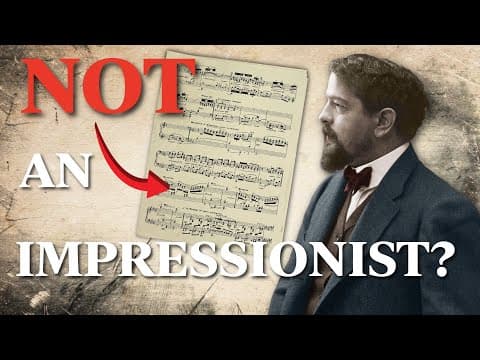
[0:00]Impressionism is a term used by imbeciles to describe music with the utmost inaccuracy. These were the words of Claude Debussy in 1908. Despite the fact that he never called himself an impressionist, most people do so anyway. Find out just what Debussy does to get these strange new sounds of impressionism. A dreamy impression, misty impressionistic chord, delicious little impression often a hazy distance. You hear that? That's an impressionistic chord. It's been that way since at least 1887, when Debussy sent the score of his new orchestral work, Printemps, to the French Academy of Fine Arts, the prestigious institution that had just awarded him the coveted Prix de Rome scholarship three years earlier. But rather than seeing promising development from the composer as they had hoped, the Academy members were shocked by Debussy's abandonment of classic techniques. This was no traditional three or four part symphony, but a free form, two movement suite depicting the symbolic rebirth of spring. Much of it was written in the frowned upon key of F sharp major, which is easy enough to play on a keyboard, but creates unnecessary challenges and awkward fingerings for the orchestra. Debussy even treated the human voice like some kind of instrument, singing wordless tones in complex rhythms.
[1:55]Beyond this, there were many passages that blurred the line between major and minor tonalities, with ambiguous whole tone scales and ninths. The committee's response was clear. His feeling for musical color is so strong that he is apt to forget the importance of accurate design and form. He should beware this vague impressionism, which is one of the most dangerous enemies of artistic truth. This is the first known mention of impressionism in connection with Debussy's music. Most people today don't think of this word as an insult, but in Debussy's time, it very often was. To understand what the committee was so upset about, we have to go back to the origins of impressionism in art. The word first came into popular use after a group of French artists organized an 1874 exhibition in Paris. Among the many works on display was Claude Monet's, Impression, Sunrise, whose title was quickly applied more generally to the group. By capturing the essence of everyday subjects through broad, spontaneous brushstrokes, the so-called Impressionists rebelled against the academic style of painting, which favored more realistic figures in historical settings. But impressionism was more than just a new way to paint. It fundamentally shifted artistic priority from the organizing logic of the mind to the immediate perception of the eye, resulting in that characteristically unfinished appearance. Returning to the committee, they saw Debussy as doing essentially the same thing in music as the impressionist did in painting. They heard in this vague music the counterpart to an artistic movement that obscured their idea of reality and therefore truth itself. But Debussy, of course, saw it the other way around. True art couldn't be found by relying on dusty old academic forms, but by exploring the freedom of purely musical expression. I feel more and more that music, by its very essence, is not something that can flow inside a rigorous, traditional form. It consists of colors and of rhythm... The rest of it is just nonsense invented by unfeeling imbeciles on the backs of the Masters. Those unfeeling imbeciles lacked the vocabulary to describe Debussy's increasingly original works of the 1890s. Many other labels were put forth including paganist, primitive, pseudo-Oriental, but these never caught on. Impressionism, though, was already a buzzword in painting and like Debussy's music, it was associated with the blurring of conventional details. So, the hazy features of impressionist painting became a loose but convenient analogy for Debussy's breakthrough style of composition.
[4:45]In reviews of Debussy's String Quartet of 1893, we find references to both pointillism and impressionism as explanations of Debussy's fragmented use of themes.
[5:03]The next year, a critic described the Prelude to the Afternoon of a Faun as a subtly impressionist symphony, consisting entirely of sound-spots, that aren't organized by a pattern but by different blended textures.
[5:23]Most divisive of all for its first critics was Debussy's 1902 opera Pelléas et Mélisande. With its unbroken musical backdrop and speech-like singing, it had no traditional set piece arias or take home melodies. Often scenes would end unresolved and in abrupt confusion. Venez avec moi. -Où allez-vous? Je ne sais pas. Je suis perdu aussi. *mysterious music* One critic described the opera as impressionistic mood painting which cannot be listened to for long without an incurable shattering of the nerves. Another reviewer thought this musical impressionism could be charming for smaller pieces, but dangerous in larger ones, which require a solid architecture. It's difficult to go farther in this vagueness he wrote, without falling into incoherence. In other words, Debussy's first audiences felt lost in his music, which sounded to them like nothing else. Impressionism was never Debussy's term, but rather it was one offered up by and reinforced through his most vocal critics. No wonder he despised it.
[6:53]An acquaintance recalled that whenever the term was mentioned in Debussy's presence, he became irritated and would have nothing of it, claiming that on the contrary, he descended from the French 18th century harpsichordists.
[7:10]The fact that impressionism originated in criticism of Debussy's music without the composer's consent is just one of the many problems with this label. Impressionism has never had a stable meaning in music, an issue that was already acknowledged in this 1924 dictionary definition, which described it as a not very clearly defined musical term. The old idea of impressionism as color over form was still present in this definition, but it appeared alongside two intriguing additions. Impressionism was by this time seen as a broader movement whose chief modern exponent was Debussy, and it was generally applied to music intended to convey some suggestion of landscape or a picture in which color is more important than outline. The idea that impressionism was a musical school with Debussy at its head was shot down by the other most commonly labeled impressionist composer, Maurice Ravel. who said in a 1928 interview, if you ask me if the French have an impressionist school of music, I must admit that I never associated the term with music. Monet and his school were impressionists, but in the kindred art there is no counterpart of this. The other definition of impressionism as essentially pictorial music, something that describes an image, has created even more confusion over the last century. In many ways, this idea that impressionistic music paints a vivid picture of something has become its default meaning. The danger of this interpretation, though, according to scholar Ronald Burnside, is that it creates a frame of reference around painting instead of music, giving rise to the practice of reading things into Debussy's music, which may not be there at all, and of obscuring things which are. For instance, the scholar Stefan Jarociński urged listeners of Debussy's music not to be misled by his poetic titles, such as those of the piano preludes, which the composer suggested only after writing the music. He famously tucked these inscriptions away at the end of each prelude as if they were mere afterthoughts. Jarociński doubted the ability of several of these titles to conjure literal images of any kind. They aren't solely related to imagery, but rather have various connections to poetry, myths, natural phenomena, objects, and places. To reduce Footsteps in the Snow, for instance, to a depiction of a wintery landscape, was anathema to Jarociński, who rather intuited themes of personal loss and solitude that went beyond the implied image.
[10:10]Many scholars have argued that Debussy's music is better aligned not with the impressionist painters, but with the symbolist poets, who used highly musical language to suggest moods, states of mind, and hidden realities. One commentator put Debussy's apparent symbolist style in this way. Debussy uses chords like the symbolist poet Mallarmé uses words as mirrors, which concentrate the light from a hundred different angles upon the exact meaning, while remaining symbols of that meaning and not the meaning itself. To illustrate how this differs from the impressionist view, let's take a look at one of Debussy's piano preludes, which at the end of the score is linked with the idea of dead leaves. An impressionist interpretation would maintain that this piece is descriptive of the leaves themselves.
[11:11]On the other hand, a symbolist analysis might suggest dead leaves as a metaphor or symbol for melancholy, which is the expression marking at the top of the score.
[11:50]To be fair, symbolists' literary aesthetics can be less intuitive than impressionist's paintings. It's easier for most people to see a Monet and think, yeah, that kind of looks like how Debussy's reflections in the water sounds. It's not that there are no comparisons to be made between music and impressionist art. Even Ravel, who distanced himself from the label, once allowed for its use as a passing analogy to painting in his piano suite Miroirs. Likewise, we can hear how certain themes in Debussy's Images for Piano have affinities to the motions of rippling water and fluttering fish. But to say that the entire goal of these pieces is the suggestion of imagery, would probably be simplistic, even with their sometimes visually evocative titles. After all, it was about the Images for Orchestra that Debussy said he was trying to write something else - realities, in a manner of speaking - what imbeciles call 'impressionism'. Ultimately, Jarociński spent 150 pages of his book arguing for symbolism over impressionism, only to reject both as general labels for Debussy's music. He concluded that neither can help us escape from the labyrinth of erroneous generalizations. So what happens if we interpret Debussy's music without resorting to either of these terms? In the composer's own words, his approach to composition was not a direct imitation, but a sentimental transformation of what is invisible in nature. Can one convey the mystery of a forest by measuring the height of the trees? Is it not rather its unplumbable depth which stirs the imagination? For Debussy, music had the abstract power to suggest these hidden phenomena, whose expression went beyond the mere description of images. Pierre Boulez avoided the term impressionism when describing the sense of hidden, amorphous forms within Debussy's works. One finds a succession of events whose logic is extremely convincing but profoundly inexplicable. His ideal goal was to preserve the illusion, so that the listener did not know how it was made, so that everything seemed to be organized according to permanently secret laws. Music theorist Rudolph Reti seemed to point out one of these secret laws in how Debussy moved from one key area to another. Instead of a conventional linking chord or phrase, he sometimes just dwelled on a certain note and increased its accent, an almost passive gesture.
[14:40]And rather than being preoccupied with imagery in his piano études, Debussy seemed more interested in abstract musical elements, with each study based on a different interval or technique. There are thematic figures in the familiar sense of the term, noted Boulez, but the underlying theme is the chosen interval. The pictorial impressionism analogy just isn't very useful here. There are no concrete suggestions of images. Each piece revolves around its particular material and develops on its own terms.
[15:43]To recap at this point, we know the label impressionism wasn't approved by Debussy himself. It was recycled from painting and applied to music via his critics. Additionally, scholars have argued that the over-reliance on pictorial impressionism, the idea that this music is descriptive of imagery, has often misled listeners to look for visual meanings that aren't always there. This brings us to our final problem with the term impressionism. Why do we continue to use this label at all? Its use is now more common than ever, and not just in Debussy's music. For the last hundred plus years, the word has been applied to a still growing list of composers from around the world. Griffes in America, Albéniz in Spain, Szymanowski in Poland, Respighi in Italy, Sibelius in Finland, and many more, not to mention most turn of the century French composers. Some of these occasionally use the word impression in work title or two, but the pool of so-called impressionists has grown so wide that we should be skeptical of the label's general usefulness. Were all of these composers inspired by late 19th century painting philosophy, or has impressionism just evolved to mean vaguely atmospheric 20th century music? Debussy expert David Code agreed with the latter in his 2010 biography of the composer, writing that these days to compose in an impressionist manner means simply to compose somewhat like Debussy. So maybe we should just not call these composers anything at all. That was the exasperated response of Charles Koechlin, who, like his colleagues, Debussy and Ravel, was accused of being dangerously infected by impressionism. He refuted this label on the grounds that his music was not vague or incoherent, but based on unique forms that suited each piece, a sentiment that Debussy likely would have agreed with. People often asked Koechlin, which school he belonged to? Irritated, he would reply, none. Ah, I see, they would say, you are an eclectic. This wretched word infuriated Koechlin even more. Cannot the works be taken for what they are, he pleaded, without being filed into specific boxes? Koechlin's question is still relevant today, though impressionism has taken on a broader and more positive meaning since the early 20th century. Nobody means it as an insult anymore, but at the same time, people are still negotiating with this term, even while it's widely understood as linked to Debussy's music. Ultimately, it is useful and even crucial to know that Debussy and many of his colleagues were not self-styled musical impressionists. We should be able to meaningfully comment on their music without needing to invoke impressionism in every case. When abused, the term can become a reductive, inaccurate, and overemphasized buzzword. At the same time, it's probably not necessary to correct everyone who cites impressionism over whatever one's favorite ism happens to be. Given that all such isms tend to obscure at least as much as they illuminate, it is useless to argue in general terms for the validity of any one over any other. Still, he added that it seems unlikely that impressionism can ever be dislodged from the broader cultural imagination. In a 2018 video, pianist Daniel Barenboim seemed to allow the term while qualifying its meaning. Debussy is considered in many ways the father of French musical impressionism, which is true, but it mustn't be confused with impressionism in painting. Debussy was much more influenced by literature, Mallarmé and Baudelaire than by painting. His sources of inspiration were literature and nature. As with many historical and stylistic labels, impressionism is imperfect, as coarse and hazy as the paintings that inspired it. So, it's probably best to take Debussy, Ravel, and Koechlin seriously by not abusing it, acknowledging that impressionism is our term for their music, not theirs.