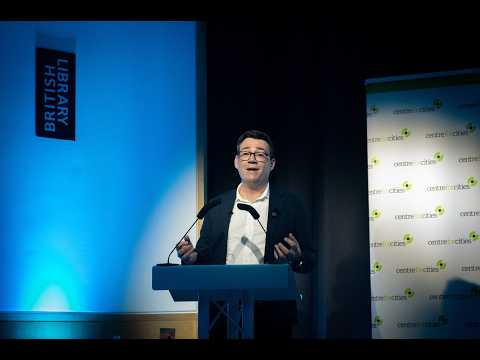
[0:03]Thank you, Andrew. That was an extraordinarily helpful introduction, actually, from, uh, from my point of view. I'm definitely not here to talk about my, uh, my career plans. Other than to say, I wrote a book, as you might know, with the Mayor of the Liverpool City Region, Steve Rotheram, about leaving Westminster and establishing devolution across England. It's called Head North. So, all I can say today is that the sequel Head South is currently on hold. I'll update you at some point. Um, what I want to say today is that the time has most definitely come for a serious conversation about our political system and its pervading culture, particularly so in the aftermath of the Gorton and Denton by-election. It revealed the full depth of the chasm between people and Westminster politics. I don't think anybody can seriously dispute that statement. Certainly, if anybody was there, you will know the truth of what I'm saying. It hasn't been connecting for some time, a long time. But actually, I think something worse is starting to come through, and it's revealed, actually, in a poll by More in Common today about the cost of living crisis. The worst thing is that people are actually giving up on it. They are concluding that it won't solve their problems. In the past, you know, there would always be a sense that, oh, the next big change in politics will bring a refresh and a solution. This poll today by More in Common says 59% of people across Britain expect that the cost of living crisis will never end. 59%. I would say that is code red for Westminster politics. This is getting extremely dangerous. And change in our political system and culture is desperately needed. So, where to look for the solution? The good thing from our point of view in Greater Manchester, obviously, it's a Greater Manchester constituency, the good thing is people do differentiate what's happening at the devolved Greater Manchester level from what happens at the national level.
[2:41]And some of the changes that we have brought through because of the policy levers we have are seen in a different way. The most obvious example being the decision to put our buses back under public control after four decades of deregulation. And the changes then we are making with that public control, two-pound fares still in place this week, removing the 9:30 restriction on older and disabled people's bus passes. You know, in Westminster that would be seen as a sort of a small thing, but you know what, it isn't actually. That has liberated a lot of older and disabled people in Greater Manchester this week to be able to travel whenever they want and go care for the grandkids if they need to early in the morning, or get to a hospital appointment, or go to work, because I disabled person. Whatever, you know, these things matter, and we are making those changes, and I think people increasingly can see the difference between what we're doing and some of the things that I there's no reflection on on any particular government just in recent times, I think, I would say, pretty much since the since the since the early 2010s.
[3:50]And actually, they can see the skyline of Manchester changing and the economy beginning to change in a fundamental way. We are proud of the fact that there is increasing national attention on our growth rate over the last decade. 3.1% average annual growth. That has built now a 100 billion pound economy in Greater Manchester. The growth rate doubled the UK average over the decade. Something significant is happening. And our population has now gone over three million. So, second city, Birmingham, we'll all get I don't know what the center of the city's view is on that particular that's question, but we know we possibly say, we know ours and it's just wonderful to be in the second city today to deliver this, uh, this speech, uh, to to you all. Um, so, if if even if people don't live in Greater Manchester, I think they can see something here and actually, I'm pointing to what's gone on in the Liverpool City Region, the West Midlands, under Andy Street and now Richard Parker as mayors. You know, there is change. The regions are kind of making themselves known and and felt in a way that they've not done for a long time. But in our case, I think it's quite clear that over the last decade, Greater Manchester has become more functional in a period when the country has become more dysfunctional. Again, I don't think that is a contentious statement. I think it is just simply true. So, that brings us to today. And the interest in Manchesterism. Today, I want to define it. Manchesterism is the polar opposite of Westminsterism. And it's not a new thing. I mean, this is the important point to get over. It has a a real long tradition that I'm just going to talk about in a moment. What is happening now is that it's having a rebirth through devolution and a renaissance of Manchesterism. It actually dates back 200 years. In 1826, the great city I lead was in the middle of building the first commuter rail line in the world with our neighbors, Liverpool. Innovating, doing things for itself and driving social progress with the proceeds of growth. That is what Manchester was doing back then. It was establishing Manchesterism. And the interesting thing about it is Manchesterism was actually a pluralistic political, uh, theme that, uh, for certain shaped modern liberalism, Toryism, and indeed, obviously, laborism. If you look back, um, to the 1800s, a social pioneer, Richard Cobden, very much led what was called Manchester liberalism or the Manchester school. Even it was called Manchesterism back then. And his thesis was that free trade, and you might know many of you who know our city we have had a free trade hall in the city, free trade will build a fairer society if it's truly, uh, free. And that's best symbolized by Cobden's work to repeal the Corn Laws that kept people's food prices high and inflated. And in many ways, in that period, I would argue, he established the cornerstone of Manchesterism. Basically, it's this. That economic progress must always go hand in hand with social progress. You should not have one without the other. It's always got to be both of them at the same time.
[8:04]And I would say that the city has been true to that ever ever since. It's how it is today. People, um, celebrate the entrepreneurial culture in Greater Manchester. You know, it's symbolized by Gary Neville, people like like that, you know, really, you know, ambitious people who who drive things hard. But the other side of it is that entrepreneurial, yes, but never walking on by on the other side, never. And that's never been the Manchester way and never would be and always collaborative more than competitive. Uh, and that, as I say, is true today as it was in Cobden's time. When it comes to Toryism, Disraeli made a speech in Manchester in 1872. And it is famously known as the speech that tried to establish one nation Toryism. The idea that again, you know, you pro, uh, business markets, but you have a regard for for everybody in society. And he coined that phrase, what Manchester does today, the world does tomorrow. That was his view of Manchesterism and what he drew he drew from it, pointing to the industrial innovation and the social innovation. And of course, um, you've got then laborism. uh, with all of its roots that the modern Labour Party took over, if you like, in the early 20th century and drew from all of that and created the modern labour tradition, very, very much rooted from great what had happened in Greater Manchester. Obviously, the suffragettes, um, but, uh, before that, the cotton workers who refused to handle slave picked cotton and helped bring an end to the American Civil War. It's why we have a statue of Abraham Lincoln in the city to this very to this very day. You know, all of that was taken to build modern, uh, laborism. However, I'm going to give you another quote from one of our most famous modern sons, uh, and certainly an idol, an idol of mine, Tony Wilson. He, I would say, was probably more than anybody, I am by praise to Howard Bernstein to Richard Leese, but Tony in my view started the turnaround of Modern Manchester. You know, we've just come back from a a Brit's weekend, which was, which, for those who saw me, you could see I was probably enjoying myself along the the mercy of Jack Whitehall on on Saturday night, but I, it was a great moment for for our city, first time out of London. Um, a brilliant thing and actually, it's helped us regain our reputation as party central in the UK, after, you know, it was six years ago, wasn't it, that that Boris Johnson's Ten Downing Street took that cry of us, but we've well and truly got it back.
[11:05]It it was brilliant and the thing that made it brilliant was because music began the turnaround of Modern Manchester. In my teenage years, I would go into the city, uh, and it was bleak, let's be honest. Uh, things were closing, it was empty, but the music went in to the empty warehouses and factories and created a kind of sense in the city that things were possible again. I went to university from Greater Manchester in the late 1980s, and I saw all of these young people from other, let's say, maybe more affluent parts of the country with pictures of Salford Lads Club on their wall. And I was like, whoa, you know, okay. I know, yeah, well, I've been there. I know there, and, uh, yeah, I saw the Smiths at Salford University. Maybe like, did you? Really? And it was interesting because it kind of made us feel we had something that other people wanted. For most of the '80s, it didn't feel like that. There was a great line in the Smith's song, I think it's Hand in Glove, where it says, we may be hidden by rags, but we'll have something, we have something they'll never have. And that was kind of what the music did at that time. It put a bit of belief back when it had gone really, and it made people feel that we could I don't know, aspire to something again. And certainly my generation of people growing up in the Northwest, absolutely felt that. And the music did start the turnaround. But, you know, my God, um, it it needed it needed something. Because actually the 20th century was really unkind to the Northwest of England and certainly to Manchester with the devastating effects of deindustrialization. So, here's the quote from Tony Wilson. He said this, not long before he died suddenly, but he said this in 2007, in the Northwest, it rains and rains. And yet, we managed to produce the best music, the industrial revolution, the trade union movement, the Communist Manifesto, and even the Goddamn computer. Down south, where the sun never sets, you took all of our money and what did you produce? Chaz and Effing Dave. True. The anger in that quote, I think, is expressing a feeling about the country having departed from Manchesterism. Because in my view, that's what happened in the second half of the 20th century. That tradition that I said everyone had had drawn from economic and social progress. I I would point to three things that happened that changed changed all of it. And what Tony, perhaps, was was was talking about. Firstly, all of a sudden, it became acceptable for economic progress to be saw alongside social harm. The progress actually creates the social harm because of deregulation, privatization. So, the essentials, all of a sudden, people are paying more for them. Can't afford them, housing, energy, water. But that was deemed okay because other people were making money. So, it wasn't economic progress and social progress anymore. It was progress for some but hardship for others. And then you think about the low-wage insecure labor market that took hold as well in the latter part of the last century and into into this one. Secondly, you could point to the fact that under all political parties, there was a loss of local accountability and local control in public services. Things were sentenced to arms-length organizations, but not under the democratic control of places in the NHS, in education across, in fact, the whole the whole waterfront. So, places lost their ability to shape what they were about because the control wasn't there in housing particularly. You know, as council stock, housing stock was transferred out. You know, then that that is a massive thing that means your your your ability, your agency at a local level severely weakened. And then there was thirdly the drive for more political centralization that we saw in the latter half of the last century. In the 80s, the abolition of regional bodies, the Greater Manchester Council back then and the Greater London Council. More recently, and I would say shamefully, we've seen the emasculation of local government in terms of its ability to function. And today, many councils across England find themselves on the brink of viability. That is a a complete rejection, if you like, of Manchesterism. Manchesterism is by definition, bottom up. Places doing more for themselves, setting their own ambitions. In an era where people walk out of their front door and see potholes and overgrown parks and ask, you know, why they can't be fixed and then told there's no money. Can you think of anything else that damages trust in politics than that? Is there anything that more explains the levels of alienation people feel if politics can't fix a pothole? Explains a lot, doesn't it? The collapse of local government and the failure of Westminster to fix the financing of local government. To me, that is a really big thing that underlies the the alienated political climate that we that we experienced today. People just don't see politics as able to fix the basics. They can't see solutions from it, and hence that worrying statistic I gave you from the More in Common, uh, poll. And it plays to what I've seen in my political journey and my 16 years in Westminster. I just saw the political, if you like, culture just becoming more and more shallow. Um, it it simply doesn't try to fix the big problems. It the aim is to to score points across the house, isn't it? You know, it's not not there to fix things. It's just there to get try and persuade enough people that like us, not them. It's but that's not that's not what politics was in this country, certainly not in the 19th, early 20th century. It was something fundamentally different, and people are now thinking, well, where where's that gone? Where have the big political figures gone? Uh, why aren't people working to fix things anymore? I I would say, you know, exhibit A is social care. Linked to local government financing. I mean, it's unbelievable, is it not? That how many years now, almost 40 years, I think, isn't it? After the, um, uh, or third certainly over 30 after the Royal Commission. No, 30 years, isn't it? The Royal Commission on social care. And it's 15 years now since I put forward the idea of a national care service as health secretary. How can it still not be fixed? My dad is in the care system and I see it now. It's unbelievable how people on the front line of social care do not get a basic enough salary to support themselves, even though they are doing incredible things to look after people. I mean, how how how does Westminster just turn away from that and not seem to bother, that it just leaves that in that in that situation? And what I've seen is, you know, so often now, the care system just has to ring 999. And if there's a minor problem, 999 into hospital. So, no wonder, is it, that the NHS is in permanent perma-crisis, winter crisis, because it it the preventive end just cannot cope basically. But why is Westminster just just almost like I said, well, well, we'll just leave that. It's just an incredible state of affairs, uh, to be honest. So, if politics is once again to regain people's trust and be about a long-term problem solving, I think we have to build a new political culture entirely. And what we have done in Greater Manchester through devolution is go back to the roots of Manchesterism, stay true to them, and use devolution to apply its principles and characteristics afresh in modern times. And what are those characteristics? Future-facing, long-term, bottom-up, collaborative, innovative, redistributive, not extractive, and above all, ambitious. That last point is crucial. Before devolution, the United Kingdom had no ambition for Greater Manchester, as I said before. The government of this country did not have a kind of stated aim about what it could be. And that would be true of West Yorkshire, West Midlands, you name it, all over. And it's only devolution that's allowed us to to come in and set an ambition for it. Which is a an indictment, to be honest, is it not of of the national political system? In my time, it only ever really spoke about London and the Southeast. And that's part of the reason why in the end, I left Westminster. I couldn't see how the system was ever going to help the North of England in the way that I wanted to see it being supported. Just wasn't going to happen. And hence, Head North, the book, Steve and I trying to establish devolution on the back of our experience in Westminster. We we had to fight for the right to set an ambition for our area. We had we had to prise powers out of Westminster. They're not really been given willingly. To be fair, George Osborne played a big a big role, and I I always recognize that. And this actually, if you go back to Manchesterism, devolution in England is one of the very few things, I think, in politics right now that has real consensus across the main political parties. There's not much else. And therefore it's something of a life raft, I think, in these in these times in which we in which we live. But having set an ambition, we've used the powers we have to build an entirely different political culture to the one you find in Westminster. It's about problem-solving, not point-scoring. It's place-first, not party-first. But the thing is, if you operate on a place-first principle all the time, as I tried to do as mayor of Greater Manchester, and Steve tries to do, and Tracy, and, um, all the other all the other mayors, if you do that, you actually gain more respect for your party. And that's the thing that Westminster just does not understand. And just go straight to criticizing the other parties. You know, that isn't the way in my view, you'd get politics back up in people's esteem. You say what you're going to do and what you're going to do to fix the place. And by doing that, you win support because of the strength of your ideas and what and what you want to do. So, this is where we kind of come to, really. And my worry right now is that the alienation created by Westminster politics could actually sink the life raft of devolution because it's based on councils. And as I said before, they are in a parlous state. And if the frustration about not fixing a pothole kind of comes out of the polls in big swings against count people trying to run councils, in the end, we will lose what's being built here because the politics will change and we won't have enough parties that will sign up to a place-first approach together as we've done with the Lib Dems in Stockport and the Tories in Bolton when they were when they were in power. All of a sudden, the alienated politics that we see at national level will sweep in to the emerging devolved structures and where will we be as a country then if that happens. But there is a more positive view, which I hold still. The strength of what we're doing in Greater Manchester is getting over to people and the next decade ahead of us is enormously exciting. We're calling it a decade of good growth. We've created a good growth fund. We've set out a plan, which I did at the Institute for Fiscal Studies, uh, in January for five global industrial clusters. Creative Media, we've already got that one at Media City. Digital and Tech, AI, and Cyber in our city centers. That's the second one. Life Sciences on the Oxford Road Corridor, again. We're about to, well, come the UK Biobank to Manchester Science Park. The Life Sciences cluster in Greater Manchester is really the most vibrant possibly at the moment at the moment. And then we've got two more that are now being built. Advanced Manufacturing and Materials at Atom Valley in the Northeast, near Rochdale, Bury, and Oldum. Uh, where we're building a center now with the University of Manchester's help, and that's why we're so grateful that they're supporting this event today. They have been huge partners of ours. All of our universities, actually, the University of Manchester particularly, absolutely bedded in with us in building a research-driven, innovation-led economy. And that's what we've intentionally done, uh, since the deindustrialization, as I say, in the second half of the last century. And then the fifth cluster is a clean energy cluster in the Southwest at Carrington. And these will develop over the next decade. And think about this, how exciting is it to see the re-industrialization of the birthplace of the industrial revolution. Incredible, isn't it? And maybe we'll get a train line as well 200 years after we built the first one. But I'm not holding my breath about that one, Andrew. Um, so, all of it is hopeful, isn't it? Isn't it? I hope it is. I I feel hopeful in the job that I'm doing and go feel back where I started. It was always an absolutely split decision to sort of think about going back to Westminster. I'm so invested in what we're doing. But I also see how we can't go much further unless we also, uh, you know, change the the Westminster political culture, and it's the two are sort of bound up bound up together. Uh, this is the moment, I think, to to really, you know, call for that significant change in the political system and in our political culture. We are we have a plan alongside the decade of good growth for people in Greater Manchester. And it's based now on a hugely innovative reform of public services, in effect, building one one system in Greater Manchester. Highly integrating a lot of it, networking it all to support the resident or the citizen of Greater Manchester in a whole person way. Again, the top-down silos of Whitehall cannot fix things in people's lives. Because they deal with a little bit of what's going on in their life, but they neglect everything else. So, how can that fix? How can the DWP get back people back to work, if it's not paying any attention to the trauma, the housing, the debt, you name it? It's just not going to happen, isn't it? That just does not work. So, we're going to try and build the opposite, a highly integrated system and a live well model so that people in Greater Manchester can access the growing Greater Manchester economy. We're creating a technical education system, an equal alternative to the university route through T levels or the new V levels, going into sort of apprenticeships, degree apprenticeships. So, that those five clusters I mentioned, young people can see a future for themselves there and plot it from school through college into those really high quality jobs. This is what what we're trying to do. And again, it's a reversal of the Westminster model. Westminster is about numbers, not names. Westminsterism, I should say, is about numbers, uh, numbers not names. Manchesterism is about names, not numbers. And if you start there, it's a whole world of difference that you can do if that's the way you're where you're thinking and you're trying to support people. So, come to the come to the end of what I wanted to say, Andrew. I I think if we carry on at this, I I do think we can make things more functional again, but it is asking the British state to remodel itself, to support Manchesterism everywhere. That is what we need. And currently, we find ourselves in two worlds, if I'm honest with you. There's so many good things going on. But with help from friends like Andrew in the center of cities, we are also always arguing about the resistance of the system to to free us up more. It's a bit ridiculous, isn't it? After 10 years of devolution. They are still pushing us away and as though they know all the answers about everything in Greater Manchester, but they don't. But still, they hold on and refuse to to devolve. And I I personally cannot see the justification for it. You go with this completely because it is working and it's something the country should should have everywhere. And and actually, we need to in some ways, go away from the silos of Whitehall to a a system that's about those people working in the combined authorities at the front line with us. And sitting around the same table, education, work and pensions, health, and all of them then working in the same networked way, rather than fighting each other from their feuds in Whitehall, which is what I remember them doing when I was a when I was a minister. Get fully with this model, say, Con a lot of people out into the combined authorities. They say often to us, oh, the capability isn't there to have this devolved or that. Well, give us the capability, you know, build the model with us. And then get fully behind it. It's so frustrating at times. Post 16 skills, employment support, all of these things should be devolved. They are intrinsically linked to local labor markets. What is the the rationale for Westminster hanging on to all of the power over those things when clearly they can't do it from where they are? I I honestly, you know, I'm getting to the point where I just refuse to spend any more of my working week making the case for Whitehall for more developed powers, because I've spent way too much of my time doing that. Why aren't they just looking at the evidence, getting behind us, and getting on with it? It just makes you think they don't actually want growth everywhere. That's that's they they actually care more about holding on to something down here in their silo than actually getting the whole of the country growing. So, we need Whitehall reform most definitely, but we also need Westminster reform if we are to bring Manchesterism to life everywhere. And I'm talking about electoral reform, reform of the whip system, and replacing the Lords with a Senate of the nations and regions, and then beyond that, that much more maximum devolved model that I've been talking about before. Because if you reform Westminster along the principles that I said, more collaborative as a kind of starting point. I think it would create a new political culture at the national level based on the principles of Manchesterism. And you would get, I think, a different way of being able to make long-term change. Too many places feel lost and neglected because politicians don't control the things that shape them. So, we have to regain the control of those things. And it's a different way of doing that that is needed. More long-term, more collaborative, uh, between, uh, different different politicians. If you go at things in that way and you have a public investment strategy based on that, based on stability, long-term and collaboration, you will remove the volatility, which leaves us in hot to the bond markets, to use that phrase again. Politicians and politics has left us there because it gave away control of the essentials. It left us all paying too much for the everyday things that we that we need. The country doesn't control its costs anymore because of that. If you're chasing rents in the private rented segment through the benefit system, you don't control your costs. So, actually, rebuilding public provision is not the alternative to fiscal prudence. It is fiscal prudence. And that's a quote from Matt Lawrence, who's published a pamphlet on Manchesterism today. The privatization premium and the case for public provision. And I would recommend it to you all. It's it's the opposite of what what people who oppose what I'm saying try and make this sound sort of a blissful thinking, fanciful. Actually, you regain control of places, of the economy, if you have the ability to make sure the essentials are there for people at a price they can they can afford. And it gets the country back to work and functioning again, and actually to make Britain a more investable proposition once again. Thank you very much for listening, everyone.