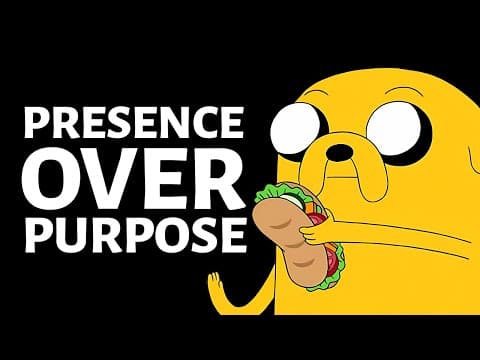
[0:00]While everyone else in Oo rushes around trying to prove their worth, Jake figured out something different. Maybe life isn't about being the strongest, the smartest, or even the most heroic. Maybe the point is just being present, finding joy in what's right in front of you, and loving the people around you exactly as they are. It's this philosophy that made Jake the beloved hero we all know, and by understanding his five core pillars of philosophy, not that he really thinks it through, we can even become like him. But to do that, we must first understand Jake's past, as he actually starts the series with a secret. He wasn't always the laid-back mentor brother we know and love. In one last job, we learn that Jake had spent years as a successful criminal, not just petty theft, organized crime. He was good at it, too. Really good. You are the only master thief with the skills to swipe it. But somewhere along the way, Jake made a choice. He walked away from that life and never looked back. That decision shapes everything about his current philosophy, because Jake knows what it's like to scheme, to plan, and to hustle for power. He also knows what it feels like to realize that none of that really makes you happy. So, when we meet him in Season 1, Jake has already learned the first lesson of wisdom. Can you guess what it is? We'll give you a hint. He starts off as Finn's easygoing sidekick, content to watch the clouds or play a song while everyone else rushes around trying to prove themselves. From that moment on, everything about Jake seems simple. The way he talks, the way he solves problems, even the way he handles danger. While others build plans and strategies, Jake trusts his gut. He uses his stretchy powers to do what he thinks is best and moves on. If it works, great. If it doesn't, he tries something else. He doesn't overthink what it means to be good or brave or worthy. He just keeps things clear and simple and direct. Help your friends, be honest, enjoy what's in front of you. At a time when everyone else is complicating every feeling and every mistake, Jake shows a different path. When Jake loses his stretchy powers in the Witch's garden, watch what he doesn't do. Adventuring is too much hard work for a bro without his powers. From now on, I'm just your regular old dog. He doesn't rage against the unfairness or demand immediate solutions. He just treats losing his defining ability like the weather. Something that happened, something you just adapt to. But here's what makes this profound rather than passive. Jake isn't giving up. He's choosing to focus his energy on what he can actually control. And that all leads back to the first pillar of his philosophy, simplicity. It comes back everywhere. Take Finn. He's mostly busy trying to prove himself. To him, Jake acts as a gentle guidance, dropping occasional wisdom gold. Dude, sucking at something is the first step towards being sort of good at something. Showing that your worth doesn't disappear just because you can't do everything yet. It's okay to be bad at something. You can't expect yourself to be a master in something you haven't done before. And even so, it's not directly tied to your worth. But it's exactly that realization and humility that allows for growth, even if it may trigger some insecurity or avoidance at first. There's three more great examples that highlight this simple way of thinking. I used to hang out there back when I used to snatch old ladies purses. Don't worry, I stopped doing that a long time ago. I didn't know it was wrong. Just a clear, honest acceptance that he made mistakes, that he learned and moved on. He never pretends to be perfect, and he never needs to be. Or take Puhoi. When Finn gets anxious about parallel universes and alternate selves, Jake picks up his favorite cup and throws it out the window. Huh. Now it's gone forever, so it's not real and I don't care about it anymore. Some direct teaching from stoic philosophy. The idea that you suffer when you get attached to things outside your control. Now, he's just passing it on. But the clearest example comes in Jake the Dog. When Jake encounters Prismo's wish-granting power, think about what most people would do with unlimited cosmic power. Fix the world's problems, become immortal, gain ultimate knowledge. Jake wishes for a sandwich. I wish for a sandwich. Prismo, the Grant Wisher, is totally confused here, but Jake is completely content just to munch away on a sandwich. He doesn't really need anything more. Happiness doesn't scale with power. Wanting simple immediate pleasures is actually sometimes more satisfying than wanting abstract greatness that can trap you in this loop. When you can have anything, choosing a sandwich is the choice of someone who already knows what makes him happy. That's the first pillar of Jake's philosophy. Don't make life more complicated than it needs to be. Keep it simple. Focus on what's real. Your friends, your immediate needs, the moment you're actually living in. Everything else is just noise. If simplicity is where Jake's wisdom begins, the second pillar is where it comes alive. Even in the most mundane moments. No, scrap that, especially in the most mundane moments. But what is this pillar exactly? Well, take a look at Time Sandwich, where we can see Jake at his most philosophical while making lunch. I am ready to receive instruction from the realm of creation above me, for the sandwich I am about to conceive. I am open. Use me. He takes an everyday act and treats it with the same reverence other people reserve for special occasions. That's what his second pillar, Joy, actually looks like. No toxic positivity or forcing yourself to enjoy stuff. Just treating ordinary moments with genuine appreciation and attention. And Jake steps that up a notch. Take Jake the Brick, which might be the most important episode for actually understanding Jake's worldview. Jake decides to spend a few days doing absolutely nothing except being a brick in a wall, so that he can experience what it feels like when a brick wall falls down. Most people would call this a waste of time. Jake calls it fulfilling a childhood dream. Ever since I was little, I wanted to see what it's like to be a brick in a brick shack, when the brick shack falls down. As he narrates the forest life around him, Jake transforms simple observation of daily life into spiritual poetry. A bunny building its home becomes a meditation on purpose and impermanence. The falling shack becomes a lesson about letting go of permanence. This bunny has the right attitude. Who cares about being a brick in a wall or a falling down shack? There's something bigger than that, and the bunny has answers. But the best part of Jake's joy is how naturally it spreads to everyone around him. Take the beginning of Dad's Dungeon, where Jake entertains himself and Finn by shapeshifting into increasingly ridiculous forms. Alright, I'll try to turn into a cheetah farting.
[6:29]Finn can't help but laugh and play along. Jake's natural exuberance becomes contagious without him even trying. He just spreads positivity around him. Or there's even those better moments when Jake starts singing. Bacon pancakes, makin' bacon pancakes. Take some bacon and I'll put it in a pancake. Just Jake narrating what he's doing in a silly improvised tune. Don't act like we didn't all enjoy that. It's one of the most famous clips. Bacon pancakes, makin' bacon pancakes. Take some bacon and I'll put it in a pancake. Those two pillars are only a start though. His philosophy goes deeper than just personal peace and joy and simplicity. He has this ability to understand pain in others that most characters in Adventure Time never develop, which leads me to the third surprising pillar. Princess Cookie might be one of the most overlooked episodes for understanding this pillar. For context, during this episode, a cookie named Baby Snacks takes hostages because he's angry at PB for dismissing him when he said he wanted to be a princess. Except Jake, who immediately gets it. While everyone else sees a criminal who needs to be stopped, Jake sees someone whose dreams got crushed by an institution that didn't take him seriously. So, Jake does something that changes everything. Instead of completing the mission and capturing Baby Snaps, he helps him escape, choosing the individual over the institution. This moment reveals something crucial about Jake's third philosophical pillar, empathy. His empathy extends towards people that society has written off. And when those people are suffering, Jake's loyalty shifts away from doing the right thing in the people's eyes and towards helping the person who needs it most. But this empathy also complicated his life. When Jake's kids are born in Jake the Dad, he tries to be the kind of responsible parent he thinks he should be, trying to protect them from every danger. The problem is, his kids don't need that kind of parenting. They mature incredibly fast, and within days, they're more capable than Jake in many ways. So eventually, he just lets them go. Even if it is much to the dislike of Kim Kil Whan, who wants his father to show up like a real father figure. It's time for you to get real. Get a job. No more games. Instead of getting defensive, though, Jake realizes that his strengths lie in being present and supportive, whatever he can do. He wins over Kim Kil Whan by showing his fatherly love instead of responsibility. Something that allowed them to put their differences aside and see the other person for who they really are, and not who someone else wants them to be. The pattern is always the same. Jake pays attention, sometimes, to what's actually happening instead of what he thinks should be happening. Showing empathy over dominance. But most importantly, he extends that same flexibility to other people. Jake doesn't expect anyone to be perfect or consistent or easy to understand. He meets people where they are, not where he wishes they were. By the middle seasons, Jake has figured out something that most people never learn, which is the fourth pillar of his philosophy. Perhaps even the most important one. Let's go back to the episode Ocarina for this one. Jake arrives three hours late to his children's birthday party, carrying pocket macaroni salad as a gift. By any conventional measure, he's failing as a father. Happy birthday, puppies. It's macaroni salad. There's no elaborate excuse here, and still, all but one of his kids are genuinely happy to see him, stemming from the same realization. When Jake is present, he's fully present, and he's trying his best. Like in Daddy-Daughter Card Wars, Jake drops some of his most straightforward life wisdom that fits with this pillar of his philosophy. 20s are for regretting. 30s are for being dignified, and 40s. older than I ever want to be. Jake recognizes that different life stages call for different approaches, and fighting against where you are in life just makes you miserable. He's just there in the moment, realizing what others need him to be. That quality is exactly why everyone wants to be like him and hang around with him. And that all leads me to the final pillar of Jake's philosophy. For some, even the most important one. See if you can spot it. The biggest hint of what this philosophy is is in the new frontier, where Jake has a prophetic dream surrounding his death. Now, most people would panic here, right? Seeing your own death? Finn certainly does when Jake tells him about it. But Finn's Jake is pretty remarkable. He's calm, almost curious about it. Dude, just accept it. When Finn desperately tries to prevent the dream from coming true, Jake can't be asked. He doesn't try to even escape or find a clever workaround. He accepts what he thinks is his fate. You have to let me go. No, please. Destiny! Jake approaches his own death the same way he approaches losing his powers or his favorite cup. As something that happens, something you can't control, something you adapt to rather than fight. Is that you? Pushes Jake's acceptance even further. Prismo is erased, and the only way for him to come back to reality is by Jake sacrificing himself for eternity. And Jake doesn't even hesitate. Sometimes cosmic necessity requires personal loss, and fighting against that just makes things worse. His acceptance for everything is just everywhere, really. Like when he's captured by Kioth in a dungeon. What? No, you have to suffer. It's one of his guiding principles that leads him to perfect enlightenment in the 50th Dead World. He becomes completely at peace, beyond individual wants or needs, merged with cosmic consciousness. By any measure, this is the ultimate spiritual achievement. Jake has transcended the cycle of death and rebirth. But when Jake discovers that Finn is struggling in an earlier Dead World, something interesting happens. Jake just chooses to leave his enlightened state. He gives up perfect transcendence to reincarnate and be with his friend again. Because that is what matters for him. It's great being alive with you. The show presents this choice without judgment. Jake's decision to abandon individual perfection and heaven for connection with his best friend, isn't seen as a failure or a step backward. It's the natural expression of who Jake has always been. Enjoying the simple things, finding joy in every moment, showing empathy, being present, and finally, accepting life as it is. This final pillar of acceptance means understanding the difference between what you can change and what you can't, and putting your energy towards what actually matters. Jake accepts his mortality, but he doesn't waste his life either. He accepts that he can't control cosmic forces, but he still acts according to his values. He accepts that perfect enlightenment might mean being alone, and he chooses imperfect connection instead. Throughout the entire series, Jake demonstrates that true acceptance leads to more authentic action, not less. When you stop fighting against reality, you can actually engage with it more fully. Jake learns to let go of everything. His criminal past, his powers, his expectations, his need to control outcomes, even his attachment to a perfect spiritual state. But he never let go of love. And in the end, that's what turns out to be the most enlightened choice of all. That comes full circle. Now, if you want to know how not Jake, but Finn taught us how to grow, watch our video on the hero who couldn't save himself. It's also got some deep lessons in it.