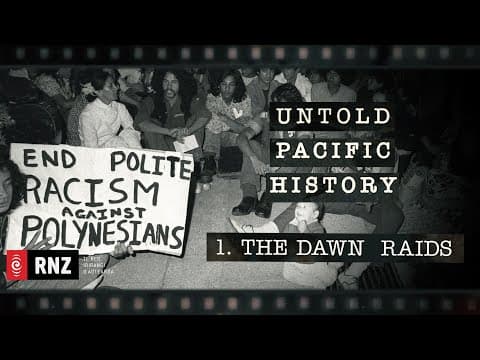
[0:10]Post-war New Zealand was considered to be the land of milk and honey. Pacific Islanders were encouraged to come to New Zealand to help fill the labor shortage. Back then they wanted a lot of our labor from the islands 'cause a lot of people who didn't want to do those jobs, mainly in the factories. And so my dad came in the early 70s and then he brought us over from the islands for better education and better lifestyle and more, you know, opportunities for, for their kids here. So education was really, really important to them and it's not exactly so that you get good jobs at the end of it. It's so you become a good Samoan and to meet your roles and obligations as a daughter, or a son to a parent and family. But for some Pacific Islanders, the land of milk and honey was about to turn sour and their dream of a better life would become a nightmare. We had all these hiding places in the flat we lived in. We had um, exit plans, all of that. Your phone would go three rings stop. So that meant, okay, immigration on the way. I thought a lot of them considered me as a traitor. I didn't belong to them that I was a white Samoan.
[1:28]Many Pacific people lived in the inner city working in factories and pursuing better education, but often these communities faced issues that migrants from European countries didn't have to face. One time, I was a mother of three kids, working full-time, doing part-time university, finishing my MA degree off. Just happened to glance at this car that had driven past, and a skin head puts his head out and says, what are you staring at, you black bitch? One guy was a good friend, who was a wrestler, Samoan wrestler, and he was walking up the Glue Pot. The Glue Pot was a pub in Ponsonby road right near, not far from the police station I used to work. As he walked up the stairs to the top of the bar, uh he sort of miscalculated the steps and he almost slipped and then he swore, you know, the F-word and then there was a cop two steps down, grabbed him and locked him up for swearing in a public place. So little offenses like that, you get arrested and get a police record, which I thought was rather dumb and stupid. In the early 1970s, there was an economic downturn, and with unemployment rising, Pacific Islanders found that they were no longer wanted. Immigration policies that had been ignored were now being policed. Politically it was Rob Muldoon's wish to get back into Parliament and he was using Pacific Islanders saying that we're overstayers and all the rest of that um stereotyping, you know, that we were bad, we were the ones stealing people's jobs, etc, etc. You know, like that kind of attitude and putting it out through the media and succeeding. And we've got to control our immigration. We can't let a a flood come here and swamp us and swamp our economy. During the 75 elections, they got the biggest majority ever, still, it's a record. And he used racism, racist attitude, scaremongering. When the national party came into power, there was a crackdown on immigration, and overstayers lived in fear of deportation. I was only a small child when we came, I was about three, going on four. I do remember going from place to place but not really knowing why we have to keep moving, you know? And my name that's called wasn't my real name. I had to use a false name, Peter. I had a name called Peter to Laqui. My dad told me that was your name, so I remember this old palani lady, Mrs. Cooper, she would always say, Bye, Peter. I would always go, Oh, yeah, that's right, that's me. So I'd just wave and walk past. Police and immigration officers would carry out dawn raids to catch illegal immigrants. We would have signals that I didn't know, but my mom and dad already had these, you know, because we had uncles staying with us as well. Uh and and they were all overstayers. So mum would, would tell a story, oh, we have to go because Dad's got something to do, la la la la. Load up into the car, take off. At a moment's notice, everything was ready to go, ready to rock and roll, you know. We had all these hiding places in the um, flat we lived in. We had um exit plans, all of that, all mapped out. They already knew what to do, uh and and there was a one night where um the signal was made and we all loaded up into our cortina, because we heard the flat up the road getting raided. So we all loaded up in a Ford cortina and then made our way up to Kikohi. For me as a Samoan policeman, at the time I, I wasn't very comfortable at all. You know, deep down your heart, you love your people and I thought a lot of them considered me as a traitor. Uh some of them considered me as uh I didn't belong to them that I was a white Samoan. Pacific Islanders made up a third of all overstayers, but over two-thirds of those prosecuted were Pacific Islanders. Governments used to just turn a blind eye to overstayers, that's why they let so many UK people overstay. Uh but what I never understood is so why did they turn on the Pacific Islanders and not everybody else? So um you know, I thought that that was just terrible and and completely racial profiling. I bet you they didn't ask anyone from the UK whether they had a passport on the streets. During the 70s, there was a wave of young people who began to stand up to question authority, including a group of Pacific Islanders known as the Polynesian Panthers. It was a time of revolution. To heck with authority, to heck with conservatism, to heck with the Vietnam War. That's the kind of climate that we were growing up in. A lot of us were uh ex-gang members and I guess the philosophy of the Panther was uh non-violence. And it was almost like a epiphany that the problems that we face and the challenges that we have, um, we are not going to solve them at the end of our fist. The hardest thing, um, about being Samoan and a Christian is keeping your hands in your pocket when someone calls you a coconut. The Polynesian Panthers not only had to fight against racism, but also the perception that they were just a gang. And it even came about that we hated white people. So we had to put up with that kind of stigma as well, not only from the European, the white people, but from our own people. Why you do this to the Palani? Why you go fight the police? And for us to tell them that we've got to change and what they're doing isn't right, you know? Uh one of the strategies that we came up with was to go and dawn raid the uh politicians while they were asleep at 3:00 in the morning. We didn't have cars then, you know, I mean, we're only 16, 17, 18, broke ads and stuff. Um but it was our supporters and our friends who had the vehicles. Um we used loudspeakers and spotlights. Come out now with your passports and prove to us that you, we did that. And um as soon as the lights and that come on, we'd jump in the cars and take off. But we wanted to let them know what it felt like to be dawn raided. Yeah. The dawn raids continued on, but then the government introduced a new policy that would become even more controversial. One night we were on starting up 7:00 to 3:00 in the morning and we got called into the watch house. They had a switch message, at the time it was like a like a facsing, you know, from Wellington headquarters. to say that you are to form a squad, go to the places where most Polynesian people with brown skin congregate. Question them and ask for their identity as to uh their eligibility to stay in New Zealand. It was pretty pretty bad. It really doesn't matter you were, whether you were Samoan, Tongan, Cook Islander, you just had to be brown. And you knew you were at risk of being stopped. Before we even leave home, we're suspects. And even Maori were asked 'cause they looked like us, some of them. So um, you know, I thought that that was just terrible and and completely racial profiling. I bet you they didn't ask anyone from the UK whether they had a passport on the streets. The public outcry over the dawn raids and random stops became so loud that the government was forced to change the immigration policies. There was an amnesty. That's where we got our um our permanent residency. Ironically by um Muldoon. back then, even though Muldoon was the worst perpetrator of the dawn raids, because Dad got his papers under his watch, Dad always voted National. I could never understand it. But it was his loyalty because he got, oh, I got my paper from him. I said, yeah, but he's an, you know, blah, blah, blah. He said, no, no, I'm voting for him, you know, so he was loyal. And that's the kind of loyalty that a lot of the Pacific Islanders have. Most people go, oh, the dawn raids in the 70s, and then in the 80s it all went right, but that's actually not the true picture of it. What was happening in the 1980s was that immigration was sometimes coming into school to follow people up. When I first started there, there was a large Tongan population and that's because of an amazing teacher there who used to bring over the boys from Tonga to do their school C. One year. And because I taught woodwork, most of them ended up in my woodwork class. And so the immigration coming and going, we're looking for this person, but fortunately, we had a couple of Tongan women in the office. And they would go, oh, they're over in woodwork. And then your phone would go, three rings stop. So that meant, okay, immigration on the way. Those three rings go, you yell out once and then you switch the switch on the wall and all the machines stop. So everybody knows when the machines all stop, that something's happening. And then some people would disappear under benches. It sounds so bizarre now, it actually was a normal thing. But Seddon had been built on a dump and the dump was subsiding, was going down, down, down, down, so there's huge gaps were opening underneath the classrooms. So we found that that was a place where you could go safely and hide if you needed to. It wasn't a big fanfare. It was just how you lived with a difficult world. After I'd written the book, Dawn Raid, I kind of wanted at the launch to have more people know about it, so I wrote that for children, but I wanted more adults to know about it as well. So we put together an exhibition where you walk into sort of a page of the book, so into a 70s lounge room of a Pacific family with all the pictures on the wall and the beads around the photos. And it takes you from that lovely safe setting and into the reality of what happened in that era. The Panthers and I have spent quite a bit of time traveling around talking to high school students, primary students, and they are hungry for New Zealand knowledge and New Zealand history. When the Panthers say, I was your age and I was protesting on the streets and you know, I was getting beat up by the police and this was happening. So this is a good time for us to be creating lots and lots of really quality material to support teaching New Zealand history in schools. Black lives matter. There are many lessons that can be learned from the Dawn raid. And the spirit of the Polynesian Panthers lives on in a new generation of Pacific Islanders. I feel like our Pacific generation now is so about social justice. It's all about implementing change, change for good, um eradicating racism in Aotearoa. It's really important for Pacific in this generation to heal the trauma that happened to our older generations so that it never happens again. For some people, it's actually not a history lesson. It's a piece of a life, sometimes remembered as a flickering childhood, sometimes remembered in adolescence, sometimes remembered as a parent trying to protect other people or community leader trying to keep people safe at a church meeting. And I think that that's the interesting way of looking at the dawn raids. They weren't a historical thing that sat in a box. They were the manifestation of something that came up and bubbled and bled out across generations. I call myself a son of the Dawn raids, you know, because at the end of the day it happened. We don't want to go back to those days and there are important lessons to learn from our history. New Zealanders shouldn't be ashamed of it because it's history, it's what happened, but we should learn from it. And so it's the same with the, those that went through it. Us specific people shouldn't be ashamed of it because it's something that we went through. It was a means to an end, so sure they broke the law to stay here legally, but they didn't commit a crime in my view. They didn't murder anyone or steal anything. In fact they came here and contributed. It was a reverse crime in my view, but hey, I'm just yeah.


