[1:07]The voice of David Ben Gurion declaring the establishment of the state of Israel in May 1948.
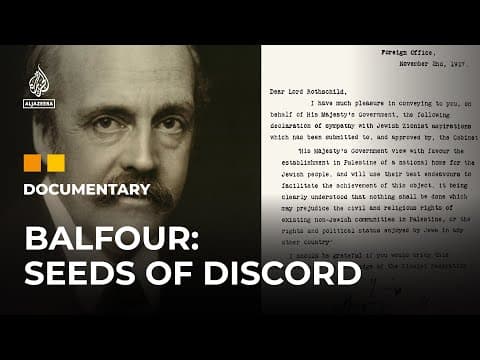
[1:26]The Balfor declaration was a letter sent by British foreign secretary Arthur Balford to a member of the British House of Lords, Lord Rothchild on the 2nd of November 1917. This letter sent to a leading figure in the British Jewish community 100 years ago had repercussions which even its authors cannot have imagined.
[1:57]Whatever its real intentions it went on to have a found impact on the Middle East and its people. And its effects still resonate across the region today.
[2:22]In 1914, the soldiers were fighting on the battle fields of Europe in the first World War. The allies Britain, France, and Russia fought the central powers of Germany, Austria, Hungary, and the Ottoman Empire for four years. But the land and sea war was not the only battle ground. Musc was also being flexed behind closed doors as allies conspired how to draw maps to their own advantage when the conflict eventually ceased.
[3:00]Sir Mark Sicks for the British and Francois George for the French, plotted how to divide the Arab lands of the Ottoman Empire, assuming it would finally fall. The Sicks agreement planned secretly to divided into French and British spheres of influence. France taking most of the Levant, Southern Anatolia and the Musal area, while the British extended their control over the Southern Levant, expanding eastwards to
[3:48]La Palestine français, anglais et russe n'arrive pas à s'accorder parce que tout le monde va avoir la Palestine. Pourquoi ? Parce que d'une part la Palestine, la France a de très riches souvenirs et l'Angleterre, elle c'est surtout la position de la Palestine qui l'intéresse parce que la Palestine est relativement proche du canal de Suez, le canal de Suez c'est la voie qui mène à l'empire des Indes. On décide de créer un régime international d'internalisation la Palestine.
[4:37]I think the British felt that there had not been enough government involvement in concluding the agreement with the French. And in that process they had not really protected their interests well enough for a post World War era in which the British Empire would continue to seek to be a dominant force in European affairs. And so, really officials across Whitehall, including Mark Sikes himself felt it was a bad deal. في اثناء هذا الجدل اعتقد اثرت مساله انه في هناك حركه صهيونيه وان في هناك جزء من اليهود يطمحون بالعوده الى فلسطين وان يكون لهم يعني وجود في فلسطين وكيان في فلسطين وانا اعتقد انه هذا المناخ هو الذي اطلق العمليه اطلق and it's a huge significance that when they're making these discussions, Jews and are not discussed. Jews were not to feature in the new cartography of the Middle East which was to be based on the idea of the Arab nation. was the movement supporting the establishment of a Jewish homeland in the area it defined as a historical land of Israel. The movement was active in early 20th century London, especially because of the persecution of Jews in Russia and Eastern Europe. Theodor had founded the Zionist movement in the late 19th century, but Jewish people in Western Europe had not rushed to support it because they were integrating quite successfully into society. Zionists believed that all Jews should someday return to that country. One of the problems was that Palestine belong to the Ottoman Empire and the Ottoman Empire was not clear that it wanted massive Jewish immigration into Palestine. And the British government offered to let Jews move in great numbers into Uganda if they wished. Um, but in any event, it really didn't happen and it didn't happen because a majority of Zionists felt that Hitler was selling them out and that the only place for Jews to move back to or at least conscious Zionist Jews to move back to was Palestine. In this I think Britain began to look on the Zionist movement as a possible partner in justifying a renegotiaations of their agreement with the French. You see for Britain simply to claim territory against what they'd already concluded in an agreement with France could create diplomatic problems for the British. But if they were to make a claim to Palestine not out of self-interest, But in order to advance a great historic ideal of the restoration of the Jewish people to their biblical homeland. That this could justify an adjustment of the terms of in a way that the French would accept. The British wanted somehow and and more and more increasingly, they felt that the Jews held the key to winning the war. Um and so they had to figure out how to the Jews to support them. Sir Mark had succeeded in drawing the line he wanted from Aker in the west to her cook in the east. But for some in government, this was not enough. The British were using the Jewish National movement to secure Palestine for themselves. This is when Hitlerman is really going to find open ears on 10 Downing Street in the foreign office, in the colonial office and it's paving the way towards that critical decision in November of 1917. And so I think you can direct you can draw a direct connection between Britain's sudden acknowledgement ofism as an idea and an ideal. And what they were dissatisfied with in the terms of. in Manchester who had become a prominent member of the Britishst movement.
[9:07]He was politically well connected and robbed shoulders with senior figures in government. So was Russian by birth.
[9:18]He was a chemist. Um and then he joined the Zionist movement. Um he climbed in the Zionist movement. He moved to Great Britain before the war, well before the war, maybe 10 years before the war began. He was not before the war very well known in the English movement. He was pretty well known in the world. but he was by no means the most visible when World War I began in Great Britain. later wrote in his memoirs about having been introduced to a British government minister, Herbert Samuel. Samuel was Jewish, but was apparently concerned that he might be anti-Zionist. However, Herbert Samuel turned out to be extremely receptive toman and went on to write an official memo in 1915, setting out a number of different possibilities for Palestine and the Jewish people. When the war broke out in 1914, Samuel was Health Minister. He had nothing to do with politics but he wrote a memorandum about Palestine because he was the only high-ranking Jew in the British government.
[10:55]The memorandum was about the future of Palestine after the war. He put forward several options. One was that it could become a Jewish state or be under a British protectorate or commonwealth.
[11:17]But he didn't find willing ears in Whitehall or in the colonial office for schemes that involved the establishment of a Jewish state in Palestine. Britain was really concerned with two things by the time that the first World War had broken out. They wanted to win the war first and foremost. This was an imperative for the survival of Britain and its empire. And secondly, they wanted to ensure that coming out of the war victorious that their empire would benefit from the victory. So at this stage, Kamman and Herbert Samuel's ideas about the rights of the Jews to settle in Palestine did not find much sympathy in the corridors of power. The final draft of the Balfour declaration was 67 words long. His majesty's government view with favor the establishment in Palestine of a national home for the Jewish people and will use their best endeavors to facilitate the achievement of this object. It being clearly understood that nothing shall be done which may prejudice the civil and religious rights of existing non-Jewish communities in Palestine or the rights and political status enjoyed by Jews in any other country. I should be grateful if you would bring this declaration to the knowledge of the Zionism Federation. Your sincerely, Arthur James Balfur. Well, in terms of international law, it really has very little standing in international law, you know, treaties between nations have significance. Um, uh, but governments often issue policy statements, statements of intention about what they plan to do, uh, and those really don't have any standing as uh, as a matter of of law. Uh for Britain, this was uh, I suppose you would say a statement of its intention as to what it would do if it were to take over Palestine, which of course it it had not yet done, uh, as of November 1917.
[1:59]Uh, there was some consultation, you know, during the summer of 1917, uh, with the United States and and the early drafts that, uh, had had the imprint of the Zionist, uh, uh, elements in Britain, um, would have referred to Palestine, uh, in its entirety as being, uh, for some sort of Jewish entity. And those elements eventually were modified, uh, before the drafting was finalized. Another key part of the terminology that emerged in part of the drafting was in some British redrafting, where instead of for the Jewish people, it was written the Jewish race. Now, eventually this was taken out, but I think it's very revealing that British officials wanted to use this kind of terminology because after all, this was how they understood the Jews of the world as being a racial group, one that welded tremendous power and also could be inspired all together as one unit behind the cause of Zionism supported by Britain and the allies. So, first of all, that was entirely wrong and didn't happen, but because this idea of Jewish power is fake, is false. In September 1939, German expansionism led to the second World War. Over 60 million people died, including between five and six million Jews. The British mandate ended at midnight on the 14th of May 1948 and immediately the formation of the state of Israel was announced. Justified by the terms of the Balfour declaration issued 31 years before. While Israelis celebrated the birth of their nation, 700,000 Palestinians were forced into camps and exile. ללא בריטניה לא הייתה קמה מדינת ישראל. אין ויכוח. בלי הציונים זה לא היה קם. אבל גם בלי בריטניה, עניין ישראל לא הייתה קמה. Two years after the declaration, a church leader in Jerusalem wrote to British Prime Minister Lloyd George about Jews and Palestine trying to control holy sites. Lloyd George's office had said thatman didn't want to do anything affecting the rights of Arabs. It said he simply wanted to be involved in a council to help provide refuge to Jews fleeing Russia and Eastern Europe. This exchange suggested that Britain felt it had not promised a Jewish state but simply a place for them to live alongside Arabs. When the League of Nations set out the British mandate in Palestine in 1923, it made Britain responsible for implementing the Balfour declaration. As a result, Jewish immigration to Palestine increased, as did Arab opposition to it, expressed in a series of Palestinian protests against Britain in the 1920s. They understood the people of Palestine to be Muslims and Christians, but did not imagine that they would constitute a national community that would seek national independence. And after the war, very quickly when it becomes clear that Palestinian Arab nationalists mobilizing against Islam, the British government are quick to see a major problem. The Balfour declaration had put in train a series of events that began to signal its deep flaws. Arab descent built to the three-year revolt between 1936 and 1939. It was a nationalist uprising against the British administration, demanding Arab independence and the end of Jewish immigration. It was in the appeal Commission of 1937 that the British first recognized that instead of balancing communities, they had set in motion, a rivalry between incompatible national movements, Jewish and Palestinian Arab. And it was at that point that they tried to solve the problem by dividing Palestine into two states Arab and Jewish through a partition plan. And I think there you have the first recognition or admission from British officials of the failure of the declaration. In May 1939, the British government published a policy document on Palestine called a white paper. It abandoned the partitioning of Palestine into two states and called in for an independent Palestine in which Arabs and Jews would share government. It limited Jewish immigration to 75,000 for five years and said that the Arab majority should determine future immigration levels. It also said that Balfor had not meant to create a Jewish state at the expense of the Arabs. Any more than the Mahin correspondent 24 years before had promised an Arab state to Sharaf Hussein of Mecca. But the white paper met opposition and was dropped.