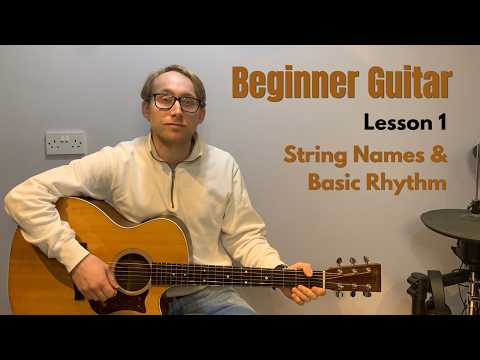
[0:00]Hi, my name's Chris, and this is beginner guitar lesson one, part of my guitar fundamentals course. In today's lesson, we'll be learning the string names on the guitar, and then working on playing a basic rhythm just with a couple of the open strings. I'll be using a pick to demonstrate today plucking the strings, but feel free to use your thumb or your fingers, um, adapt it to whatever suits you. So, to start off with, um, I've got a little word game, and I'm going to point to the strings at the same time saying this, but we've got from the thinnest string, Every bunny gets dizzy at Easter. Or the string numbers, 1, 2, 3, 4, 5, 6. Um, using the word game, basically take the first letter of each of those words, and we have, Every, E, Bunny, B, Gets, G, Dizzy, D, At, A, Easter, E. You notice that we have two E strings. We had the high E string, which is the thinnest one, it sounds higher in pitch, and the low E string, which obviously sounds a bit lower in pitch. Um, what we're going to have a go at is just staying and playing that together. So, in your own time, pause the video if you need to, but basically, we're going to go into this. Every, Bunny, Gets, Dizzy, At, Easter. Now, you notice I used my fretting hand, my left hand over here a little bit, that was just to mute the strings. You don't actually have to press anything down, but to mute a string, if you want to do that, just lightly touch it. And that should stop the sound. Um, but don't worry about that too much for now. So, um, what we're going to do as a little game is to see, um, if you can spell some words on the guitar using those open strings. So, when we don't fret the strings, don't press down on the frets, we call it open. This would be a fretted note. So, um, we're going to start off with the word egg. So, you could do this with the high E or the low E string, but I'm going to start with the high E string. So, we're going to go E, G, G. And then you could do some more words, we've got, for example, we could do bed, B, E, D, or, um, we've got add, A, D, D. Yes, so, um, have a little go at playing some of the words like that. Um, I'll put some more, um, in the description. Um, and also, see if you come up with some of your own words, just for a bit of fun. So, um, a little bonus as well, just before I move on, is you could obviously any of these words, for example, the bed, you could do B, and then low E, and then D. Just to get your brain working, both those strings. Okay, so part two, we're going to work on trying to play a steady rhythm on the guitar. What we're going to do is focus on the high E string and the B string. What we'll do is just start with plucking each of them once. So, you've got the high E, can mute that if you want to, otherwise let it ring out, that's fine, and then the B string. You can, like, gradually speed that up. You could do this for maybe 30 seconds, see how fast you can get on that. Um, the main thing is to keep a nice, steady tempo. So, rather than going, you want to go, one, two, three, four, one, two, three, four. Once you're happy with that, that's sort of a little warm-up or a little drill we can do. Um, we'll go onto the actual exercise. So, I've just started counting it there, but I want you to play each note as a quarter note. Very simply, it lasts for one beat, or one number in this case. So, it'd be like counting to four and we play on every number. So, we just go, one, two, three, four, on the high E string, and then on the B string, same thing. One, two, three, four. So, here's a little close-up of me, uh, playing that. So, after four, one, two, three, four,
[5:34]Um, what we could do is do, um, that four times, and just make that a nice little exercise. You can do it to a metronome once you feel a bit more confident, but for now, I'm just doing it at a slow, comfortable tempo. Um, I'll give us a count-in, so count to four, and then I'll start. So, one, two, three, four. One, two, three, four, one, two, three, four. Let's start again. Two, three, four, one, two, three, four, one, two, three, four, one, two, three, four. Last one. One, two, three, four, one, two, three, four. Yeah, and um, like I said, try and keep a slow, steady tempo. If that's too fast, feel free to slow it down. Um, you could aim for about 70 BPM, um, if you've got a metronome at home, and you feel, uh, you know, you feel like you're quite confident on that. Um, main thing you don't want to do is do this. One, two, three, four, one, two, three, four. You know, so, um, try and keep it steady, even the string changes, you want it to almost be seamless so no one can tell. So, if you're struggling with that, go back to that little warm-up exercise, you know, just going, E, E, E, E. Um, at the moment, um, you can look, obviously, at the strings, but you don't want to do it too much because you will get neck and upper back ache potentially. So, have a look where they are to begin with, of course, but afterwards, try and do it without looking. So, One, two, three, four, one, two, three, four. Um, another thing, just on the posture there. So, obviously, you might want to see it first, but just to have a look, but try and keep that guitar upright. And, uh, that will help a lot. Haven't said much about the hand positioning, but basically, I've got my elbow comfortably over the body here, and I'm just resting maybe, against my palm there or side of my palm, just on the thicker strings for now, as it helps me have like a anchor point. Um, again, if you're doing this with finger style, you could even put your thumb here, here, and use your index and middle fingers. Or, if you don't have a pick, and not comfortable with fingers, you could just do thumb.
[8:26]Just as a little demonstration of using that with metronome. Got one, two, three, four. One, two, three, four, one, two, three, four. So, that's the kind of idea there, of using the metronome. And just finally, just a little practice tip. You don't need to do an hour or two a day, especially not at the beginner stage. But trying to do 15 minutes, um, three times a week, will definitely get things going, and, uh, I'd recommend trying to schedule in a time that works for you, and, you know, actually plan it ahead so it doesn't, uh, yeah, you don't leave it 'til like Friday and like, oh, no, I haven't done any practice or something like that, then you've got a busy weekend maybe. So, try and find out a few slots that, um, you can make work for you. And then, um, yeah, and then, uh, that'll keep you progressing. I have got a PDF for the homework as well. If you'd be, if you'd like a copy, um, I will be posting it on the website once that's finished. Um, in the meantime, I'll put a link in the description, and, uh, I hope to see you soon.